Department of Behavioral Health and Nutrition, College of Health Sciences, University of Delaware, Newark, DE, United State of America.
Department of Nutrition, Food and Exercise Sciences, College of Human Sciences, Florida State University, Tallahassee, FL, United State of America.
PLoS One. 2018 Oct 25;13(10):e0206315. doi: 10.1371/journal.pone.0206315. eCollection 2018.
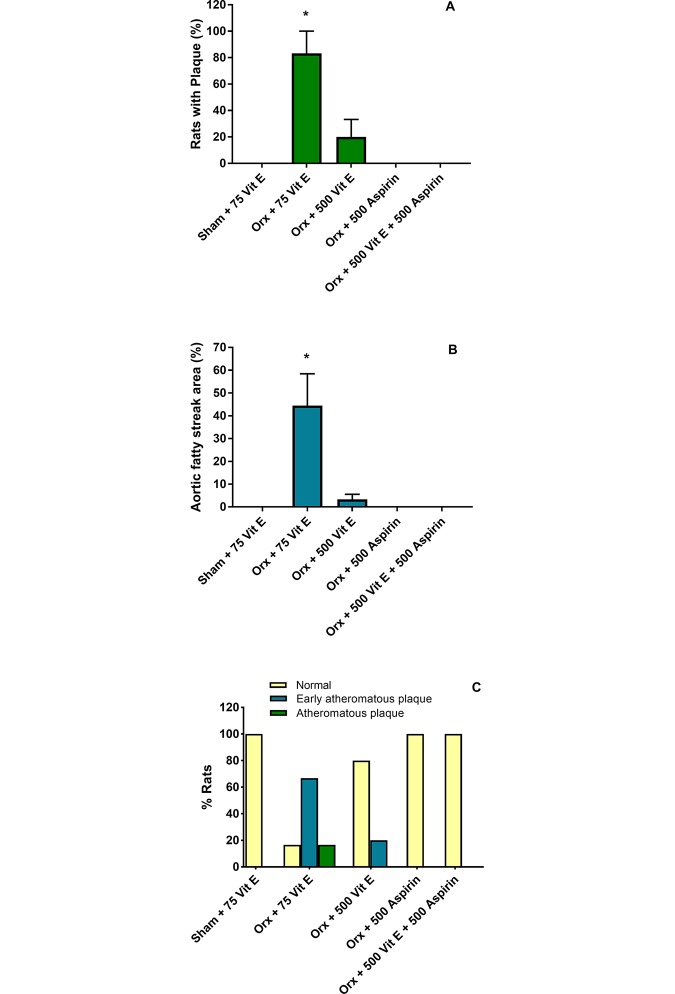
The present study was designed to assess the extent to which vitamin E and aspirin individually or in combination prevent and/or reverse bone loss and atherosclerotic lesion formation in orchidectomized aged rats. Forty-nine 12-month old male Sprague-Dawley rats were either sham-operated (Sham, one group) or orchidectomized (Orx, four groups) and fed a control diet for 120 days to establish bone loss and atherosclerotic lesions. Thereafter, rats were assigned to the various treatment groups (n = 9 to 10 per group): 1) Sham and 2) Orx groups received AIN93M, containing 75 IU vitamin E and served as control, and the other three Orx groups received either 3) 500 IU vitamin E, 4) 500 mg aspirin, or 5) 500 IU vitamin E + 500 mg aspirin per kg diet for 90 days. After 90 days of treatment, rats were sacrificed, necropsied, and tissues were collected for analyses. Results show that 500 IU vitamin E was able to reduce the development of atherosclerosis lesion formation and aortic streak area compared to Orx control. More importantly, 500 mg aspirin completely reversed the fatty streak area and made the atherosclerotic lesions disappear. Vitamin E and aspirin were not able to reverse bone loss as shown by whole body, lumbar and femoral bone mineral content and bone mineral density due to gonadal hormone deficiency. Instead, 500 mg aspirin somewhat increased the trabecular separation while decreased trabecular thickness compared to Orx control. Our findings suggest that both, vitamin E and aspirin exert anti-atherogenic effects and aspirin is more effective than vitamin E in preventing atherosclerosis lesions in Orx rats.
本研究旨在评估单独或联合使用维生素 E 和阿司匹林在预防和/或逆转去势老龄大鼠的骨丢失和动脉粥样硬化病变形成方面的程度。将 49 只 12 个月大的雄性 Sprague-Dawley 大鼠行假手术(Sham,一组)或去势(Orx,四组),并给予对照饮食 120 天以建立骨丢失和动脉粥样硬化病变。此后,将大鼠分配至各个治疗组(每组 n = 9 至 10 只):1)Sham 组和 2)Orx 组接受 AIN93M 饮食,含 75IU 维生素 E,作为对照,另外三组 Orx 组分别接受 3)500IU 维生素 E、4)500mg 阿司匹林或 5)500IU 维生素 E+500mg 阿司匹林/kg 饮食 90 天。治疗 90 天后,处死大鼠,进行尸检,收集组织进行分析。结果显示,与 Orx 对照组相比,500IU 维生素 E 能够减少动脉粥样硬化病变形成和主动脉条纹面积的发展。更重要的是,500mg 阿司匹林完全逆转了脂肪条纹面积并使动脉粥样硬化病变消失。由于性腺激素缺乏,维生素 E 和阿司匹林均无法逆转骨丢失,如全身、腰椎和股骨的骨矿物质含量和骨矿物质密度所示。相反,与 Orx 对照组相比,500mg 阿司匹林使骨小梁分离增加,而骨小梁厚度减少。我们的研究结果表明,维生素 E 和阿司匹林均具有抗动脉粥样硬化作用,而阿司匹林在预防去势大鼠的动脉粥样硬化病变方面比维生素 E 更有效。