
静电传感器在风力涡轮机齿轮箱在线监测中的应用。
Electrostatic Sensor Application for On-Line Monitoring of Wind Turbine Gearboxes.
机构信息
College of Civil Aviation, Nanjing University of Aeronautics and Astronautics, Nanjing 210016, China.
出版信息
Sensors (Basel). 2018 Oct 22;18(10):3574. doi: 10.3390/s18103574.
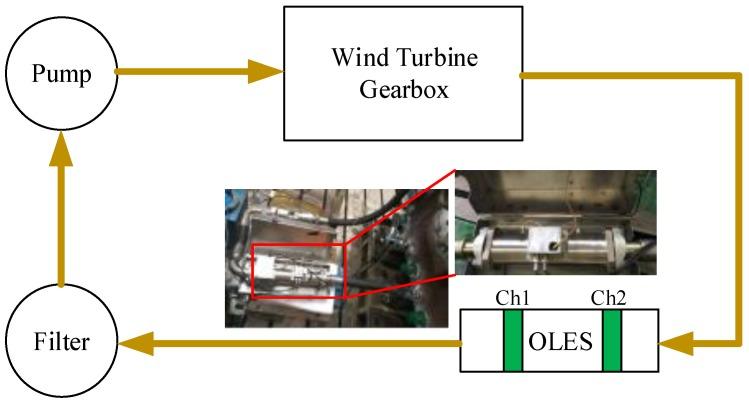
The oil-line electrostatic sensor (OLES) is a new online monitoring technology for wear debris based on the principle of electrostatic induction that has achieved good measurement results under laboratory conditions. However, for practical applications, the utility of the sensor is still unclear. The aim of this work was to investigate in detail the application potential of the electrostatic sensor for wind turbine gearboxes. Firstly, a wear debris recognition method based on the electrostatic sensor with two-probes is proposed. Further, with the wind turbine gearbox bench test, the performance of the electrostatic sensor and the effectiveness of the debris recognition method are comprehensively evaluated. The test demonstrates that the electrostatic sensor is capable of monitoring the debris and indicating the abnormality of the gearbox effectively using the proposed method. Moreover, the test also reveals that the background signal of the electrostatic sensor is related to the oil temperature and oil flow rate, but has no relationship to the working conditions of the gearbox. This research brings the electrostatic sensor closer to practical applications.
油线静电传感器(OLES)是一种基于静电感应原理的新型磨损颗粒在线监测技术,在实验室条件下已取得良好的测量效果。然而,对于实际应用,该传感器的实用性仍不明确。本工作的目的是详细研究静电传感器在风力涡轮机齿轮箱中的应用潜力。首先,提出了一种基于双探头静电传感器的磨损颗粒识别方法。进一步地,通过风力涡轮机齿轮箱台架试验,全面评估了静电传感器的性能和磨粒识别方法的有效性。试验表明,该静电传感器能够有效地监测磨损颗粒,并利用所提出的方法指示齿轮箱的异常。此外,试验还揭示了静电传感器的背景信号与油温及油流量有关,但与齿轮箱的工作条件无关。本研究使静电传感器更接近实际应用。




 Zotero 插件