Department of Psychology and Educational Sciences, University of Palermo, 90133 Palermo, Italy.
Tilburg School of Humanities and Digital Sciences, Tilburg University, 5037AB Tilburg, The Netherlands.
Int J Environ Res Public Health. 2018 Oct 22;15(10):2319. doi: 10.3390/ijerph15102319.
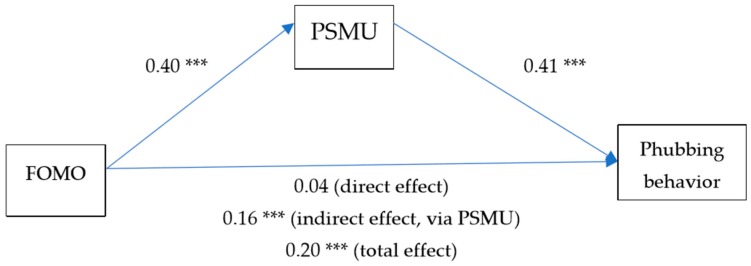
Fear-of-missing-out (FOMO) refers to feelings of anxiety that arise from the realization that you may be missing out on rewarding experiences that others are having. FOMO can be identified as an intra-personal trait that drives people to stay up to date of what other people are doing, among others on social media platforms. Drawing from the findings of a large-scale survey study among 2663 Flemish teenagers, this study explores the relationships between FOMO, social media use, problematic social media use (PSMU) and phubbing behavior. In line with our expectations, FOMO was a positive predictor of both how frequently teenagers use several social media platforms and of how many platforms they actively use. FOMO was a stronger predictor of the use of social media platforms that are more private (e.g., Facebook, Snapchat) than platforms that are more public in nature (e.g., Twitter, Youtube). FOMO predicted phubbing behavior both directly and indirectly via its relationship with PSMU. These findings support extant research that points towards FOMO as a factor explaining teenagers' social media use.
错失恐惧(Fear-of-missing-out,简称 FOMO)是指当人们意识到自己可能会错过他人正在经历的有益体验时,所产生的焦虑感。FOMO 可以被视为一种内在特质,驱使人们关注他人在社交媒体平台等渠道上的动态。本研究基于对 2663 名弗拉芒青少年的大规模调查研究,探讨了 FOMO、社交媒体使用、社交媒体使用问题(Problematic social media use,简称 PSMU)和低头行为之间的关系。正如我们所预期的那样,FOMO 与青少年使用社交媒体的频率以及他们使用的平台数量呈正相关。FOMO 对更私人的社交媒体平台(如 Facebook、Snapchat)的使用预测作用要强于更具公共性质的平台(如 Twitter、Youtube)。FOMO 通过与 PSMU 的关系,直接或间接预测了低头行为。这些发现支持了现有研究,即 FOMO 是解释青少年社交媒体使用的一个因素。