Sviestina Inese, Mozgis Dzintars
Faculty of Medicine, University of Latvia, Raiņa bulv., LV-1586 Riga, Latvia.
Children's Clinical University Hospital, Vienibas avenue 45, LV-1004 Riga, Latvia.
Medicina (Kaunas). 2018 Oct 23;54(5):74. doi: 10.3390/medicina54050074.
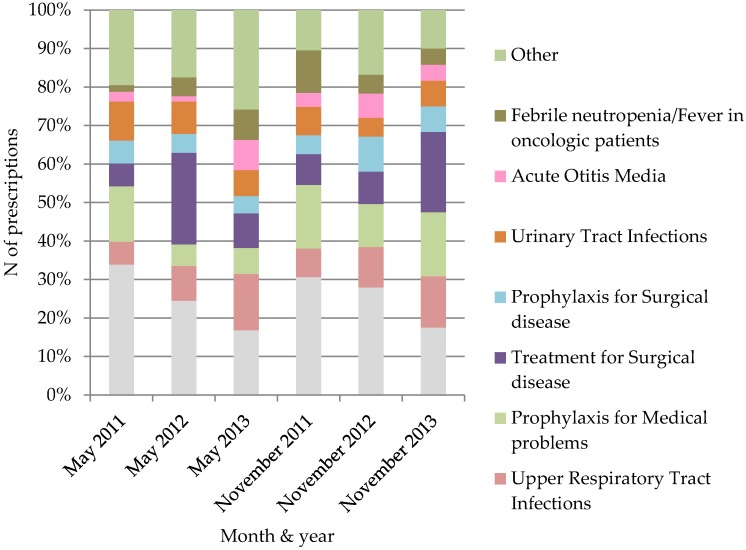
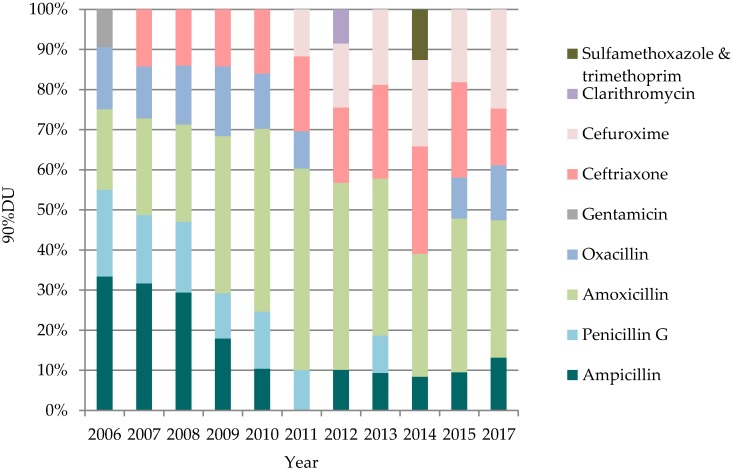
Many pediatric patients have been treated with antibiotics during their hospitalization. There is a need to improve antibiotic prescribing for pediatric patients because many of these prescriptions are inappropriate. Antibiotic consumption analysis was conducted at the Children's Clinical University Hospital to identify targets for quality improvement. A one day cross-sectional point prevalence survey (PPS) was conducted in May and November 2011⁻2013 using a previously validated and standardized method. The survey included all inpatient pediatric and neonatal beds and identified all children receiving an antibiotic treatment on the day of survey. Total consumption of systemic antibiotics belonging to the ATC J01 class (except amphenicols (J01B) and a combination of antibacterials (J01R)) was also analyzed by using a defined daily dose (DDD) approach and antibiotic drug utilization (90%DU) for the period 2006⁻2015. Results were compared with results in 2017 using the DDD and 90%DU methodology. The most commonly used antibiotic group in all PPS, except in May and November 2011, was β-lactam antibiotics (J01D): 42 (40%) prescriptions in May 2013 and 66 (42%) and November 2011. In 2006⁻2015 and also in 2017, the most commonly used antibiotic groups were penicillins (J01C) and β-lactam antibiotics (J01D)-76% (90%DU) of the total antibiotic consumption registered in 2006, 73% in 2015 and 70% in 2017. Starting in 2008, amoxicillin was the most commonly used antibiotic at the hospital. The usage of ceftriaxone increased from 3% in 2006 to 13% in 2015, but decreased in 2017 (7%). Study results from 2006⁻2015 showed that there was a need to establish a stronger antibiotic prescribing policy in the hospital reducing the use of broad-spectrum antibiotics (especially 3rd generation cephalosporins) and increasing the use of narrower spectrum antibiotics. It was partly achieved in 2017 with some reduction in ceftriaxone use.
许多儿科患者在住院期间接受了抗生素治疗。由于许多此类处方并不恰当,因此有必要改善儿科患者的抗生素处方开具情况。在儿童临床大学医院进行了抗生素消费分析,以确定质量改进的目标。2011年至2013年的5月和11月,采用先前验证和标准化的方法进行了为期一天的横断面现患率调查(PPS)。该调查涵盖了所有儿科和新生儿住院床位,并确定了调查当天所有接受抗生素治疗的儿童。还使用限定日剂量(DDD)方法和2006年至2015年期间的抗生素药物利用情况(90%DU),分析了属于ATC J01类(不包括氯霉素(J01B)和抗菌药物组合(J01R))的全身用抗生素的总消费量。使用DDD和90%DU方法将结果与2017年的结果进行了比较。在所有PPS中,除2011年5月和1月外,最常用的抗生素类别是β-内酰胺类抗生素(J01D):2013年5月有42份(40%)处方,2011年11月有66份(42%)。在2006年至2015年以及2017年,最常用的抗生素类别是青霉素(J01C)和β-内酰胺类抗生素(J01D)——2006年记录的抗生素总消费量的76%(90%DU),2015年为73%,2017年为70%。从2008年开始,阿莫西林是该医院最常用的抗生素。头孢曲松的使用量从2006年的3%增加到2015年的13%,但在2017年有所下降(7%)。2006年至2015年的研究结果表明,有必要在医院制定更强有力的抗生素处方政策,减少广谱抗生素(尤其是第三代头孢菌素)的使用,并增加窄谱抗生素的使用。2017年部分实现了这一目标,头孢曲松的使用量有所减少。