Rojas Paula, Antoñanzas Fernando
Department of Economics and Business, University of La Rioja, 26004 Logroño, Spain.
Antibiotics (Basel). 2020 Jul 19;9(7):423. doi: 10.3390/antibiotics9070423.
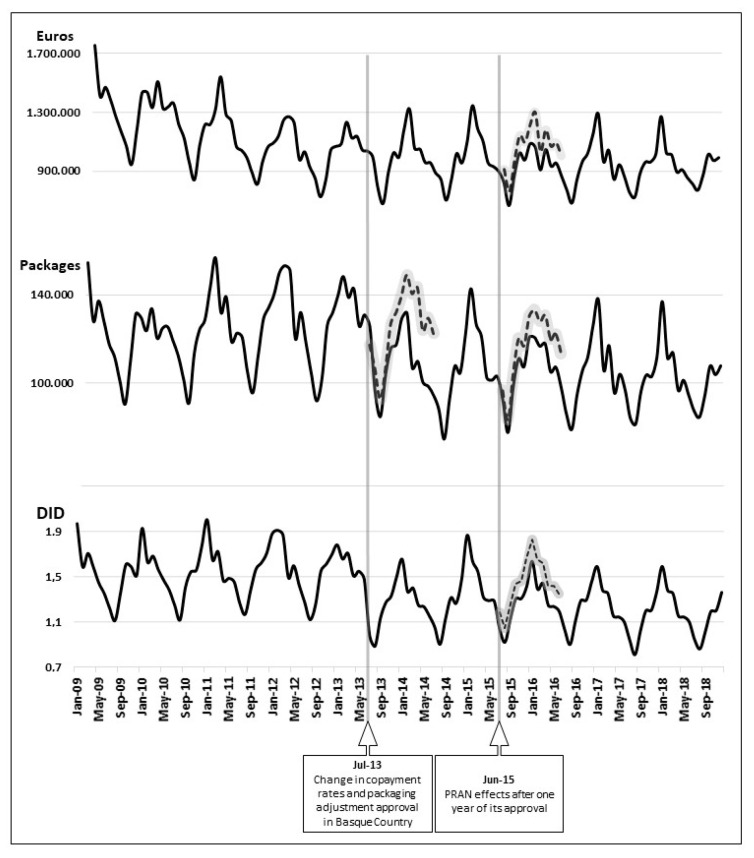
In 2013, a change in copayment rate was introduced in the Basque Country (one year later than in the other regions in Spain), and improvements were made to drug packaging. In 2014, a National Program Against Bacterial Resistance (Spanish abbreviation: PRAN) was approved. The aim of this study is to analyze the impact of change to the copayment rate, the adjustment of drug packaging, and the approval of PRAN on the consumption of antibiotics. Raw monthly data on the consumption of antibiotics (costs, packages, and daily defined doses per thousand people (DID)) were collected from January 2009 to December 2018 in the Basque Country. Counterfactual and intervention analysis (Autoregressive integrated moving average (ARIMA) model) was performed for the total series, disaggregated by group of antibiotics (2019 WHO Access, Watch, and Reserve (AWaRe) Classification) and active substances with the highest cost per prescription (cefditoren and moxifloxacin), the lowest cost per prescription (doxycycline and cloxacillin), and the most prescribed active ingredients (amoxicillin, azithromycin, and levofloxacin). Introduction of copayment led to a 'stockpiling effect' one month before its implementation, equal to 8% in the three consumption series analyzed. Only the adjustment of drug packaging significantly reduced the number of packages dispensed (-12.19%). PRAN approval reduced consumption by 0.779 DID (-4.51%), representing a significant decrease for both 'access' and 'watch' group antibiotics. Despite the delay in implementing changes to copayment, there was a 'stockpiling effect'. With the adjustment of packaging, fewer packs were prescribed but with a higher drug load and price. PRAN approval reduced both the consumption of 'access group antibiotics' (first-line treatment) and 'watch group antibiotics' (second-line treatment).
2013年,巴斯克地区引入了共付率变化(比西班牙其他地区晚一年),并对药品包装进行了改进。2014年,一项国家抗细菌耐药性计划(西班牙语缩写:PRAN)获得批准。本研究的目的是分析共付率变化、药品包装调整以及PRAN的批准对抗生素消费的影响。收集了2009年1月至2018年12月巴斯克地区抗生素消费的原始月度数据(成本、包装以及每千人每日限定剂量(DID))。对整个系列进行了反事实和干预分析(自回归积分移动平均(ARIMA)模型),并按抗生素组(2019年世界卫生组织准入、观察和储备(AWaRe)分类)以及每张处方成本最高的活性物质(头孢妥仑和莫西沙星)、每张处方成本最低的活性物质(多西环素和氯唑西林)以及处方量最多的活性成分(阿莫西林、阿奇霉素和左氧氟沙星)进行了分类分析。共付率的引入在实施前一个月导致了“囤货效应”,在所分析的三个消费系列中均为8%。只有药品包装的调整显著减少了配药包装数量(-12.19%)。PRAN的批准使消费减少了0.779 DID(-4.51%),这对“准入”和“观察”组抗生素来说都是显著下降。尽管共付率变化的实施有所延迟,但仍出现了“囤货效应”。随着包装的调整,处方包装数量减少,但药物含量和价格更高。PRAN的批准减少了“准入组抗生素”(一线治疗)和“观察组抗生素”(二线治疗)的消费。