Shafer Paul R, Fowler Erika Franklin, Baum Laura, Gollust Sarah E
Department of Health Policy and Management, Gillings School of Global Public Health, University of North Carolina at Chapel Hill, Chapel Hill, NC, United States.
Government Department, Wesleyan University, Middletown, CT, United States.
J Med Internet Res. 2018 Oct 25;20(10):e10872. doi: 10.2196/10872.
Reductions in health insurance enrollment outreach could have negative effects on the individual health insurance market. Specifically, consumers may not be informed about the availability of coverage, and if some healthier consumers fail to enroll, there could be a worse risk pool for insurers. Kentucky created its own Marketplace, known as kynect, and adopted Medicaid expansion under the Affordable Care Act, which yielded the largest decline in adult uninsured rate in the United States from 2013 to 2016. The state sponsored an award-winning media campaign, yet after the election of a new governor in 2015, it declined to renew the television advertising contract for kynect and canceled all pending television ads with over a month remaining in the 2016 open enrollment period.
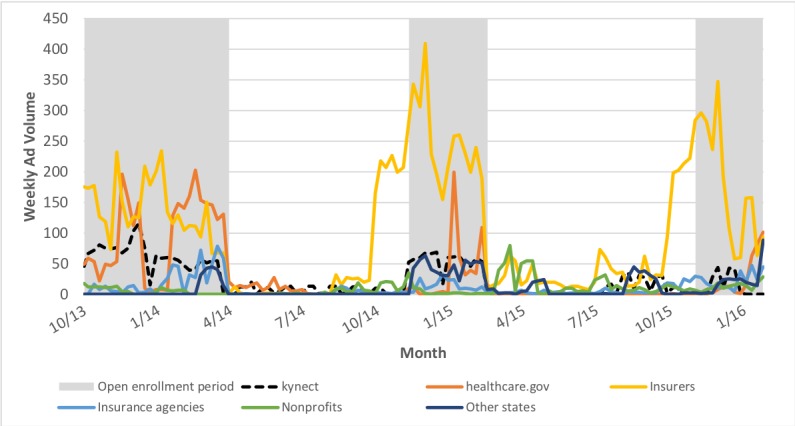
The objective of this study is to examine the stark variation in television advertising across multiple open enrollment periods in Kentucky and use this variation to estimate the dose-response effect of state-sponsored television advertising on consumer engagement with the Marketplace. In addition, we assess to what extent private insurers can potentially help fill the void when governments reduce or eliminate television advertising.
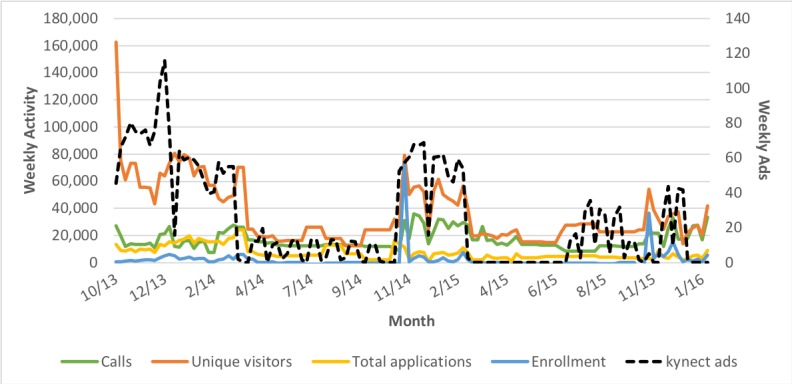
We obtained television advertising (Kantar Media/Campaign Media Analysis Group) and Marketplace data (Kentucky Health Benefit Exchange) for the period of October 1, 2013, through January 31, 2016, for Kentucky. Advertising data at the spot level were collapsed to state-week counts by sponsor type. Similarly, a state-week series of Marketplace engagement and enrollment measures were derived from state reports to Centers for Medicare and Medicaid Services. We used linear regression models to estimate associations between health insurance television advertising volume and measures of information-seeking (calls to call center; page views, visits, and unique visitors to the website) and enrollment (Web-based and total applications, Marketplace enrollment).
We found significant dose-response effects of weekly state-sponsored television advertising volume during open enrollment on information-seeking behavior (marginal effects of an additional ad airing per week for website page views: 7973, visits: 390, and unique visitors: 388) and enrollment activity (applications, Web-based: 61 and total: 56).
State-sponsored television advertising was associated with nearly 40% of unique visitors and Web-based applications. Insurance company television advertising was not a significant driver of engagement, an important consideration if cuts to government-sponsored advertising persist.
医疗保险参保推广力度的降低可能会对个人医疗保险市场产生负面影响。具体而言,消费者可能无法得知保险覆盖范围的可及性,而且如果一些健康状况较好的消费者未能参保,那么保险公司面临的风险池可能会更糟。肯塔基州创建了自己的市场平台kynect,并根据《平价医疗法案》扩大了医疗补助范围,这使得2013年至2016年美国成年人未参保率降幅最大。该州发起了一场获奖媒体宣传活动,但在2015年新州长当选后,该州拒绝续签kynect的电视广告合同,并在2016年开放注册期还剩一个多月时取消了所有待播电视广告。
本研究的目的是考察肯塔基州多个开放注册期内电视广告的显著差异,并利用这种差异来估计州政府赞助的电视广告对消费者参与市场平台活动的剂量反应效应。此外,我们评估了在政府减少或取消电视广告时,私人保险公司在多大程度上有可能帮助填补空白。
我们获取了2013年10月1日至2016年1月31日期间肯塔基州的电视广告数据(凯度媒体/广告媒体分析集团)和市场平台数据(肯塔基州健康福利交易所)。按赞助商类型将地区层面的广告数据汇总为州周计数。同样,从该州向医疗保险和医疗补助服务中心提交的报告中得出一系列州周的市场平台参与度和参保措施。我们使用线性回归模型来估计医疗保险电视广告投放量与信息寻求指标(呼叫中心来电次数;网站页面浏览量、访问量和独立访客数)以及参保情况(基于网络的申请量和总申请量、市场平台参保人数)之间的关联。
我们发现开放注册期间每周州政府赞助的电视广告投放量对信息寻求行为(每周多播出一条广告对网站页面浏览量的边际效应:7973次、访问量:390次、独立访客数:388人)和参保活动(基于网络的申请量:61份、总申请量:56份)有显著的剂量反应效应。
州政府赞助的电视广告与近40%的独立访客和基于网络的申请量相关。保险公司的电视广告并非参与度的重要驱动因素,如果政府赞助广告的削减持续下去,这是一个重要考量因素。