AlSagob Eman I, Bardwell David N, Ali Ala O, Khayat Samer G, Stark Paul C
Department of Preventive Dental Sciences, College of Dentistry, Princess Nourah bint Abdulrahman University, Riyadh, Saudi Arabia.
Department of Prosthodontics and Operative Dentistry, School of Dental Medicine, Tufts University, Boston, MA, USA.
Interv Med Appl Sci. 2018 Jun;10(2):102-109. doi: 10.1556/1646.10.2018.07.
The objective was to compare the marginal leakage (silver nitrate uptake) of nanohybrid resin-based composite (RBC) and two bulk-fill flowable RBCs with specific clinical protocols.
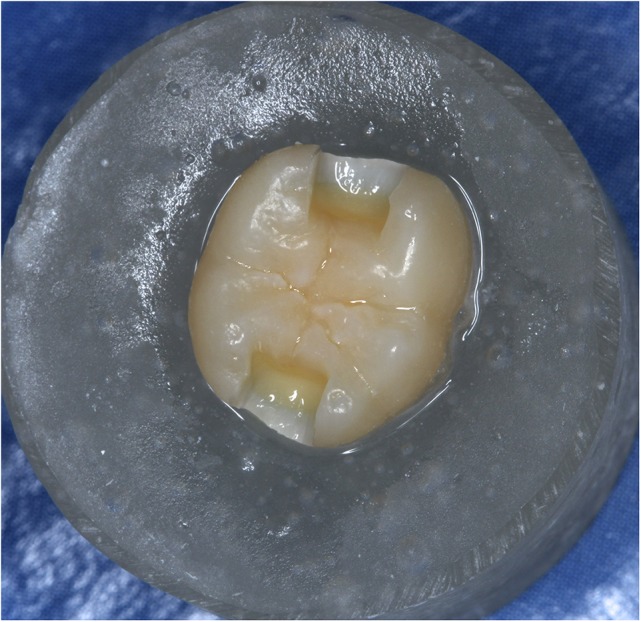
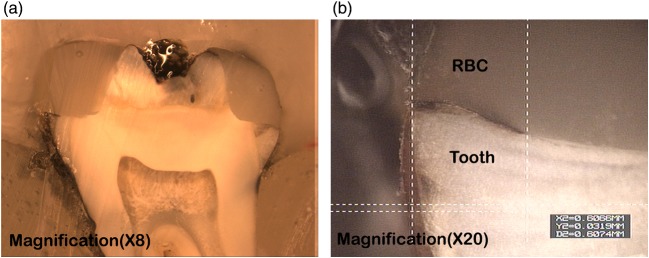
Four experimental groups of RBC were investigated including conventional composite Filtek™ Supreme in 2 mm increment (FS2), Filtek™ Supreme in 4 mm increment (FS4), Filtek™ Supreme Flowable (BFF), and SureFil SDR flow (SDR). Class II box preparation (4 × 4 × 3 mm) in extracted intact human molars was carried out and restored using the experimental groups, all according to the manufacturers' recommendations except FS4. Samples were aged by thermocycling (2,000 cycles). Microleakage was calculated by measuring dye penetration in sectioned teeth using a stereomicroscope. Level of significance was set at < 0.05.
BFF and FS2 exhibited the least dye penetration and microleakage measurement with no significant difference between the two groups, followed by SDR. FS4 showed the highest microleakage with significant difference in comparison with BFF and FS2. Gingival microleakage was found to be significantly higher than occlusal microleakage.
The microleakage of the bulk-fill composites BFF and SDR are comparable with conventional composite FS2; however, it is more predictable to use FS2.
本研究旨在根据特定临床方案,比较纳米混合树脂基复合材料(RBC)与两种大块充填可流动RBC的边缘渗漏情况(硝酸银摄取量)。
对四组实验性RBC进行研究,包括增量为2mm的传统复合材料Filtek™ Supreme(FS2)、增量为4mm的Filtek™ Supreme(FS4)、Filtek™ Supreme Flowable(BFF)和SureFil SDR flow(SDR)。在完整拔除的人类磨牙上制备II类箱形洞(4×4×3mm),并使用实验组材料进行修复,除FS4外,所有操作均按照制造商的建议进行。通过热循环(2000次循环)对样本进行老化处理。使用体视显微镜测量切片牙齿中的染料渗透情况,计算微渗漏。显著性水平设定为<0.05。
BFF和FS2的染料渗透和微渗漏测量值最低,两组之间无显著差异,其次是SDR。FS4的微渗漏最高,与BFF和FS2相比有显著差异。发现牙龈微渗漏明显高于咬合面微渗漏。
大块充填复合材料BFF和SDR的微渗漏与传统复合材料FS2相当;然而,使用FS2更具可预测性。