Kaur Gagandeep, Bansal Rajinder K, Bansal Manu, Bansal Dolphi, Garg Reeshu, Singla Sakshi, Gupta Seema
Department of Conservative Dentistry and Endodontics, Guru Nanak Dev Dental College and Research Institute, Sunam, IND.
Department of Orthodontics, Kothiwal Dental College and Research Centre, Moradabad, IND.
Cureus. 2024 Oct 3;16(10):e70745. doi: 10.7759/cureus.70745. eCollection 2024 Oct.
Endodontically treated teeth (ETT) undergo structural changes, including a reduction in water content and loss of dentin elasticity, which can compromise their mechanical properties. One critical factor influencing the long-term prognosis of a restored ETT is the marginal adaptation of the restorative material. The present study compared the marginal adaptability of Smart Dentin Replacement (SDR) Plus, fiber-reinforced, and nanofilled composites in ETT using scanning electron microscopy (SEM).
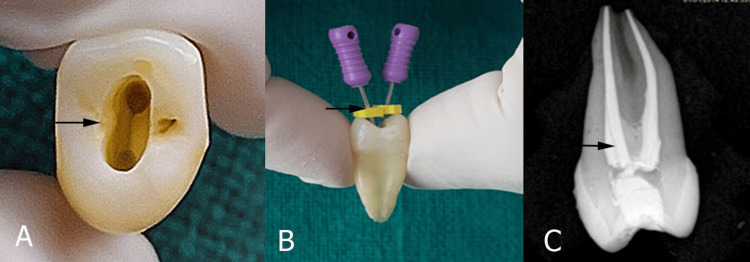
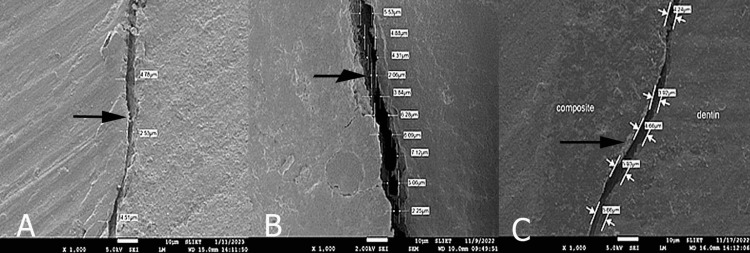
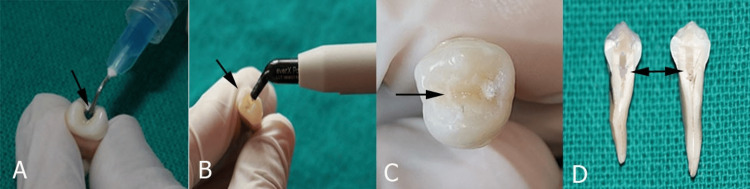
Cavities were made in 30 recently extracted maxillary premolars distributed into three experimental groups depending on the restorative material used: group 1 as SDR Plus (Dentsply Sirona, Charlotte, North Carolina, USA), group 2 as fiber-reinforced composite (EverX, GC Corp., Tokyo, Japan), and supra nanofilled composite (Estelite Sigma Quick, Tokuyama Dental Corp., Tokyo, Japan). Standardized access openings were performed, and endodontic treatment was completed in all teeth. Specific composite restoration techniques were applied according to the manufacturer's instructions. After thermocycling for 30 days, the restored teeth were sectioned and viewed using SEM (Labindia Instruments Pvt. Ltd., Maharashtra, India) to measure the width of the marginal gap. The data were analyzed using statistical software.
The mean marginal gap width varied significantly among the groups. Group 1 had a lower mean marginal gap of 2.99 μm, group 2 exhibited the highest mean marginal gap of 10.24 μm, and group 3 had a mean marginal gap of 5.51 μm. Overall, group 2 consistently showed significantly larger marginal gaps than the other groups.
Within the limitations of this study, SDR Plus demonstrated better marginal adaptation than fiber-reinforced and supra-nanofilled resins in the coronal restoration of ETT. Fiber-reinforced composites demonstrated the maximum marginal gap, followed by nanofilled composites. Thus, SDR Plus may be recommended as a suitable restorative material to enhance the longevity and success of endodontic treatments.
经过根管治疗的牙齿(ETT)会发生结构变化,包括含水量降低和牙本质弹性丧失,这可能会损害其机械性能。影响修复后的ETT长期预后的一个关键因素是修复材料的边缘适应性。本研究使用扫描电子显微镜(SEM)比较了智能牙本质替代物(SDR)Plus、纤维增强复合材料和纳米填充复合材料在ETT中的边缘适应性。
在30颗最近拔除的上颌前磨牙上制备窝洞,根据所用修复材料分为三个实验组:第1组为SDR Plus(美国北卡罗来纳州夏洛特市登士柏西诺德公司),第2组为纤维增强复合材料(日本东京GC公司的EverX),第3组为超纳米填充复合材料(日本东京德山齿科公司的Estelite Sigma Quick)。进行标准化的开髓,所有牙齿均完成根管治疗。根据制造商的说明应用特定的复合树脂修复技术。经过30天的热循环后,将修复后的牙齿切片,使用SEM(印度马哈拉施特拉邦的Labindia Instruments Pvt. Ltd.)观察以测量边缘间隙的宽度。使用统计软件对数据进行分析。
各组的平均边缘间隙宽度差异显著。第1组的平均边缘间隙较低,为2.99μm,第2组的平均边缘间隙最高,为10.24μm,第3组的平均边缘间隙为5.51μm。总体而言,第2组的边缘间隙始终明显大于其他组。
在本研究的局限性内,SDR Plus在ETT的冠部修复中显示出比纤维增强和超纳米填充树脂更好的边缘适应性。纤维增强复合材料的边缘间隙最大,其次是纳米填充复合材料。因此,SDR Plus可被推荐为一种合适的修复材料,以提高根管治疗的寿命和成功率。