Department of Urology, Renmin Hospital of Wuhan University, Wuhan, Hubei 430060, P.R. China.
Department of Neurosurgery, Renmin Hospital of Wuhan University, Wuhan, Hubei 430060, P.R. China.
Mol Med Rep. 2018 Dec;18(6):5445-5454. doi: 10.3892/mmr.2018.9586. Epub 2018 Oct 24.
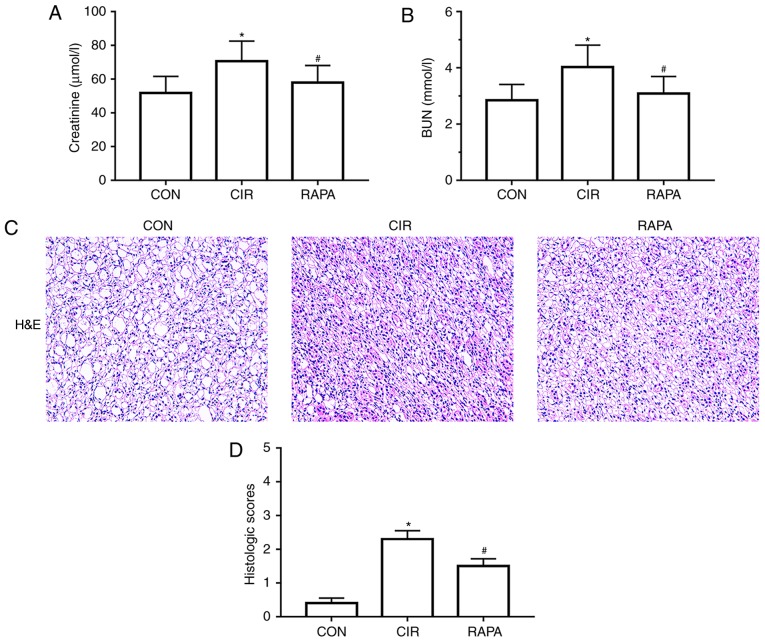
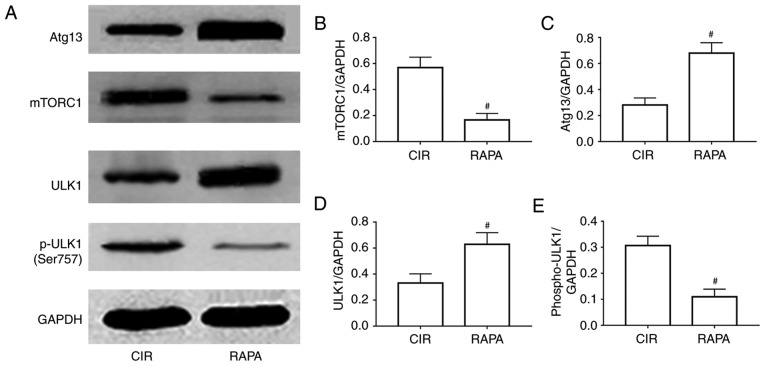
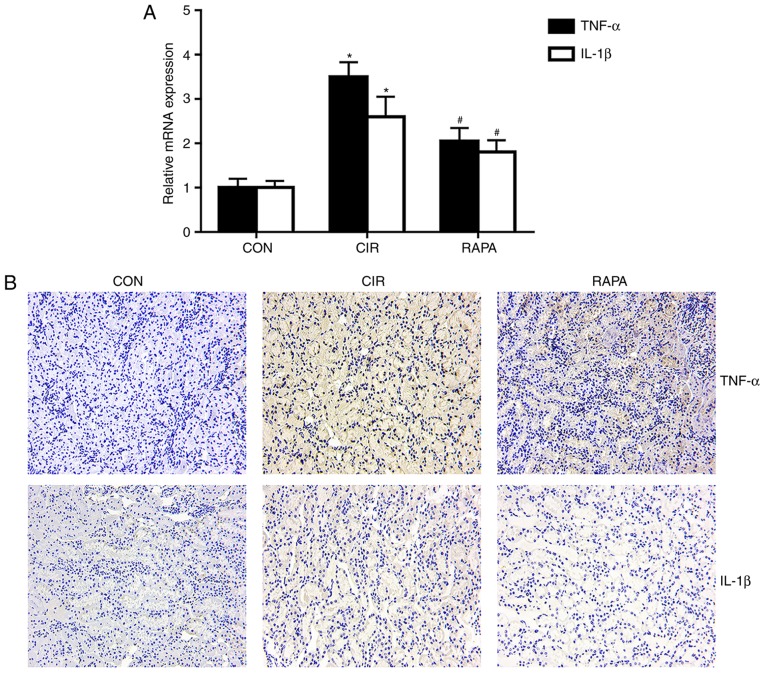
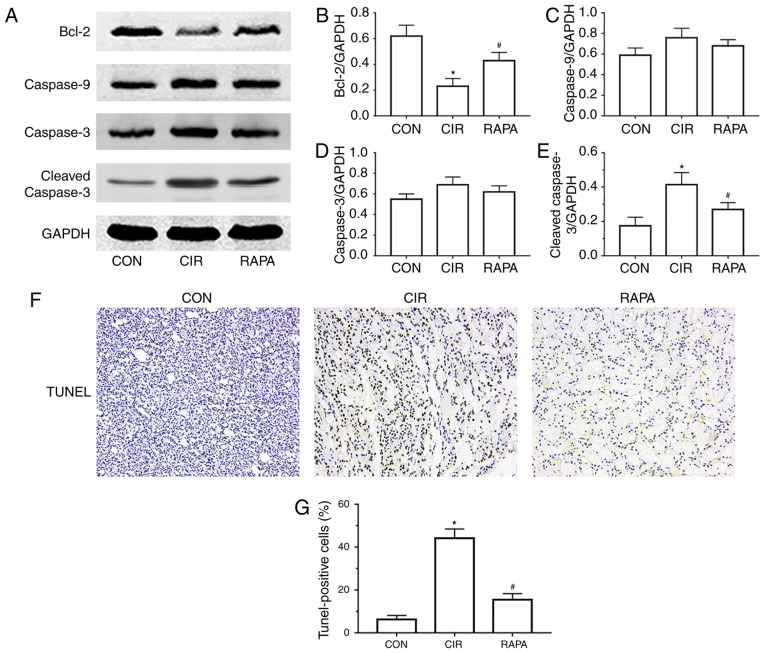
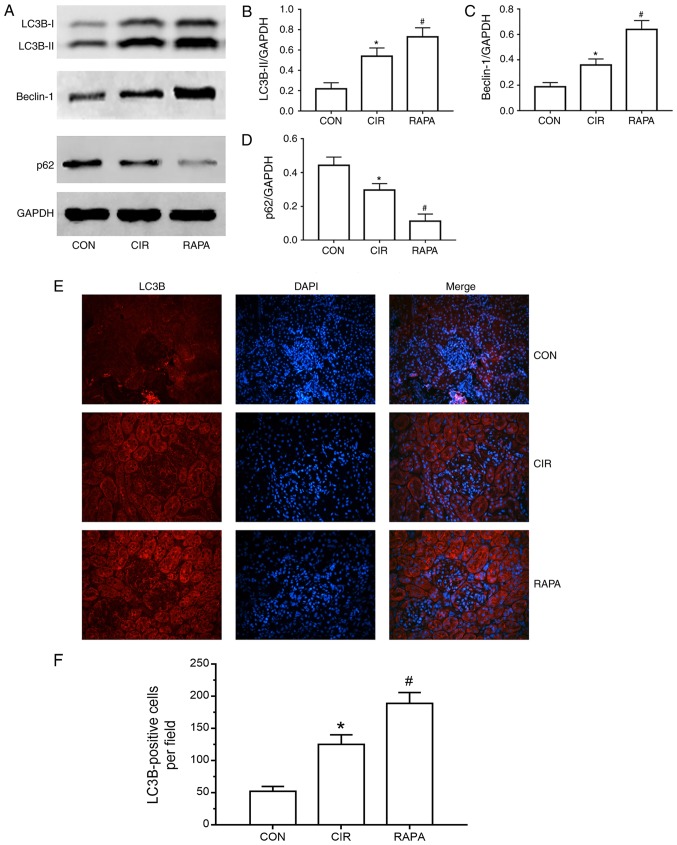
Acute kidney injury (AKI) is a clinically common and severe complication of ischemia‑reperfusion (I/R), associated with high morbidity and mortality rates, and prolonged hospitalization. Rapamycin is a type of macrolide, primarily used for anti‑rejection therapy following organ transplantation and the treatment of autoimmune diseases. Rapamycin has been identified to exert a protective effect against AKI induced by renal I/R as an autophagy inducer. However, whether rapamycin preconditioning may relieve AKI following cerebral I/R (CIR) remains to be fully elucidated. The purpose of the present study was to investigate the effects of CIR on the renal system of rats and the role of rapamycin in AKI following CIR. In the present study, a CIR model was established in Sprague‑Dawley rats via a 90‑min period of middle cerebral artery occlusion and 24 h reperfusion, and pretreatment with an intraperitoneal injection of rapamycin (dosage: 1 mg/kg; 0.5 h) prior to CIR. The levels of serum creatinine and blood urea nitrogen (BUN), and the expression of inflammation‑, apoptosis‑ and autophagy‑associated markers were subsequently measured. In addition to certain histopathological alterations to the kidney, it was identified that CIR significantly increased the levels of serum creatinine, BUN, tumor necrosis factor‑α and interleukin‑1β, and significantly induced apoptosis and autophagy. It was observed that rapamycin induced autophagy through the mammalian target of rapamycin complex 1/autophagy‑related 13/unc‑51 like autophagy activating kinase 1 signaling pathway, and that rapamycin pre‑treatment significantly improved renal function and alleviated renal tissue inflammation and cell apoptosis in rats following CIR. In conclusion, the results suggested that rapamycin may alleviate AKI following CIR via the induction of autophagy.
急性肾损伤(AKI)是缺血再灌注(I/R)的一种临床常见且严重的并发症,与高发病率和死亡率以及住院时间延长有关。雷帕霉素是一种大环内酯类药物,主要用于器官移植后的抗排斥治疗和自身免疫性疾病的治疗。雷帕霉素已被确定为一种自噬诱导物,对肾 I/R 引起的 AKI 具有保护作用。然而,雷帕霉素预处理是否可以缓解脑 I/R(CIR)后的 AKI 仍有待充分阐明。本研究旨在探讨 CIR 对大鼠肾脏系统的影响以及雷帕霉素在 CIR 后 AKI 中的作用。在本研究中,通过 90 分钟的大脑中动脉闭塞和 24 小时再灌注建立了 CIR 模型,并在 CIR 前进行腹腔内注射雷帕霉素(剂量:1mg/kg;0.5h)预处理。随后测量了血清肌酐和血尿素氮(BUN)的水平,以及炎症、凋亡和自噬相关标志物的表达。除了肾脏的某些组织病理学改变外,还发现 CIR 显著增加了血清肌酐、BUN、肿瘤坏死因子-α和白细胞介素-1β的水平,并显著诱导了细胞凋亡和自噬。观察到雷帕霉素通过哺乳动物雷帕霉素靶蛋白复合物 1/自噬相关 13/非典型蛋白激酶 1 信号通路诱导自噬,并且雷帕霉素预处理显著改善了 CIR 后大鼠的肾功能并减轻了肾脏组织炎症和细胞凋亡。综上所述,结果表明雷帕霉素可能通过诱导自噬来缓解 CIR 后的 AKI。