Postgraduate Program in Health Sciences, Health Sciences Center, State University of Maringá, Maringá, Paraná, Brazil.
Spatial Ecology and Conservation lab (LEEC), Department of Ecology, Institute of Biosciences, São Paulo State University, Rio Claro, São Paulo, Brazil.
PLoS Negl Trop Dis. 2018 Oct 26;12(10):e0006907. doi: 10.1371/journal.pntd.0006907. eCollection 2018 Oct.
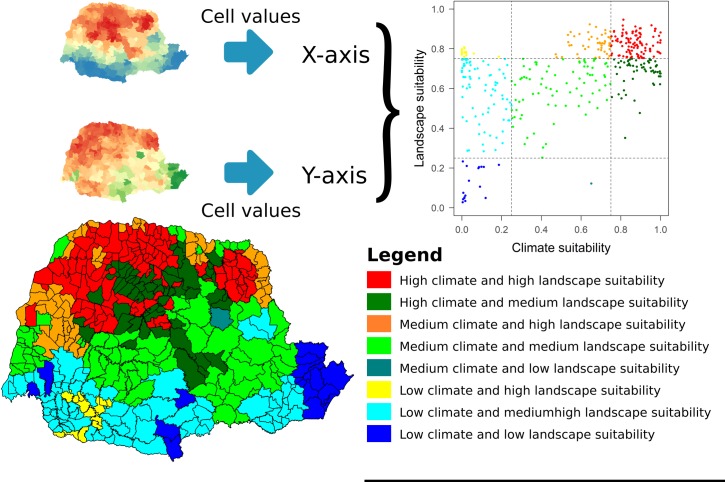
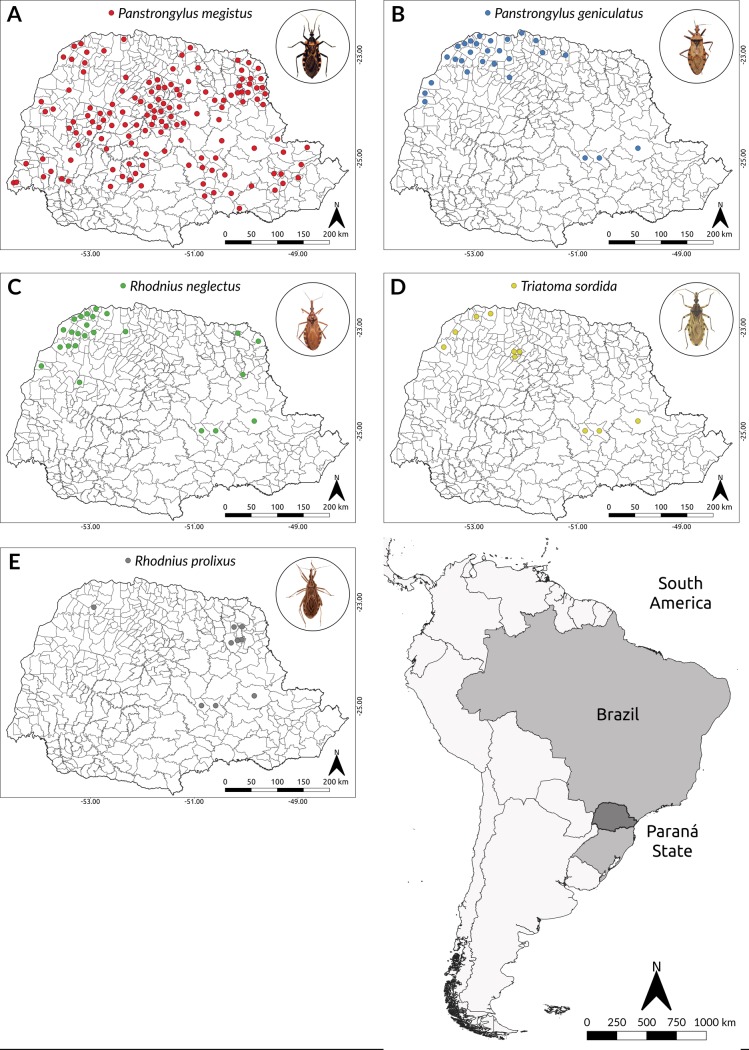
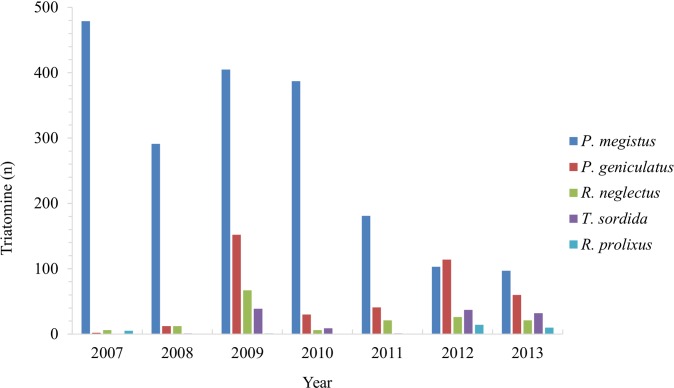
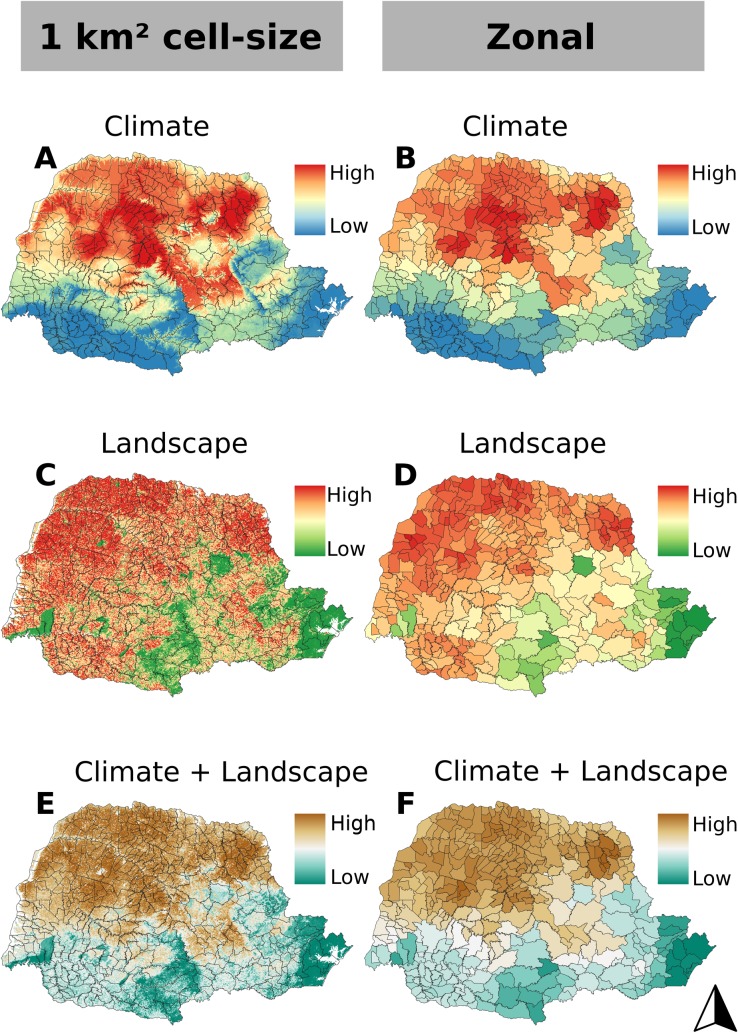
After obtaining certification of the absence of transmission of the Trypanosoma cruzi by Triatoma infestans in 2006, other native species of protozoan vectors have been found in human dwellings within municipalities of the State of Paraná, Southern Brazil. However, the spatial distribution of T. cruzi vectors and how climatic and landscape combined variables explain the distribution are still poorly understood. The goal of this study was to predict the potential distribution of T. cruzi vectors as a proxy for Chagas disease transmission risk using Ecological Niche Models (ENMs) based on climatic and landscape variables. We hypothesize that ENM based on both climate and landscape variables are more powerful than climate-only or landscape-only models, and that this will be true independent of vector species. A total of 2,662 records of triatomines of five species were obtained by community-based entomological surveillance from 2007 to 2013. The species with the highest number of specimens was Panstrongylus megistus (73%; n = 1,943), followed by Panstrongylus geniculatus (15.4%; 411), Rhodnius neglectus (6.0%; 159), Triatoma sordida (4.5%; 119) and Rhodnius prolixus (1.1%; 30). Of the total, 71.9% were captured at the intradomicile. T. cruzi infection was observed in 19.7% of the 2,472 examined insects. ENMs were generated based on selected climate and landscape variables with 1 km2 spatial resolution. Zonal statistics were used for classifying the municipalities as to the risk of occurrence of synanthropic triatomines. The integrated analysis of the climate and landscape suitability on triatomines geographical distribution was powerful on generating good predictive models. Moreover, this showed that some municipalities in the northwest, north and northeast of the Paraná state have a higher risk of T. cruzi vector transmission. This occurs because those regions present high climatic and landscape suitability values for occurrence of their vectors. The frequent invasion of houses by infected triatomines clearly indicates a greater risk of transmission of T. cruzi to the inhabitants. More public health attention should be given in the northern areas of the State of Paraná, which presents high climate and landscape suitabilities for the disease vectors. In conclusion, our results-through spatial analysis and predictive maps-showed to be effective in identifying areas of potential distribution and, consequently, in the definition of strategic areas and actions to prevent new cases of Chagas' disease, reinforcing the need for continuous and robust surveillance in these areas.
2006 年证实了在巴西南部巴拉那州的人类住区中,不存在传播克氏锥虫的传播媒介三带喙库蚊之后,又在其他原生原生质体媒介物种中发现了这种疾病。然而,克氏锥虫媒介的空间分布以及气候和景观综合变量如何解释其分布仍知之甚少。本研究的目的是使用基于气候和景观变量的生态位模型(ENM)来预测克氏锥虫媒介的潜在分布,以此作为传播查加斯病风险的替代指标。我们假设基于气候和景观变量的 ENM 比仅基于气候或景观变量的模型更强大,并且无论媒介物种如何,这种情况都是如此。2007 年至 2013 年,通过社区昆虫学监测共获得了 5 种 2662 只三锥虫的记录。标本数量最多的物种是 Panstrongylus megistus(73%;n=1943),其次是 Panstrongylus geniculatus(15.4%;411),Rhodnius neglectus(6.0%;159),Triatoma sordida(4.5%;119)和 Rhodnius prolixus(1.1%;30)。在总共捕获的标本中,71.9%是在室内捕获的。在所检查的 2472 只昆虫中,有 19.7%观察到克氏锥虫感染。基于 1km2 空间分辨率的选定气候和景观变量生成了 ENM。使用区域统计数据将市政当局分为发生拟态锥虫的风险等级。气候和景观适宜性对三锥虫地理分布的综合分析对于生成良好的预测模型非常有效。此外,这表明巴拉那州西北部、北部和东北部的一些城市地区发生克氏锥虫媒介传播的风险更高。这是因为这些地区的气候和景观适宜度非常适合其媒介的存在。受感染的三锥虫经常入侵房屋,这显然表明向居民传播克氏锥虫的风险更大。应更加关注巴拉那州北部地区的公共卫生,因为该地区的疾病媒介具有较高的气候和景观适宜度。总之,通过空间分析和预测图,我们的结果表明,在识别潜在分布区域方面是有效的,因此,可以确定战略区域,并采取行动预防新的恰加斯病病例,这进一步强调了在这些地区持续和强有力监测的必要性。