• 文献检索
  • 文档翻译
  • 深度研究
  • 学术资讯
  • Suppr Zotero 插件Zotero 插件
  • 邀请有礼
  • 套餐&价格
  • 历史记录
应用&插件
Suppr Zotero 插件Zotero 插件浏览器插件Mac 客户端Windows 客户端微信小程序
定价
高级版会员购买积分包购买API积分包
服务
文献检索文档翻译深度研究API 文档MCP 服务
关于我们
关于 Suppr公司介绍联系我们用户协议隐私条款
关注我们

Suppr 超能文献

核心技术专利:CN118964589B侵权必究
粤ICP备2023148730 号-1Suppr @ 2026

文献检索

告别复杂PubMed语法,用中文像聊天一样搜索,搜遍4000万医学文献。AI智能推荐,让科研检索更轻松。

立即免费搜索

文件翻译

保留排版,准确专业,支持PDF/Word/PPT等文件格式,支持 12+语言互译。

免费翻译文档

深度研究

AI帮你快速写综述,25分钟生成高质量综述,智能提取关键信息,辅助科研写作。

立即免费体验

基于智能手机的动态评估(SBAA-BD)在双相情感障碍患者长期治疗中包括一个预测系统,用于预测即将到来的发作:一项随机对照单盲试验的研究方案。

Effectiveness of smartphone-based ambulatory assessment (SBAA-BD) including a predicting system for upcoming episodes in the long-term treatment of patients with bipolar disorders: study protocol for a randomized controlled single-blind trial.

机构信息

Department of Psychiatry and Psychotherapy, University Medical Center Dresden, Dresden, Germany.

Department of Sport and Sport Science and House of Competence, Karlsruhe Institute of Technology, Karlsruhe, Germany.

出版信息

BMC Psychiatry. 2018 Oct 26;18(1):349. doi: 10.1186/s12888-018-1929-y.

DOI:10.1186/s12888-018-1929-y
PMID:30367608
原文链接:https://pmc.ncbi.nlm.nih.gov/articles/PMC6204033/
Abstract

BACKGROUND

The detection of early warning signs is essential in the long-term treatment of bipolar disorders. However, in bipolar patients' daily life and outpatient treatment the assessment of upcoming state changes faces several difficulties. In this trial, we examine the effectiveness of a smartphone based automated feedback about ambulatory assessed early warning signs in prolonging states of euthymia and therefore preventing hospitalization. This study aims to assess, whether patients experience longer episodes of euthymia, when their treating psychiatrists receive automated feedback about changes in communication and activity. With this additional information an intervention at an earlier stage in the development of mania or depression could be facilitated. We expect that the amount of time will be longer between affective episodes in the intervention group.

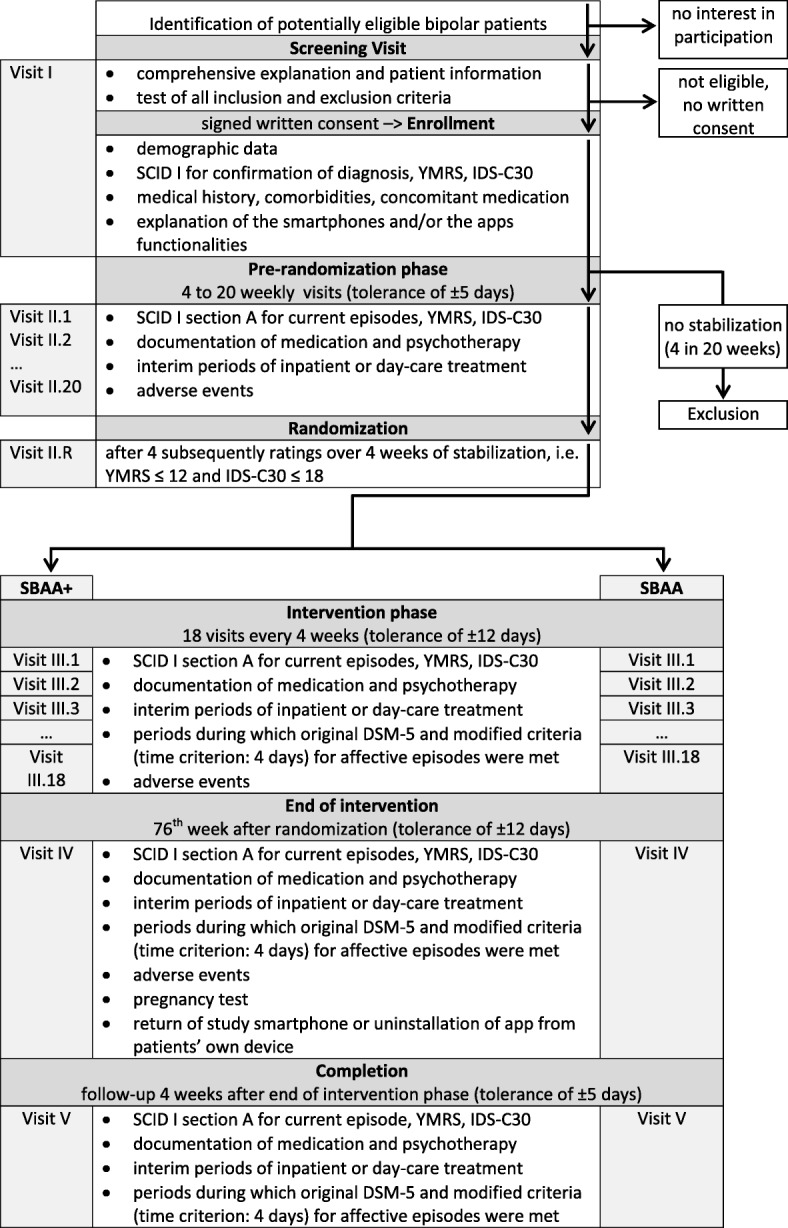
METHODS/DESIGN: The current study is designed as a randomized, multi-center, observer-blind, active-control, parallel group trial within a nationwide research project on the topic of innovative methods for diagnostics, prevention and interventions of bipolar disorders. One hundred and twenty patients with bipolar disorder will be randomly assigned to (1) the experimental group with included automated feedback or (2) the control group without feedback. During the intervention phase, the psychopathologic state of all participants is assessed every four weeks over 18 months. Kaplan-Meier estimators will be used for estimating the survival functions, a Log-Rank test will be used to formally compare time to a new episode across treatment groups. An intention-to-treat analysis will include data from all randomized patients.

DISCUSSION

This article describes the design of a clinical trial investigating the effectiveness of a smartphone-based feedback loop. This feedback loop is meant to elicit early interventions at the detection of warning signs for the prevention of affective episodes in bipolar patients. This approach will hopefully improve the chances of a timely intervention helping patients to keep a balanced mood for longer periods of time. In detail, if our hypothesis can be confirmed, clinical practice treating psychiatrists will be enabled to react quickly when changes are automatically detected. Therefore, outpatients would receive an even more individually tailored treatment concerning time and frequency of doctor's appointments.

TRIAL REGISTRATION

ClinicalTrials.gov : NCT02782910 : Title: "Smartphone-based Ambulatory Assessment of Early Warning Signs (BipoLife_A3)". Registered May 25 2016. Protocol Amendment Number: 03. Issue Date: 26 March 2018. Author(s): ES.

摘要

背景

在双相情感障碍的长期治疗中,早期预警信号的检测至关重要。然而,在双相患者的日常生活和门诊治疗中,评估即将发生的状态变化面临着一些困难。在这项试验中,我们研究了基于智能手机的自动反馈对日常生活中评估到的早期预警信号的有效性,以延长缓解期并预防住院。本研究旨在评估当治疗精神病医生收到关于沟通和活动变化的自动反馈时,患者是否会经历更长时间的缓解期。通过这些额外的信息,可以更早地干预躁狂或抑郁的发展阶段。我们预计干预组的情感发作之间的时间会更长。

方法/设计:本研究是一个在全国性的双相情感障碍创新诊断、预防和干预方法研究项目内进行的随机、多中心、观察者盲法、活性对照、平行组试验。120 名双相情感障碍患者将被随机分配到(1)实验组,包括自动反馈,或(2)对照组,无反馈。在干预阶段,所有参与者的精神病理学状态将在 18 个月内每四周评估一次。Kaplan-Meier 估计器将用于估计生存函数,对数秩检验将用于正式比较治疗组之间新发发作的时间。意向治疗分析将包括所有随机患者的数据。

讨论

本文描述了一项临床试验的设计,该试验旨在研究基于智能手机的反馈回路的有效性。该反馈回路旨在在发现双相患者的预警信号时引发早期干预,以预防情感发作。这种方法有望提高及时干预的机会,帮助患者保持更长时间的平衡情绪。具体来说,如果我们的假设能够得到证实,治疗精神病医生的临床实践将能够在自动检测到变化时迅速做出反应。因此,门诊患者将获得更个性化的治疗,包括就诊时间和频率。

试验注册

ClinicalTrials.gov:NCT02782910:标题:“基于智能手机的日常生活评估早期预警信号(BipoLife_A3)”。注册于 2016 年 5 月 25 日。方案修正案编号:03。发布日期:2018 年 3 月 26 日。作者:ES。

https://cdn.ncbi.nlm.nih.gov/pmc/blobs/0332/6204033/773eb3d51d60/12888_2018_1929_Fig2_HTML.jpg
https://cdn.ncbi.nlm.nih.gov/pmc/blobs/0332/6204033/4978c89b7c4a/12888_2018_1929_Fig1_HTML.jpg
https://cdn.ncbi.nlm.nih.gov/pmc/blobs/0332/6204033/773eb3d51d60/12888_2018_1929_Fig2_HTML.jpg
https://cdn.ncbi.nlm.nih.gov/pmc/blobs/0332/6204033/4978c89b7c4a/12888_2018_1929_Fig1_HTML.jpg
https://cdn.ncbi.nlm.nih.gov/pmc/blobs/0332/6204033/773eb3d51d60/12888_2018_1929_Fig2_HTML.jpg

相似文献

1
Effectiveness of smartphone-based ambulatory assessment (SBAA-BD) including a predicting system for upcoming episodes in the long-term treatment of patients with bipolar disorders: study protocol for a randomized controlled single-blind trial.基于智能手机的动态评估(SBAA-BD)在双相情感障碍患者长期治疗中包括一个预测系统,用于预测即将到来的发作:一项随机对照单盲试验的研究方案。
BMC Psychiatry. 2018 Oct 26;18(1):349. doi: 10.1186/s12888-018-1929-y.
2
Reducing the rate and duration of Re-ADMISsions among patients with unipolar disorder and bipolar disorder using smartphone-based monitoring and treatment - the RADMIS trials: study protocol for two randomized controlled trials.使用基于智能手机的监测与治疗降低单相情感障碍和双相情感障碍患者再入院率及缩短再入院时长——RADMIS试验:两项随机对照试验的研究方案
Trials. 2017 Jun 15;18(1):277. doi: 10.1186/s13063-017-2015-3.
3
The effect of smartphone-based monitoring and treatment including clinical feedback versus smartphone-based monitoring without clinical feedback in bipolar disorder: the SmartBipolar trial-a study protocol for a randomized controlled parallel-group trial.基于智能手机的监测和治疗(包括临床反馈)与单纯基于智能手机的监测对双相障碍的效果:SmartBipolar 试验-一项随机对照平行组试验的研究方案。
Trials. 2023 Sep 12;24(1):583. doi: 10.1186/s13063-023-07625-1.
4
Daily electronic monitoring of subjective and objective measures of illness activity in bipolar disorder using smartphones--the MONARCA II trial protocol: a randomized controlled single-blind parallel-group trial.使用智能手机对双相情感障碍患者的疾病活动主观和客观指标进行每日电子监测——MONARCA II试验方案:一项随机对照单盲平行组试验
BMC Psychiatry. 2014 Nov 25;14:309. doi: 10.1186/s12888-014-0309-5.
5
Eye movement desensitization and reprocessing therapy versus supportive therapy in affective relapse prevention in bipolar patients with a history of trauma: study protocol for a randomized controlled trial.眼动脱敏与再加工疗法与支持性疗法预防有创伤史双相情感障碍患者情感复发的对照研究:一项随机对照试验的研究方案
Trials. 2017 Apr 4;18(1):160. doi: 10.1186/s13063-017-1910-y.
6
Web-based intervention to improve quality of life in late stage bipolar disorder (ORBIT): randomised controlled trial protocol.基于网络的干预措施改善晚期双相情感障碍患者的生活质量(ORBIT):随机对照试验方案。
BMC Psychiatry. 2018 Jul 13;18(1):221. doi: 10.1186/s12888-018-1805-9.
7
Daily electronic self-monitoring in bipolar disorder using smartphones - the MONARCA I trial: a randomized, placebo-controlled, single-blind, parallel group trial.使用智能手机对双相情感障碍进行每日电子自我监测——MONARCA I试验:一项随机、安慰剂对照、单盲、平行组试验。
Psychol Med. 2015 Oct;45(13):2691-704. doi: 10.1017/S0033291715000410. Epub 2015 Jul 29.
8
Online psycho-education to the treatment of bipolar disorder: protocol of a randomized controlled trial.双相情感障碍治疗的在线心理教育:一项随机对照试验的方案
BMC Psychiatry. 2016 Dec 22;16(1):452. doi: 10.1186/s12888-016-1159-0.
9
The Bipolar Illness Onset study: research protocol for the BIO cohort study.双相情感障碍起病研究:BIO队列研究的研究方案
BMJ Open. 2017 Jun 23;7(6):e015462. doi: 10.1136/bmjopen-2016-015462.
10
Study protocol: group-based psychoeducation for relatives of patients with bipolar disorder-a large scale real-world randomized controlled parallel group trial, the R-bipolar RCT.研究方案:基于群组的双相情感障碍患者家属心理教育 - 一项大规模真实世界随机对照平行群组试验,即 R-双相 RCT。
Trials. 2024 May 23;25(1):342. doi: 10.1186/s13063-024-08172-z.

引用本文的文献

1
StudyU: A Platform for Designing and Conducting Innovative Digital N-of-1 Trials.StudyU:一个用于设计和实施创新型数字 N-of-1 试验的平台。
J Med Internet Res. 2022 Jul 5;24(7):e35884. doi: 10.2196/35884.
2
Toward a Digital Future in Bipolar Disorder Assessment: A Systematic Review of Disruptions in the Rest-Activity Cycle as Measured by Actigraphy.迈向双相情感障碍评估的数字未来:一项关于通过活动记录仪测量的静息-活动周期中断的系统综述。
Front Psychiatry. 2022 May 23;13:780726. doi: 10.3389/fpsyt.2022.780726. eCollection 2022.
3
Pocketable Labs for Everyone: Synchronized Multi-Sensor Data Streaming and Recording on Smartphones with the Lab Streaming Layer.

本文引用的文献

1
Smartphone-based objective monitoring in bipolar disorder: status and considerations.基于智能手机的双相情感障碍客观监测:现状与思考。
Int J Bipolar Disord. 2018 Jan 23;6(1):6. doi: 10.1186/s40345-017-0110-8.
2
Aims and structure of the German Research Consortium BipoLife for the study of bipolar disorder.德国双相情感障碍研究联盟BipoLife的研究目的与架构
Int J Bipolar Disord. 2016 Dec;4(1):26. doi: 10.1186/s40345-016-0066-0. Epub 2016 Nov 21.
3
Using Smartphones to Monitor Bipolar Disorder Symptoms: A Pilot Study.使用智能手机监测双相情感障碍症状:一项试点研究。
人人可用的口袋实验室:使用 Lab Streaming Layer 在智能手机上实现同步多传感器数据流式传输和记录。
Sensors (Basel). 2021 Dec 5;21(23):8135. doi: 10.3390/s21238135.
4
Validity of the Aktibipo Self-rating Questionnaire for the Digital Self-assessment of Mood and Relapse Detection in Patients With Bipolar Disorder: Instrument Validation Study.Aktibipo自评问卷在双相情感障碍患者情绪数字自我评估和复发检测中的有效性:工具验证研究
JMIR Ment Health. 2021 Aug 9;8(8):e26348. doi: 10.2196/26348.
5
Monitoring Sleep Changes via a Smartphone App in Bipolar Disorder: Practical Issues and Validation of a Potential Diagnostic Tool.通过智能手机应用程序监测双相情感障碍患者的睡眠变化:实际问题及一种潜在诊断工具的验证
Front Psychiatry. 2021 Mar 24;12:641241. doi: 10.3389/fpsyt.2021.641241. eCollection 2021.
6
Digital phenotyping: towards replicable findings with comprehensive assessments and integrative models in bipolar disorders.数字表型分析:通过双相情感障碍的综合评估和整合模型实现可重复的研究结果。
Int J Bipolar Disord. 2020 Nov 17;8(1):35. doi: 10.1186/s40345-020-00210-4.
7
Development of an Emotion-Sensitive mHealth Approach for Mood-State Recognition in Bipolar Disorder.一种用于双相情感障碍情绪状态识别的情感敏感型移动健康方法的开发。
JMIR Ment Health. 2020 Jul 3;7(7):e14267. doi: 10.2196/14267.
8
Improving early recognition and intervention in people at increased risk for the development of bipolar disorder: study protocol of a prospective-longitudinal, naturalistic cohort study (Early-BipoLife).提高对双相情感障碍发病风险增加人群的早期识别和干预:一项前瞻性纵向自然队列研究(Early-BipoLife)的研究方案
Int J Bipolar Disord. 2020 Jul 1;8(1):22. doi: 10.1186/s40345-020-00183-4.
9
[Ambulatory monitoring and digital phenotyping in the diagnostics and treatment of bipolar disorders].[动态监测与数字表型分析在双相情感障碍诊断与治疗中的应用]
Nervenarzt. 2019 Dec;90(12):1215-1220. doi: 10.1007/s00115-019-00816-9.
10
Methodological Challenges in Randomized Controlled Trials on Smartphone-Based Treatment in Psychiatry: Systematic Review.精神科基于智能手机治疗的随机对照试验中的方法学挑战:系统评价
J Med Internet Res. 2019 Oct 27;21(10):e15362. doi: 10.2196/15362.
JMIR Ment Health. 2016 Jan 6;3(1):e2. doi: 10.2196/mental.4560.
4
Daily electronic self-monitoring in bipolar disorder using smartphones - the MONARCA I trial: a randomized, placebo-controlled, single-blind, parallel group trial.使用智能手机对双相情感障碍进行每日电子自我监测——MONARCA I试验:一项随机、安慰剂对照、单盲、平行组试验。
Psychol Med. 2015 Oct;45(13):2691-704. doi: 10.1017/S0033291715000410. Epub 2015 Jul 29.
5
The prevalence and burden of bipolar depression.双相抑郁症的患病率和负担。
J Affect Disord. 2014 Dec;169 Suppl 1:S3-11. doi: 10.1016/S0165-0327(14)70003-5.
6
Daily electronic monitoring of subjective and objective measures of illness activity in bipolar disorder using smartphones--the MONARCA II trial protocol: a randomized controlled single-blind parallel-group trial.使用智能手机对双相情感障碍患者的疾病活动主观和客观指标进行每日电子监测——MONARCA II试验方案:一项随机对照单盲平行组试验
BMC Psychiatry. 2014 Nov 25;14:309. doi: 10.1186/s12888-014-0309-5.
7
Smartphone-based recognition of states and state changes in bipolar disorder patients.基于智能手机对双相情感障碍患者状态及状态变化的识别。
IEEE J Biomed Health Inform. 2015 Jan;19(1):140-8. doi: 10.1109/JBHI.2014.2343154. Epub 2014 Jul 25.
8
Wearable monitoring for mood recognition in bipolar disorder based on history-dependent long-term heart rate variability analysis.基于历史相关的长期心率变异性分析的双相情感障碍情绪识别可穿戴监测。
IEEE J Biomed Health Inform. 2014 Sep;18(5):1625-35. doi: 10.1109/JBHI.2013.2290382. Epub 2013 Nov 11.
9
Daily electronic self-monitoring of subjective and objective symptoms in bipolar disorder--the MONARCA trial protocol (MONitoring, treAtment and pRediCtion of bipolAr disorder episodes): a randomised controlled single-blind trial.每日电子自我监测双相情感障碍的主观和客观症状 - MONARCA 试验方案(双相情感障碍发作的监测、治疗和预测):一项随机对照单盲试验。
BMJ Open. 2013 Jul 24;3(7). doi: 10.1136/bmjopen-2013-003353. Print 2013.
10
Ambulatory assessment.门诊评估。
Annu Rev Clin Psychol. 2013;9:151-76. doi: 10.1146/annurev-clinpsy-050212-185510. Epub 2012 Nov 13.