Faurholt-Jepsen Maria, Frost Mads, Martiny Klaus, Tuxen Nanna, Rosenberg Nicole, Busk Jonas, Winther Ole, Bardram Jakob Eyvind, Kessing Lars Vedel
Psychiatric Center Copenhagen, Rigshospitalet, Blegdamsvej 9, DK-2100, Copenhagen, Denmark.
Psychiatric Center Copenhagen, Rigshospitalet, University Hospitalet of Copenhagen, Copenhagen, Denmark.
Trials. 2017 Jun 15;18(1):277. doi: 10.1186/s13063-017-2015-3.
Unipolar and bipolar disorder combined account for nearly half of all morbidity and mortality due to mental and substance use disorders, and burden society with the highest health care costs of all psychiatric and neurological disorders. Among these, costs due to psychiatric hospitalization are a major burden. Smartphones comprise an innovative and unique platform for the monitoring and treatment of depression and mania. No prior trial has investigated whether the use of a smartphone-based system can prevent re-admission among patients discharged from hospital. The present RADMIS trials aim to investigate whether using a smartphone-based monitoring and treatment system, including an integrated clinical feedback loop, reduces the rate and duration of re-admissions more than standard treatment in unipolar disorder and bipolar disorder.
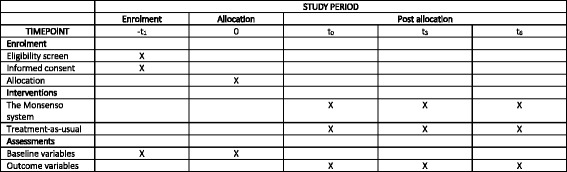
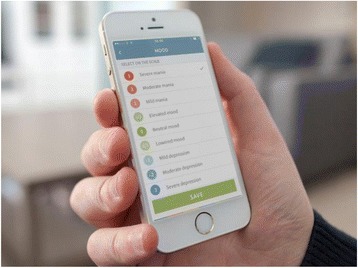
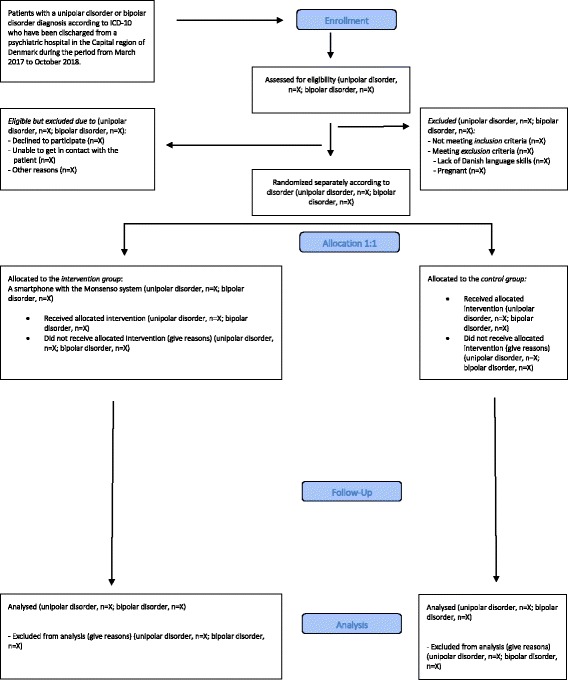
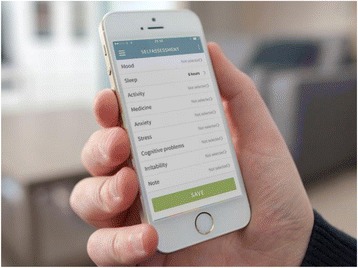
The RADMIS trials use a randomized controlled, single-blind, parallel-group design. Patients with unipolar disorder and patients with bipolar disorder are invited to participate in each trial when discharged from psychiatric hospitals in The Capital Region of Denmark following an affective episode and randomized to either (1) a smartphone-based monitoring system including (a) an integrated feedback loop between patients and clinicians and (b) context-aware cognitive behavioral therapy (CBT) modules (intervention group) or (2) standard treatment (control group) for a 6-month trial period. The trial started in May 2017. The outcomes are (1) number and duration of re-admissions (primary), (2) severity of depressive and manic (only for patients with bipolar disorder) symptoms; psychosocial functioning; number of affective episodes (secondary), and (3) perceived stress, quality of life, self-rated depressive symptoms, self-rated manic symptoms (only for patients with bipolar disorder), recovery, empowerment, adherence to medication, wellbeing, ruminations, worrying, and satisfaction (tertiary). A total of 400 patients (200 patients with unipolar disorder and 200 patients with bipolar disorder) will be included in the RADMIS trials.
If the smartphone-based monitoring system proves effective in reducing the rate and duration of re-admissions, there will be basis for using a system of this kind in the treatment of unipolar and bipolar disorder in general and on a larger scale.
ClinicalTrials.gov, ID: NCT03033420 . Registered 13 January 2017. Ethical approval has been obtained.
单相和双相情感障碍导致的发病率和死亡率占精神和物质使用障碍所致全部发病率和死亡率的近一半,且在所有精神和神经疾病中,其医疗保健成本最高,给社会带来沉重负担。其中,精神科住院费用是一项主要负担。智能手机为抑郁症和躁狂症的监测和治疗提供了一个创新且独特的平台。此前尚无试验研究基于智能手机的系统能否预防出院患者再次入院。目前的RADMIS试验旨在研究使用基于智能手机的监测和治疗系统(包括一个综合临床反馈回路),与单相情感障碍和双相情感障碍的标准治疗相比,是否能降低再次入院的发生率和持续时间。
RADMIS试验采用随机对照、单盲、平行组设计。单相情感障碍患者和双相情感障碍患者在丹麦首都地区精神病医院因情感发作出院时受邀参加各试验,并随机分为两组:(1)基于智能手机的监测系统,包括(a)患者与临床医生之间的综合反馈回路以及(b)情境感知认知行为疗法(CBT)模块(干预组);或(2)标准治疗(对照组),试验期为6个月。该试验于2017年5月开始。研究结果包括:(1)再次入院的次数和持续时间(主要指标);(2)抑郁和躁狂症状的严重程度(仅针对双相情感障碍患者)、心理社会功能、情感发作次数(次要指标);以及(3)感知压力、生活质量、自评抑郁症状、自评躁狂症状(仅针对双相情感障碍患者)、康复情况、赋权感、药物依从性、幸福感、沉思、担忧和满意度(三级指标)。RADMIS试验共纳入400名患者(200名单相情感障碍患者和200名双相情感障碍患者)。
如果基于智能手机的监测系统在降低再次入院发生率和持续时间方面被证明有效,那么将有理由在单相和双相情感障碍的一般治疗及更大范围内使用此类系统。
ClinicalTrials.gov,标识符:NCT03033420。于2017年1月13日注册。已获得伦理批准。