Department of Gastroenterology, Zhongshan Hospital, Xiamen University, Xiamen, 361005, Fujian, P. R. China.
Institute for Microbial Ecology, Xiamen University, Xiamen, 361005, Fujian, P. R. China.
Cancer Commun (Lond). 2018 Oct 26;38(1):64. doi: 10.1186/s40880-018-0333-9.
Recent studies highlight pseudogene derived long non-coding RNAs (lncRNAs) as key regulators of cancer biology. However, few of them have been well characterized in pancreatic cancer. Here, we aimed to identify the association between pseudogene derived lncRNA DUXAP8 and growth of pancreatic cancer cells.
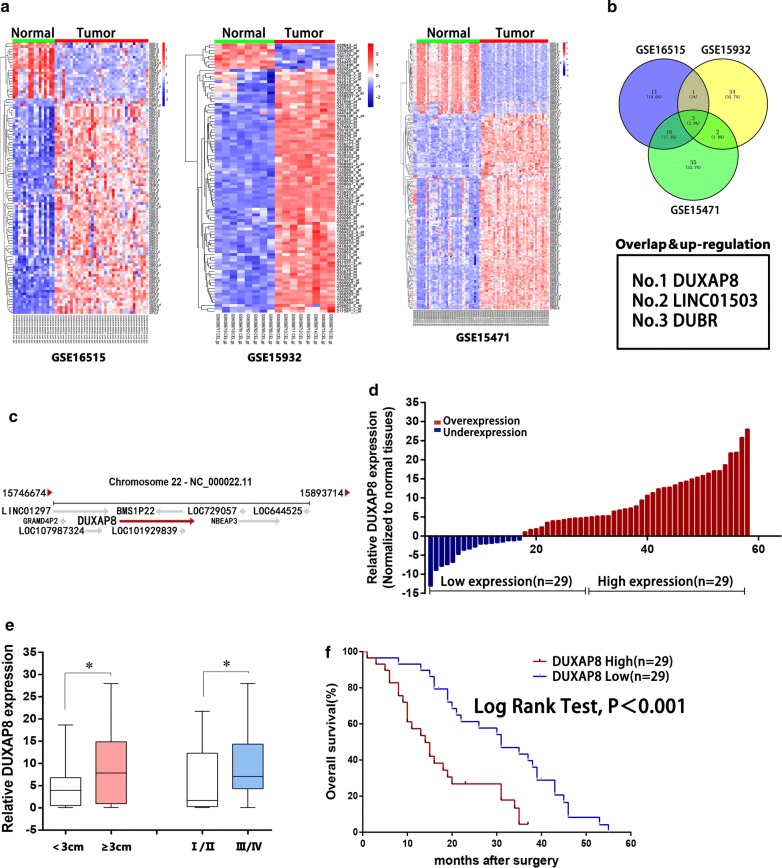
We screened for pseudogene derived lncRNAs associated with human pancreatic cancer by comparative analysis of three independent datasets from GEO. Quantitative real-time reverse transcription polymerase chain reaction was used to assess the relative expression of DUXAP8 in pancreatic cancer tissues and cells. Loss-of-function approaches were used to investigate the potential functional roles of DUXAP8 in pancreatic cancer cell proliferation and apoptosis in vitro and in vivo. RNA immunoprecipitation, chromosome immunoprecipitation assay and rescue experiments were performed to analyze the association of DUXAP8 with target proteins and genes in pancreatic cancer cells.
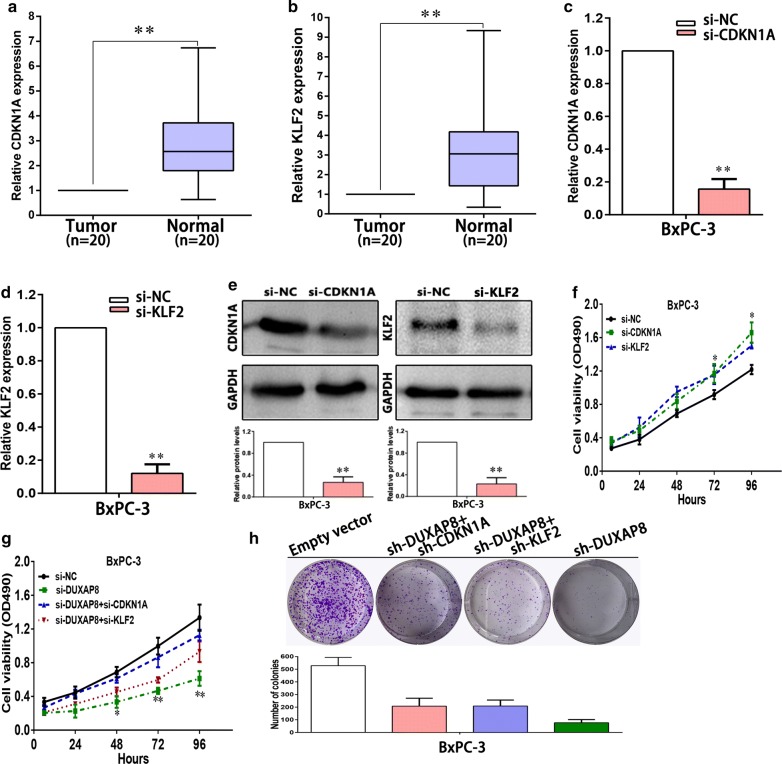
Pancreatic cancer tissues had significantly higher DUXAP8 levels than paired adjacent normal tissues. High DUXAP8 expression was associated with a larger tumor size, advanced pathological stage and shorter overall survival of pancreatic cancer patients. Moreover, silencing DUXAP8 expression by siRNA or shRNA inhibited pancreatic cancer cell proliferation and promoted apoptosis in vitro and in vivo. Mechanistic analyses indicated that DUXAP8 regulates PC cell proliferation partly through downregulation of tumor suppressor CDKN1A and KLF2 expression.
Our results suggest that tumor expression of pseudogene derived lncRNA DUXAP8 plays an important role in pancreatic cancer progression. DUXAP8 may serve as a candidate biomarker and represent a novel therapeutic target of pancreatic cancer.
最近的研究强调了假基因衍生的长非编码 RNA(lncRNA)作为癌症生物学关键调节剂的作用。然而,在胰腺癌中,它们很少被很好地描述。在这里,我们旨在确定假基因衍生的 lncRNA DUXAP8 与胰腺癌细胞生长之间的关联。
我们通过比较三个来自 GEO 的独立数据集,筛选与人类胰腺癌相关的假基因衍生的 lncRNA。实时定量逆转录聚合酶链反应用于评估 DUXAP8 在胰腺癌组织和细胞中的相对表达。体外和体内采用基因敲低方法研究 DUXAP8 在胰腺癌细胞增殖和凋亡中的潜在功能作用。采用 RNA 免疫沉淀、染色体免疫沉淀实验和挽救实验分析 DUXAP8 与胰腺癌细胞中靶蛋白和基因的关联。
胰腺癌组织中的 DUXAP8 水平明显高于配对的相邻正常组织。高 DUXAP8 表达与肿瘤体积较大、病理分期较晚和胰腺癌患者总生存期较短有关。此外,siRNA 或 shRNA 沉默 DUXAP8 表达可抑制胰腺癌细胞的体外和体内增殖,并促进凋亡。机制分析表明,DUXAP8 通过下调肿瘤抑制因子 CDKN1A 和 KLF2 的表达来部分调节 PC 细胞的增殖。
我们的研究结果表明,假基因衍生的 lncRNA DUXAP8 在胰腺癌进展中发挥着重要作用。DUXAP8 可能作为候选生物标志物,并代表胰腺癌的新治疗靶点。