Vrankar Martina, Unk Mojca
Department of Radiotherapy, Institute of Oncology Ljubljana, Ljubljana, Slovenia.
Department of Medical Oncology, Institute of Oncology Ljubljana, Ljubljana, Slovenia.
Radiol Oncol. 2018 Oct 18;52(4):365-369. doi: 10.2478/raon-2018-0037.
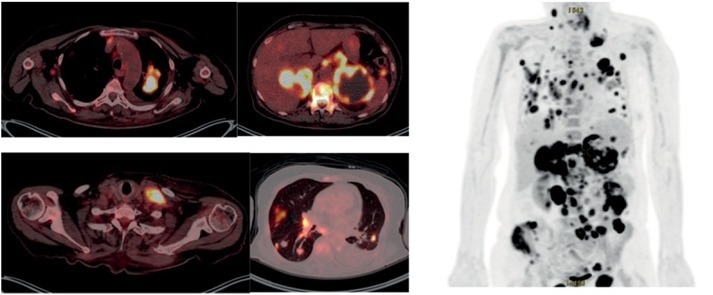
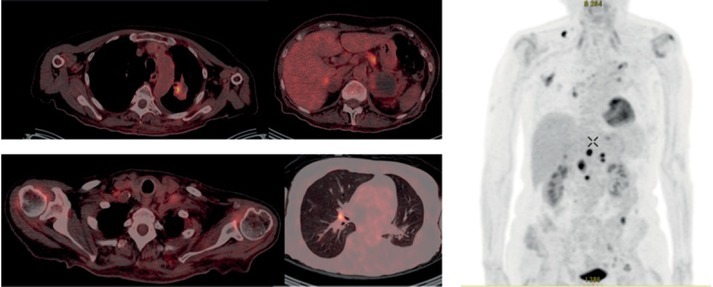
Background Uncommon response during immunotherapy is a new challenging issue in oncology practice. Recently, new criteria for evaluation of response to immunotherapy immune response evaluation criteria in solid tumors (iRECIST) were accepted. According to iRECIST, worsening of performance status (PS) accompanied to pseudoprogression reflects most probably the true progression of the malignant disease. Methods A systematic review of the literature was made by using several electronic database with the following search criteria: symptomatic pseudoprogression, atypical response, immunotherapy and lung cancer. Results In the literature, we identified five reports of seven patients treated with immunotherapy that met the inclusion criteria. We also report our experience of patient with pseudoprogression and almost complete response after one dose of immunotherapy. Conclusions As seen from our review, iRECIST criteria might be insufficient in distinguishing true progression from pseudoprogression in some patients with advanced NSCLC treated with immunotherapy. More precise assessment methods are urgently needed.
免疫治疗期间出现的罕见反应是肿瘤学实践中一个新的具有挑战性的问题。最近,实体瘤免疫治疗反应评估的新标准——实体瘤免疫反应评估标准(iRECIST)被采纳。根据iRECIST,伴随假性进展的体能状态(PS)恶化很可能反映了恶性疾病的真正进展。方法:通过使用几个电子数据库,按照以下检索标准对文献进行系统综述:症状性假性进展、非典型反应、免疫治疗和肺癌。结果:在文献中,我们确定了7例接受免疫治疗且符合纳入标准的患者的5份报告。我们还报告了1例接受一剂免疫治疗后出现假性进展且几乎完全缓解的患者的情况。结论:从我们的综述可以看出,iRECIST标准在区分接受免疫治疗的一些晚期非小细胞肺癌患者的真正进展和假性进展方面可能不够充分。迫切需要更精确的评估方法。