Hughes Matthew E, Nkyekyer Joanna, Innes-Brown Hamish, Rossell Susan L, Sly David, Bhar Sunil, Pipingas Andrew, Hennessy Alison, Meyer Denny
Centre for Mental Health, School of Health Sciences, Swinburne University of Technology, Hawthorn, Australia.
School of Health Sciences, Swinburne University of Technology, Hawthorn, Australia.
JMIR Res Protoc. 2018 Oct 26;7(10):e174. doi: 10.2196/resprot.9916.
Older adults with postlingual sensorineural hearing loss (SNHL) exhibit a poor prognosis that not only includes impaired auditory function but also rapid cognitive decline, especially speech-related cognition, in addition to psychosocial dysfunction and an increased risk of dementia. Consistent with this prognosis, individuals with SNHL exhibit global atrophic brain alteration as well as altered neural function and regional brain organization within the cortical substrates that underlie auditory and speech processing. Recent evidence suggests that the use of hearing aids might ameliorate this prognosis.
The objective was to study the effects of a hearing aid use intervention on neurocognitive and psychosocial functioning in individuals with SNHL aged ≥55 years.
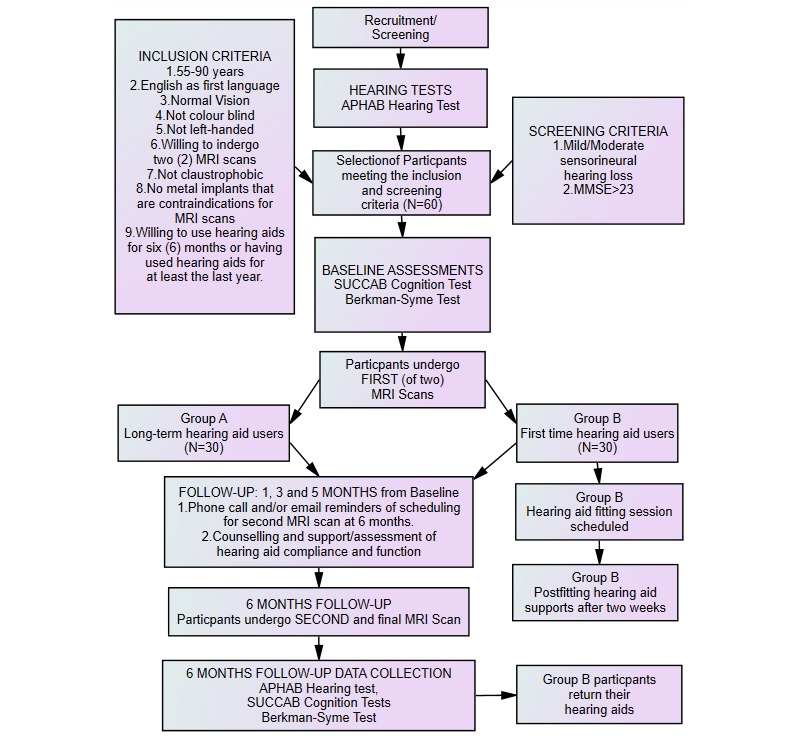
All aspects of this study will be conducted at Swinburne University of Technology (Hawthorn, Victoria, Australia). We will recruit 2 groups (n=30 per group) of individuals with mild to moderate SNHL from both the community and audiology health clinics (Alison Hennessy Audiology, Chelsea Hearing Pty Ltd). These groups will include individuals who have worn a hearing aid for, at least, 12 months or never worn a hearing aid. All participants would be asked to complete, at 2 time points (t) including baseline (t=0) and follow-up (t=6 months), tests of hearing and psychosocial and cognitive function and attend a magnetic resonance imaging (MRI) session. The MRI session will include both structural and functional MRI (sMRI and fMRI) scans, the latter involving the performance of a novel speech processing task.
This research is funded by the Barbara Dicker Brain Sciences Foundation Grants, the Australian Research Council, Alison Hennessy Audiology, and Chelsea Hearing Pty Ltd under the Industry Transformation Training Centre Scheme (ARC Project #IC140100023). We obtained the ethics approval on November 18, 2017 (Swinburne University Human Research Ethics Committee protocol number SHR Project 2017/266). The recruitment began in December 2017 and will be completed by December 2020.
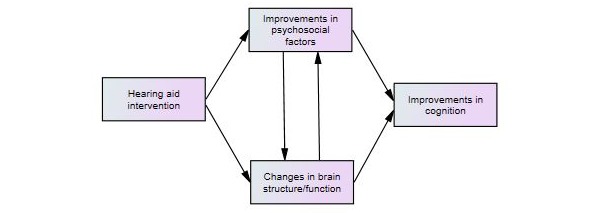
This is the first study to assess the effect hearing aid use has on neural, cognitive, and psychosocial factors in individuals with SNHL who have never used hearing aids. Furthermore, this study is expected to clarify the relationships among altered brain structure and function, psychosocial factors, and cognition in response to the hearing aid use.
Australian New Zealand Clinical Trials Registry: ACTRN12617001616369; https://anzctr.org.au/Trial/Registration/TrialReview.aspx?ACTRN=12617001616369 (Accessed by WebCite at http://www.webcitation.org/70yatZ9ze).
INTERNATIONAL REGISTERED REPORT IDENTIFIER (IRRID): RR1-10.2196/9916.
患有语后感觉神经性听力损失(SNHL)的老年人预后较差,不仅包括听觉功能受损,还包括认知能力迅速下降,尤其是与言语相关的认知能力,此外还有心理社会功能障碍以及患痴呆症的风险增加。与这种预后情况一致,患有SNHL的个体表现出全脑萎缩性脑改变,以及在听觉和言语处理基础的皮质基质内神经功能和区域脑组织结构的改变。最近的证据表明,使用助听器可能会改善这种预后。
研究使用助听器干预对年龄≥55岁的SNHL个体的神经认知和心理社会功能的影响。
本研究的所有方面将在斯威本科技大学(澳大利亚维多利亚州霍索恩)进行。我们将从社区和听力健康诊所(艾莉森·轩尼诗听力诊所、切尔西听力私人有限公司)招募2组(每组n = 30)轻度至中度SNHL个体。这些组将包括至少佩戴助听器12个月或从未佩戴过助听器的个体。所有参与者将被要求在2个时间点(t)完成听力、心理社会和认知功能测试,包括基线(t = 0)和随访(t = 6个月),并参加一次磁共振成像(MRI)检查。MRI检查将包括结构和功能MRI(sMRI和fMRI)扫描,后者涉及一项新颖的言语处理任务的执行。
本研究由芭芭拉·迪克大脑科学基金会资助、澳大利亚研究理事会、艾莉森·轩尼诗听力诊所和切尔西听力私人有限公司根据产业转型培训中心计划(ARC项目编号IC140100023)提供资金。我们于2017年11月18日获得伦理批准(斯威本科技大学人类研究伦理委员会协议编号SHR项目2017/266)。招募工作于2017年12月开始,将于2020年12月完成。
这是第一项评估使用助听器对从未使用过助听器的SNHL个体的神经、认知和心理社会因素影响的研究。此外,本研究有望阐明因使用助听器而导致的脑结构和功能改变、心理社会因素与认知之间的关系。
澳大利亚新西兰临床试验注册中心:ACTRN12617001616369;https://anzctr.org.au/Trial/Registration/TrialReview.aspx?ACTRN=12617001616369(通过WebCite于http://www.webcitation.org/70yatZ9ze访问)。
国际注册报告识别码(IRRID):RR1-10.2196/9916。