Tistad Malin, Lundell Sara, Wiklund Maria, Nyberg André, Holmner Åsa, Wadell Karin
Unit of Physiotherapy, Department of Community Medicine and Rehabilitation, Umeå University, Umeå, Sweden.
School of Education, Health and Social Studies, Dalarna University, Falun, Sweden.
JMIR Hum Factors. 2018 Oct 26;5(4):e10801. doi: 10.2196/10801.
New strategies are urgently needed to support self-management for people with chronic obstructive pulmonary disease (COPD) in primary care. The use of electronic health (eHealth) solutions is promising. However, there is a lack of knowledge about how such eHealth tools should be designed in order to be perceived as relevant and useful and meet the needs and expectations of the health professionals as well as people with COPD and their relatives.
The objective of this study was to explore the aspects of an eHealth tool design and content that make it relevant and useful for supporting COPD-related self-management strategies from the perspective of health care professionals, people with COPD and their relatives, and external researchers.
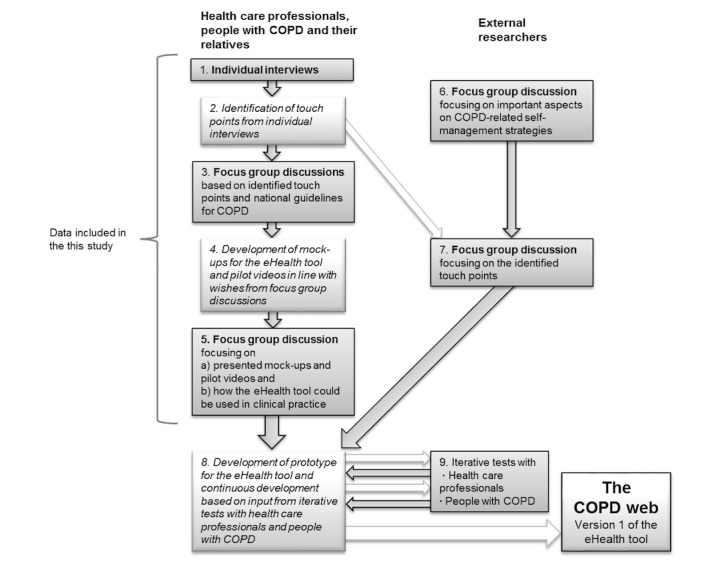
Data were collected during the development of an eHealth tool. A cocreation process was carried out with participants from two primary care units in northern Sweden and external researchers. Individual interviews were performed with health care professionals (n=13) as well as people with COPD (n=6) and their relatives (n=2), and focus group discussions (n=9) were held with all groups of participants. Data were analyzed using qualitative content analysis.
The overarching theme, reinforcing existing support structures, reflects participant views that the eHealth tool needs to be directly applicable and create a sense of commitment in users. Moreover, participants felt that the tool needs to fit with existing routines and contexts and preferably should not challenge existing hierarchies between health care professionals and people with COPD. Important content for health care professionals and people with COPD included knowledge about self-management strategies. Videos were regarded as the most effective method for communicating such knowledge.
The cocreation in the development process enables participant perspectives and priorities to be built into the eHealth tool. This is assumed to contribute to a tool that is useful and relevant and, therefore, adopted into clinical practice and everyday life. Findings from this study can inform the development of eHealth tools for people with COPD in other contexts, as well as the development of eHealth tools for self-management support of other chronic diseases.
在初级医疗保健中,迫切需要新策略来支持慢性阻塞性肺疾病(COPD)患者的自我管理。电子健康(eHealth)解决方案的应用前景广阔。然而,对于如何设计此类eHealth工具,使其被视为相关且有用,并满足医疗保健专业人员、COPD患者及其亲属的需求和期望,目前仍缺乏了解。
本研究的目的是从医疗保健专业人员、COPD患者及其亲属以及外部研究人员的角度,探索eHealth工具设计和内容中使其与支持COPD相关自我管理策略相关且有用的方面。
在一个eHealth工具的开发过程中收集数据。与瑞典北部两个初级医疗保健单位的参与者以及外部研究人员开展了共同创建过程。对医疗保健专业人员(n = 13)、COPD患者(n = 6)及其亲属(n = 2)进行了个体访谈,并与所有参与者群体进行了焦点小组讨论(n = 9)。使用定性内容分析法对数据进行分析。
总体主题“强化现有支持结构”反映了参与者的观点,即eHealth工具需要直接适用并在用户中营造一种参与感。此外,参与者认为该工具需要符合现有常规和背景,最好不应挑战医疗保健专业人员与COPD患者之间现有的层级关系。对医疗保健专业人员和COPD患者而言,重要内容包括自我管理策略的知识。视频被视为传播此类知识的最有效方法。
开发过程中的共同创建能够将参与者的观点和优先事项融入eHealth工具。这被认为有助于打造一个有用且相关的工具,从而被应用于临床实践和日常生活。本研究结果可为其他背景下针对COPD患者的eHealth工具开发提供参考,也可为其他慢性病自我管理支持的eHealth工具开发提供参考。