Lee Jaerim, Kang Sieun
1Department of Child Development and Family Studies and the Research Institute of Human Ecology, Seoul National University, Seoul, Republic of Korea.
2Department of Child Development and Family Studies, Seoul National University, 1 Gwanak-ro Gwanak-gu, Seoul, 08826 Republic of Korea.
J Child Fam Stud. 2018;27(11):3672-3686. doi: 10.1007/s10826-018-1193-2. Epub 2018 Jul 21.
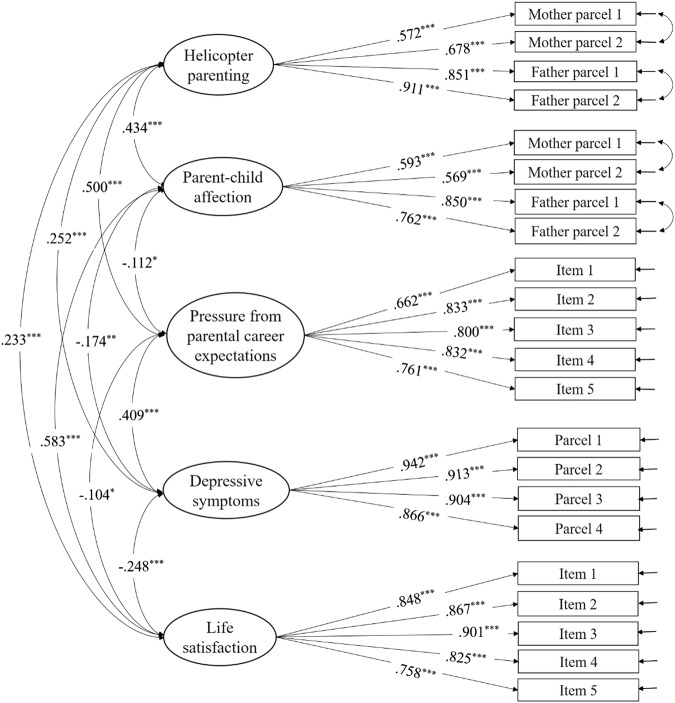
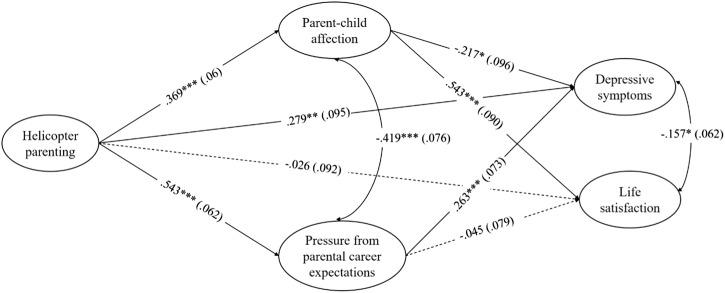
Examining helicopter parenting in a Confucian culture that values parental authority and involvement can extend previous helicopter parenting research that has mostly focused on a U.S. college student context. In this study, we aim to help clarify the mixed results in the literature regarding the psychological outcomes of helicopter parenting in emerging adulthood by examining the processes underlying the relationship between helicopter parenting and psychological adjustment in the Korean context. Using a diverse sample of Korean emerging adults, we investigated the relationships among perceived helicopter parenting, parent-child affection, pressure from parental career expectations, and psychological adjustment (depressive symptoms and life satisfaction). The data came from 562 Korean emerging adults (269 women and 293 men) aged 19-34 years who were either full-time students or unemployed and unmarried and had at least one living parent. The structural equation modeling used in this study revealed that higher levels of helicopter parenting were directly associated with greater depressive symptoms. Higher levels of helicopter parenting also had an indirect relationship with greater depressive symptoms through higher levels of pressure from parental career expectations. However, higher levels of helicopter parenting were indirectly linked to better psychological adjustment (fewer depressive symptoms, greater satisfaction with life) through higher levels of parent-child affection. Our results indicate that in the East Asian context, helicopter parenting could be related to both negative and positive psychological outcomes depending on the mediating factors.
在一个重视家长权威和参与的儒家文化背景下审视直升机式育儿方式,能够拓展此前主要聚焦于美国大学生群体的直升机式育儿研究。在本研究中,我们旨在通过探究韩国背景下直升机式育儿与心理调适之间关系的潜在过程,来帮助厘清文献中关于成年初期直升机式育儿心理结果的复杂研究结果。我们以韩国成年初期的多样化样本为对象,调查了感知到的直升机式育儿、亲子情感、来自父母职业期望的压力以及心理调适(抑郁症状和生活满意度)之间的关系。数据来自562名年龄在19至34岁之间的韩国成年初期人群(269名女性和293名男性),他们要么是全日制学生,要么处于失业未婚状态,且至少有一位在世的父母。本研究中使用的结构方程模型显示,更高水平的直升机式育儿与更严重的抑郁症状直接相关。更高水平的直升机式育儿还通过来自父母职业期望的更高压力与更严重的抑郁症状存在间接关系。然而,更高水平的直升机式育儿通过更高水平的亲子情感与更好的心理调适(更少的抑郁症状、更高的生活满意度)存在间接联系。我们的研究结果表明,在东亚背景下,直升机式育儿根据中介因素的不同可能与消极和积极的心理结果都有关系。