Unit of Clinical Neurophysiology, Satakunta Central Hospital, Pori, Finland.
Unit of Neurology, Satakunta Central Hospital, Pori, Finland.
Brain Behav. 2018 Dec;8(12):e01146. doi: 10.1002/brb3.1146. Epub 2018 Oct 29.
Sleep-Disordered Breathing (SDB) is frequent in stroke patients. Polysomnography (PSG) and cardiorespiratory polygraphy are used to confirm SDB, but the need for PSG exceeds the available resources for systematic testing. Therefore, a simple and robust pre-screening instrument is necessary to identify the patients with an urgent need for a targeted PSG. The aim of this systematic review was to identify and evaluate the available methods to pre-screen stroke patients possibly suffering from SDB.
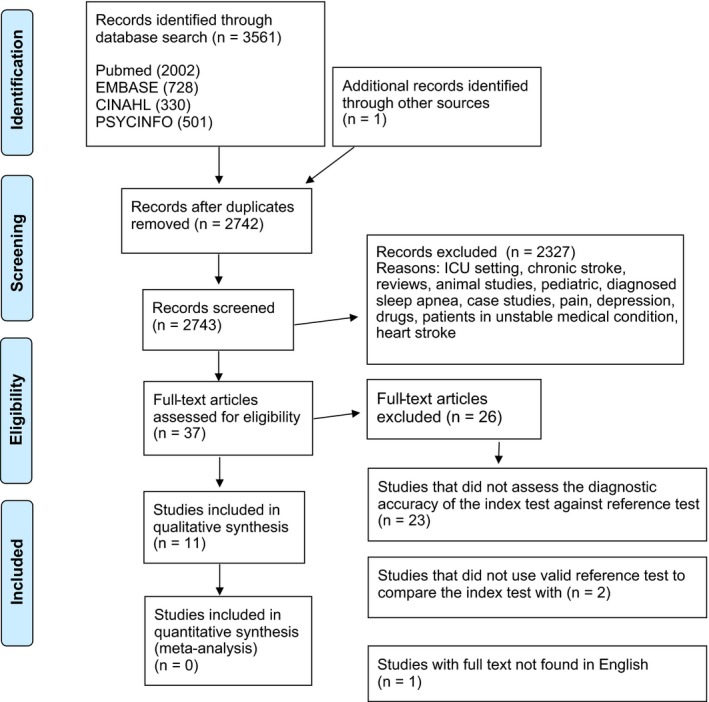
Eleven studies out of 3,561 studies met the inclusion criteria. The selected studies assessed the efficiency of seven instruments based on the data acquired clinically or by inquiries (Berlin Questionnaire, Epworth Sleepiness Scale, SOS, Modified Sleep Apnea Scale of the Sleep Disorders Questionnaire, STOP-BANG, Four-variable Screening Tool and Multivariate Apnea Index) and three physiological measures (capnography, nocturia, nocturnal oximetry). The instruments were used to predict SDB in patients after acute or subacute stroke. Either PSG or cardiorespiratory polygraphy was used as a standard to measure SDB.
No independent studies using the same questionnaires, methods or criteria were published reducing generalizability. Overall, the questionnaires were quite sensitive in finding SDB but not highly specific in identifying the non-affected. The physiological measures (capnography) indicated promising results in predicting SDB, but capnography is not an ideal pre-screening instrument as it requires a specialist to interpret the results.
The results of pre-screening of SDB in acute and subacute stroke patients are promising but inconsistent. The current pre-screening methods cannot readily be referred to clinicians in neurologic departments. Thus, it is necessary to conduct more research on developing novel pre-screening methods for detecting SDB after stroke.
睡眠呼吸障碍(SDB)在中风患者中很常见。多导睡眠图(PSG)和心肺多导睡眠描记术用于确认 SDB,但 PSG 的需求超过了系统测试的可用资源。因此,需要一种简单而强大的预筛选仪器来识别急需进行针对性 PSG 的患者。本系统评价的目的是确定和评估现有的方法,以预筛选可能患有 SDB 的中风患者。
从 3561 项研究中筛选出 11 项符合纳入标准的研究。所选研究评估了基于临床或询问获得的数据的七种仪器的效率(柏林问卷、嗜睡量表、SOS、睡眠障碍问卷的改良睡眠呼吸暂停量表、STOP-BANG、四变量筛选工具和多变量呼吸暂停指数)和三种生理测量(呼吸描记术、夜尿症、夜间血氧饱和度)。这些仪器用于预测急性或亚急性中风后患者的 SDB。PSG 或心肺多导睡眠描记术被用作测量 SDB 的标准。
没有发表使用相同问卷、方法或标准的独立研究,从而降低了研究的普遍性。总体而言,这些问卷在发现 SDB 方面相当敏感,但在识别非受影响者方面特异性不高。生理测量(呼吸描记术)表明在预测 SDB 方面有希望的结果,但呼吸描记术不是一种理想的预筛选仪器,因为它需要专家来解释结果。
急性和亚急性中风患者 SDB 的预筛选结果有希望但不一致。目前的预筛选方法不能直接提供给神经科医生。因此,有必要开展更多关于开发新型 SDB 检测方法的研究。