Center for AIDS/STD Control and Prevention, Sichuan Provincial Center for Disease Control and Prevention, Sichuan, China.
Center for AIDS/STD Control and Prevention, Guangyuan Municipal Center for Disease Control and Prevention, Gunagyuan, China.
Sci Rep. 2018 Oct 30;8(1):16046. doi: 10.1038/s41598-018-33996-6.
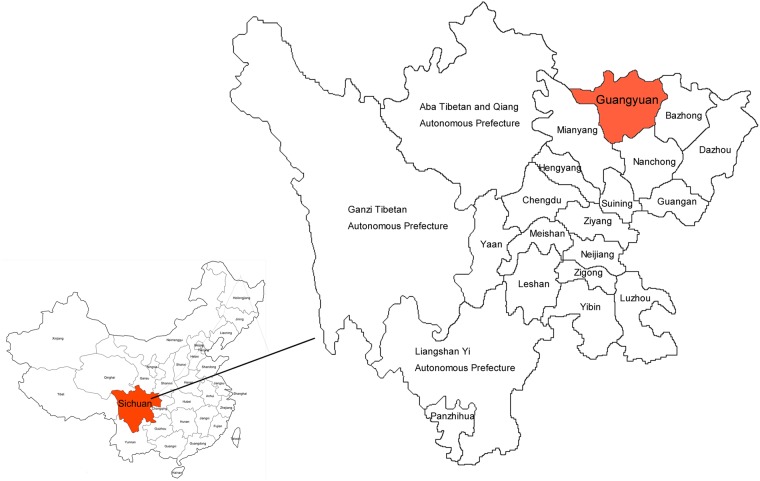
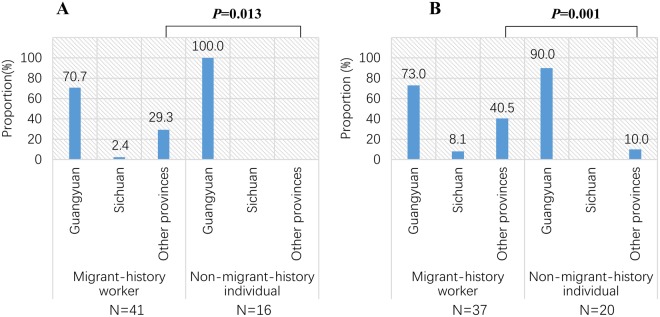
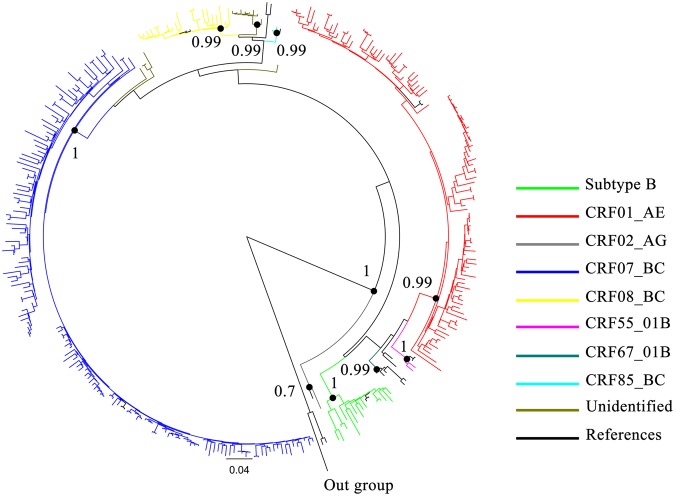
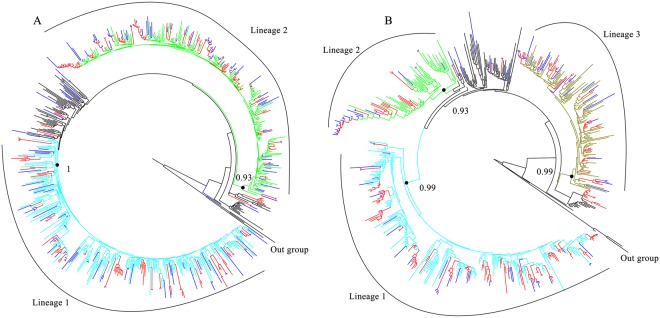
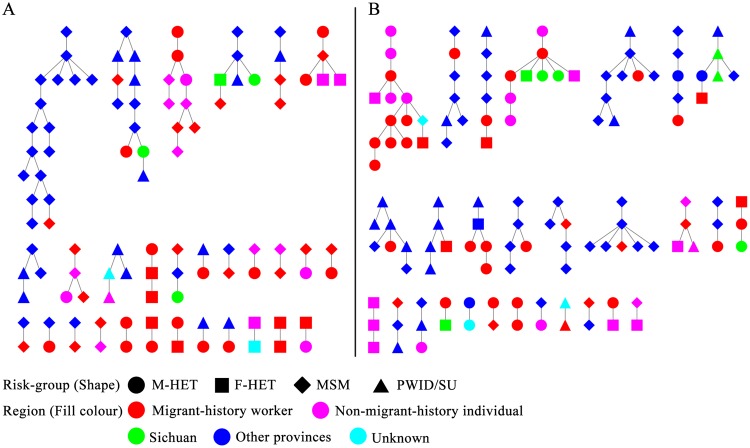
We aimed to investigate the molecular epidemic characteristics and viral transmission patterns of HIV-1 in a typical labor export area, Guangyuan city, China. Based on conducting phylogenetic trees and molecular transmission networks, a phylogenetic analysis was performed on HIV-1 pol sequences obtained from 211 migrant-history workers, 83 non-migrant-history individuals, and 21 migrant-history unknown individuals between January, 2012 and February, 2017 in Guangyuan city. Phylogenetic analysis revealed that CRF07_BC (48.3%, n = 152) and CRF01_AE (33.3%, n = 105) were the dominant strains in Guangyuan city, and circulated by multiple lineages with various epidemic characteristics. Geographic network analysis showed that Guangyuan city-related sequences with 20.3% CRF07_BC and 28.3% CRF01_AE were linked to that of other provinces, compared to that with 1.7% CRF07_BC and 5.0% CRF01_AE in cities of Sichuan. Molecular transmission network analysis further illustrated that migrant-history workers linked more sequences from other provinces than non-migrant-history individuals in both CRF07_BC (29.3% versus 0.0%, P = 0.013) and CRF01_AE (40.5% versus 10.0%, P = 0.001) networks. Our results highlighted that migrant-history workers in recent year played a vital role in fueling HIV-1 epidemic in Guangyuan city. Molecular transmission network analysis could be a useful approach for disclosing the transmission mechanism of HIV, which should be used in prevention and intervention efforts.
本研究旨在调查中国典型劳务输出地区广元市 HIV-1 的分子流行特征和病毒传播模式。基于对 2012 年 1 月至 2017 年 2 月在广元市采集的 211 名有移民史的劳务工人、83 名无移民史的个体和 21 名移民史未知个体的 HIV-1 pol 序列进行系统进化树和分子传播网络分析,结果显示 CRF07_BC(48.3%,n=152)和 CRF01_AE(33.3%,n=105)是广元市的主要流行株,存在多种具有不同流行特征的传播谱系。地理网络分析显示,与四川省内城市相比,广元市相关序列中 20.3%的 CRF07_BC 和 28.3%的 CRF01_AE 与其他省份有关,而四川省内城市仅分别为 1.7%和 5.0%。分子传播网络分析进一步表明,在 CRF07_BC(29.3%对 0.0%,P=0.013)和 CRF01_AE(40.5%对 10.0%,P=0.001)网络中,有移民史的劳务工人与其他省份的个体相连的序列多于无移民史的个体。这些结果突出表明,近年来有移民史的劳务工人在广元市 HIV-1 流行中发挥了重要作用。分子传播网络分析可能是揭示 HIV 传播机制的一种有用方法,应将其应用于预防和干预措施中。