Andrade Juliana Mara, Duarte Yeda Aparecida de Oliveira, Alves Luciana Correia, Andrade Flávia Cristina Drumond, Souza Junior Paulo Roberto Borges de, Lima-Costa Maria Fernanda, Andrade Fabíola Bof de
Fundação Oswaldo Cruz. Instituto René Rachou. Programa de Pós-Graduação em Saúde Coletiva. Belo Horizonte, MG, Brasil.
Fundação Oswaldo Cruz. Instituto René Rachou. Núcleo de Estudos em Saúde Pública e Envelhecimento. Belo Horizonte, MG, Brasil.
Rev Saude Publica. 2018 Oct 25;52Suppl 2(Suppl 2):17s. doi: 10.11606/S1518-8787.2018052000616.
To estimate the prevalence of frailty and to evaluate the associated factors in the non-institutionalized Brazilian population aged 50 years or older.
The analyses were conducted in 8,556 participants of the baseline survey of the Longitudinal Study of Health of the Brazilian Elderly (ELSI-Brazil) conducted in 2015 and 2016. Frailty was defined based on five characteristics: weight loss, weakness, slowness, exhaustion and low level of physical activity. Participants with three or more characteristics were classified as frail. A Poisson regression model was used to examine the association between frailty and sociodemographic and health factors.
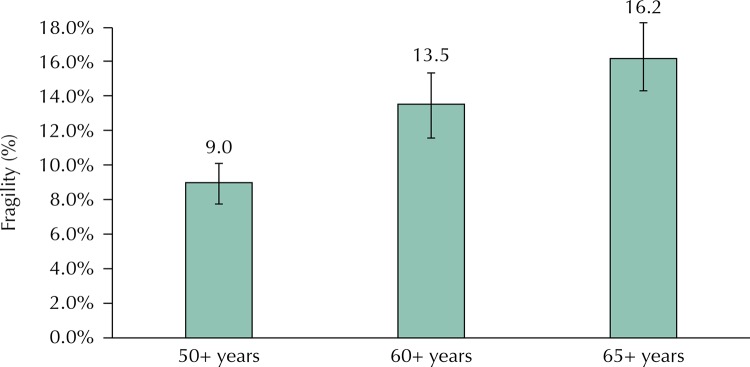
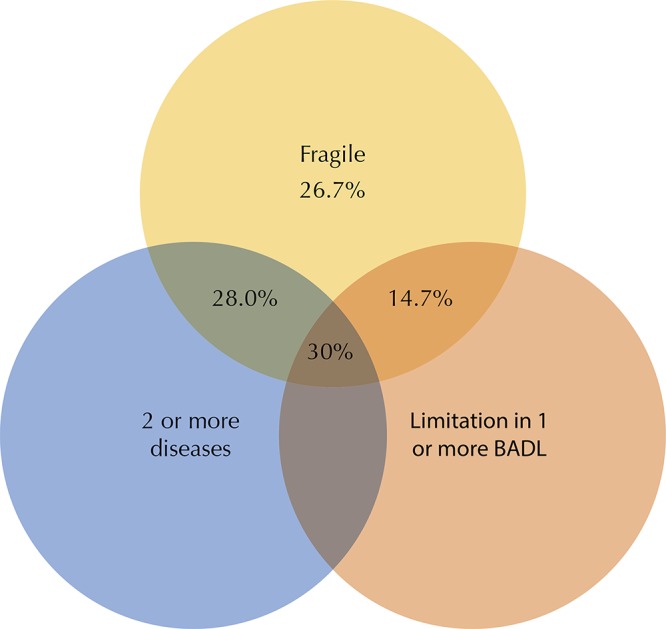
The prevalence of frailty was 9.0% (95%CI 8.0-10.1) among participants aged 50 years or over. Among the older adults aged 60 or over, the prevalence was 13.5% (95%CI 11.9-15.3) and 16.2% (95%CI 14.3-18.3) among those 65 aged years or over. Factors associated with higher prevalence of frailty were low schooling, residence without a partner, health conditions (poor self-rated health and two or more chronic diseases) and limitation to perform basic activities of daily living.
The prevalence of frailty among Brazilians aged 65 years or older is similar to their European counterparts. Poor health conditions, functional limitation and low schooling emerge as the factors most strongly associated with the frailty in this population.
评估巴西50岁及以上非机构化人群中衰弱的患病率,并评估相关因素。
分析纳入了2015年和2016年巴西老年人健康纵向研究(ELSI-巴西)基线调查的8556名参与者。根据体重减轻、虚弱、行动迟缓、疲惫和身体活动水平低这五个特征来定义衰弱。具有三个或更多特征的参与者被归类为衰弱。采用泊松回归模型来检验衰弱与社会人口学和健康因素之间的关联。
50岁及以上参与者中衰弱的患病率为9.0%(95%CI 8.0 - 10.1)。在60岁及以上的老年人中,患病率为13.5%(95%CI 11.9 - 15.3),在65岁及以上人群中为16.2%(95%CI 14.3 - 18.3)。与衰弱患病率较高相关的因素包括受教育程度低、没有伴侣同住、健康状况(自我评估健康状况差和患有两种或更多种慢性病)以及进行日常生活基本活动受限。
巴西65岁及以上人群中衰弱的患病率与欧洲同龄人相似。健康状况差、功能受限和受教育程度低是该人群中与衰弱最密切相关的因素。