Department of Epidemiology, Johns Hopkins Bloomberg School of Public Health, Baltimore, Maryland.
Division of Infectious Diseases, Northwestern University Feinberg School of Medicine, Chicago, Illinois.
AIDS. 2018 Nov 13;32(17):2547-2556. doi: 10.1097/QAD.0000000000001986.
Ongoing HIV replication while receiving combination antiretroviral therapy (cART) may reduce survival. Viremia copy-years (VCY) has shown improved mortality risk prediction over single time-point viral load measures. However, the timing of a patient's viral load history most associated with later mortality has not been studied. Here we determined the optimal duration and temporality of viral load history for predicting mortality.
Survival analysis among HIV-positive men who initiated cART in the Multicenter AIDS Cohort Study (1995-2015).
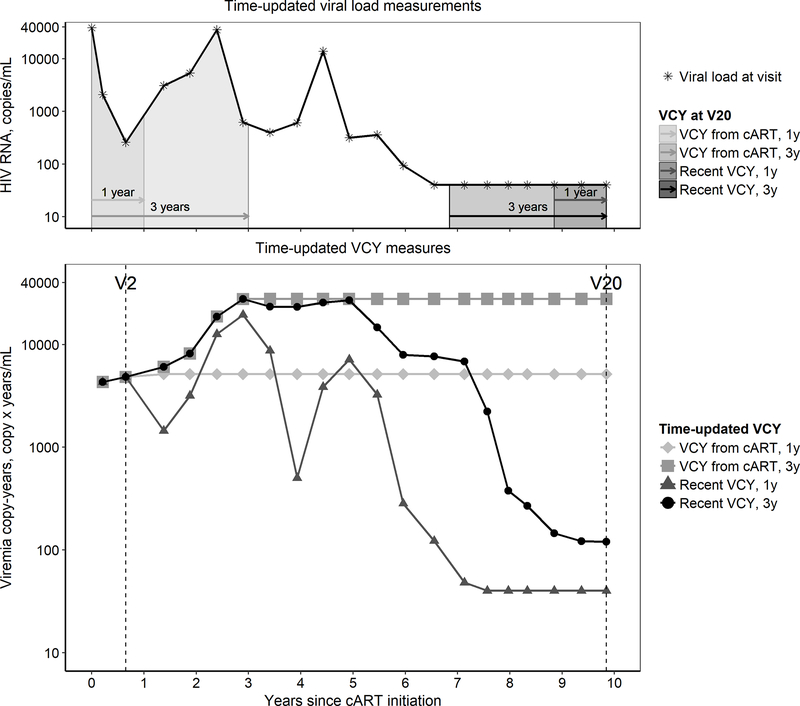
VCY measures were derived from area-under-the-viral load-curve. The overall VCY based upon the complete post-cART viral load history was compared with 20 VCYs derived from viral loads assessed during different shorter time periods (the most recent 1-10 years and initial 1-10 years following cART initiation) for associations with mortality.
Each 10-fold increase in VCYs based on the most recent 3-8 years was significantly associated with 23-26% decrease in survival times, a magnitude of effect greater than that of the most recent viral load (16%). These associations were independent of CD4 cell count and single time-point viral loads. In addition, the degree of pre-cART immunodeficiency did not affect the mortality prognostic value of VCY based on viral loads in the most recent 3 years. Conversely, the overall VCY and VCYs based on viral loads immediately following cART initiation were not independent predictors of mortality.
Among cART-treated men, VCY based upon viral loads in the recent 3 years (six viral loads) has a mortality prognostic value greater than that of the overall VCY and single time-point viral loads, making the former a more feasible measure for use.
在接受联合抗逆转录病毒治疗(cART)时持续的 HIV 复制可能会降低生存率。病毒载量复制年(VCY)已显示出优于单一时间点病毒载量测量的改善死亡率风险预测。然而,与死亡率最相关的患者病毒载量史的时间尚未研究。在这里,我们确定了预测死亡率的最佳病毒载量史的持续时间和时间性。
在多中心艾滋病队列研究(1995-2015 年)中接受 cART 治疗的 HIV 阳性男性的生存分析。
VCY 测量值来自病毒载量曲线下面积。基于整个 post-cART 病毒载量史的总体 VCY 与基于不同较短时间段(最近 1-10 年和 cART 开始后最初 1-10 年)评估的 20 个 VCY 进行比较,以评估与死亡率的相关性。
基于最近 3-8 年的 VCY 每增加 10 倍,与生存时间减少 23-26%显著相关,其效应大小大于最近的病毒载量(16%)。这些关联独立于 CD4 细胞计数和单一时间点病毒载量。此外,cART 前免疫缺陷的程度并不影响基于最近 3 年病毒载量的 VCY 对死亡率的预后价值。相反,基于 cART 开始后立即的病毒载量的总体 VCY 和 VCY 不是死亡率的独立预测因素。
在接受 cART 治疗的男性中,基于最近 3 年(6 个病毒载量)的病毒载量的 VCY 具有比总体 VCY 和单一时间点病毒载量更大的死亡率预后价值,使其成为更可行的测量方法。