Boussios Stergios, Moschetta Michele, Karathanasi Afroditi, Tsiouris Alexandros K, Kanellos Foivos S, Tatsi Konstantina, Katsanos Konstantinos H, Christodoulou Dimitrios K
Medway NHS Foundation Trust, Kent, UK (Stergios Boussios, Afroditi Karathanasi).
Drug Development Unit, Sarah Cannon Research Institute, London, UK (Michele Moschetta).
Ann Gastroenterol. 2018 Nov-Dec;31(6):659-669. doi: 10.20524/aog.2018.0305. Epub 2018 Sep 14.
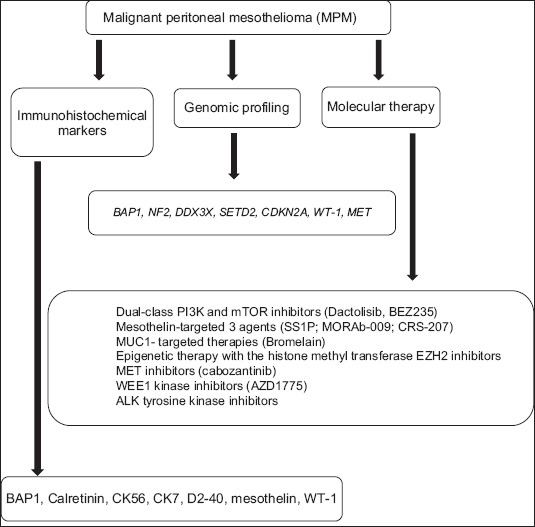
Malignant peritoneal mesothelioma (MPM) is a rare disease with a wide clinical spectrum. It arises from the peritoneal lining and commonly presents with diffuse, extensive spread throughout the abdomen and, more rarely, metastatic spread beyond the abdominal cavity. Computed tomography, magnetic resonance imaging and positron-emission tomography are important diagnostic tools used for the preoperative staging of MPM. The definitive diagnosis is based on histopathological analysis, mainly via immunohistochemistry. In this regard, negativity represents a useful diagnostic biomarker for differentiating MPM from ovarian carcinoma. In addition, loss is specific to MPM and allows it to be distinguished from both benign mesothelial lesions and ovarian serous tumors. Cytoreductive surgery (CRS) with hyperthermic intraperitoneal chemotherapy (HIPEC) has become an increasingly important therapeutic approach, while systemic therapies are still being developed. Histology, Ki-67, completeness of cytoreduction, age, sex, and baseline thrombocytosis are commonly used to optimize patient selection for CRS with HIPEC. Additionally, it is well recognized that, compared to other subtypes, an epithelial morphology is associated with a favorable prognosis, whereas baseline thrombocytosis predicts an aggressive biologicalbehavior. Platelets and other immunologic cytokines have been evaluated as potential novel therapeutic targets. Epigenetic modifiers, including BAP1, SETD2 and DDX3X, are crucial in mesothelial tumorigenesis and provide opportunities for targeted treatment. Overexpression of the closely interacting phosphoinositide 3-kinase (PI3K) and the mammalian target of rapamycin (mTOR) pathways appears crucial in regulation of the malignant phenotype. The use of targeted therapies with PI3K-mTOR-based inhibitors requires further clinical assessment as a novel approach.
恶性腹膜间皮瘤(MPM)是一种临床谱广泛的罕见疾病。它起源于腹膜衬里,通常表现为在整个腹部的弥漫性、广泛性扩散,更罕见的是超出腹腔的转移扩散。计算机断层扫描、磁共振成像和正电子发射断层扫描是用于MPM术前分期的重要诊断工具。明确诊断基于组织病理学分析,主要通过免疫组织化学。在这方面,阴性是将MPM与卵巢癌区分开来的有用诊断生物标志物。此外,[此处缺失内容]缺失是MPM特有的,使其能够与良性间皮病变和卵巢浆液性肿瘤区分开来。细胞减灭术(CRS)联合腹腔内热化疗(HIPEC)已成为一种越来越重要的治疗方法,而全身治疗仍在研发中。组织学、Ki-67、细胞减灭的完整性、年龄、性别和基线血小板增多症通常用于优化CRS联合HIPEC的患者选择。此外,众所周知,与其他亚型相比,上皮形态与良好的预后相关,而基线血小板增多症预示着侵袭性生物学行为。血小板和其他免疫细胞因子已被评估为潜在的新型治疗靶点。包括BAP1、SETD2和DDX3X在内的表观遗传修饰因子在间皮瘤发生中至关重要,并为靶向治疗提供了机会。密切相互作用的磷酸肌醇3激酶(PI3K)和哺乳动物雷帕霉素靶蛋白(mTOR)途径的过度表达似乎在恶性表型的调节中至关重要。使用基于PI3K-mTOR的抑制剂进行靶向治疗作为一种新方法需要进一步的临床评估。