a School of Pharmaceutical Science , Shanxi Medical University , Taiyuan , PR China.
b Shanxi Provincial Hospital of Traditional Chinese Medicine , Taiyuan , PR China.
Pharm Biol. 2018 Dec;56(1):528-534. doi: 10.1080/13880209.2018.1510974.
Selenium nanoparticles (SeNPs) have attracted worldwide attention due to their unique properties and potential bioactivities. Considering that hawthorn is both a traditional medicine and a common edible food, hawthorn fruit extract (HE) was chosen as a reductant to prepare SeNPs.
SeNPs were synthesized by using an aqueous HE as a reductant and stabilizer. The antitumor activities and potential mechanisms of SeNPs were explored by using a series of cellular assays.
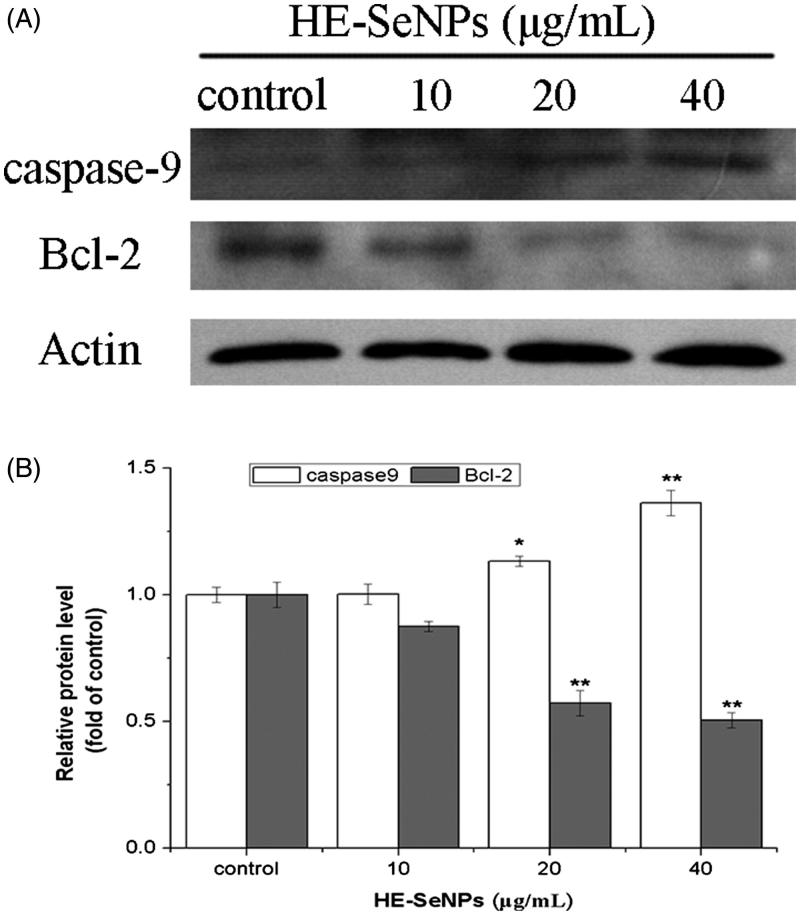
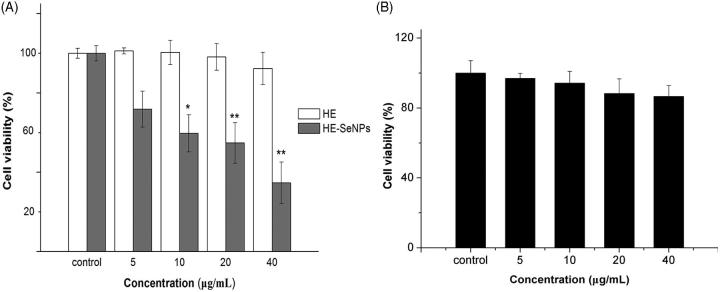
The HE mediated SeNPs (HE-SeNPs) were examined using various characterisation methods. The cytotoxicity was measured against HepG2 cells after treated with 0, 5, 10 and 20 μg/mL of HE-SeNPs for 24 h. Annexin V-FITC/PI staining analysis was performed to observe the apoptosis of HepG2 cells. Additionally, mitochondrial membrane potential (MMP), intracellular reactive oxygen species (ROS) levels were evaluated. Finally, the protein expression levels of caspase-9 and Bcl-2 were identified by Western blot.
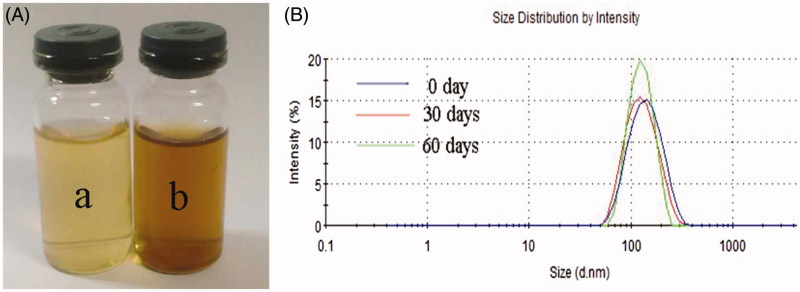
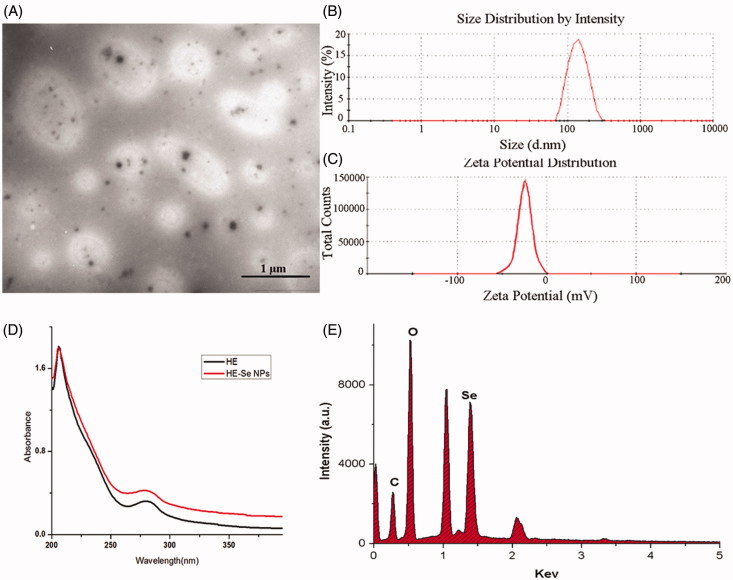
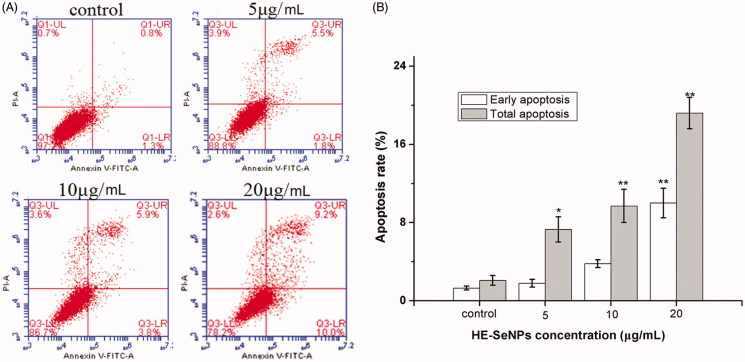
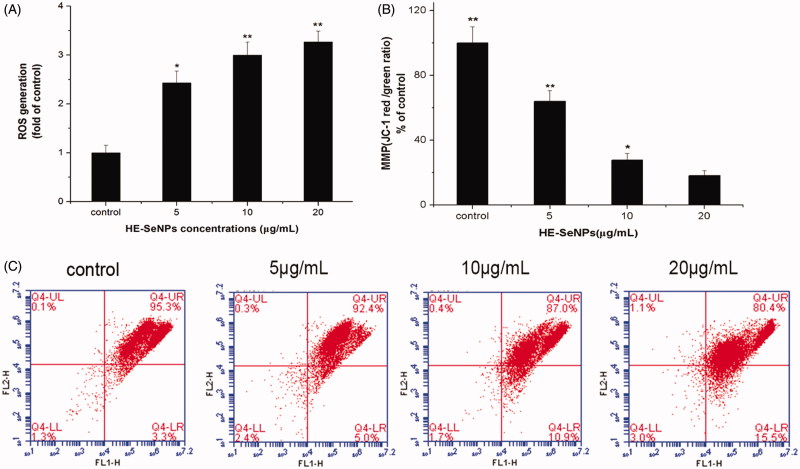
The mono-dispersed and stable SeNPs were prepared with an average size of 113 nm. HE-SeNPs showed obvious antitumor activities towards HepG2 cells with an IC of 19.22 ± 5.3 μg/mL. Results from flow cytometry revealed that both early and total apoptosis rates increased after treating with HE-SeNPs. After cells were treated with various concentrations of HE-SeNPs (5, 10 and 20 μg/mL) for 24 h, the total rate increased to 7.3 ± 0.5, 9.7 ± 1.7 and 19.2 ± 1.6%, respectively. Meanwhile, treatment of HE-SeNPs up-regulated intracellular ROS levels and reduced the MMP. In addition, HE-SeNPs induced the up-regulation of caspase-9 and down-regulation of Bcl-2.
HE-SeNPs induced intracellular oxidative stress and mitochondrial dysfunction to initiate HepG2 cell apoptosis through the mitochondrial pathway. Therefore, HE-SeNPs may be a candidate for further evaluation as a chemotherapeutic agent for human liver cancer.
由于具有独特的性质和潜在的生物活性,硒纳米粒子(SeNPs)引起了全世界的关注。考虑到山楂既是一种传统药物,也是一种常见的食用食品,因此选择山楂果提取物(HE)作为还原剂来制备 SeNPs。
使用水相 HE 作为还原剂和稳定剂合成 SeNPs。通过一系列细胞实验探讨了 SeNPs 的抗肿瘤活性及其潜在机制。
采用多种表征方法对 HE 介导的 SeNPs(HE-SeNPs)进行了检测。用 0、5、10 和 20μg/mL 的 HE-SeNPs 处理 HepG2 细胞 24h 后,测量细胞毒性。用 Annexin V-FITC/PI 染色分析观察 HepG2 细胞的凋亡。此外,还评估了线粒体膜电位(MMP)和细胞内活性氧(ROS)水平。最后,用 Western blot 法鉴定 caspase-9 和 Bcl-2 的蛋白表达水平。
制备出平均粒径为 113nm 的单分散、稳定的 SeNPs。HE-SeNPs 对 HepG2 细胞表现出明显的抗肿瘤活性,IC 为 19.22±5.3μg/mL。流式细胞术结果显示,用 HE-SeNPs 处理后,早期和总凋亡率均升高。用不同浓度的 HE-SeNPs(5、10 和 20μg/mL)处理细胞 24h 后,总凋亡率分别增加至 7.3±0.5%、9.7±1.7%和 19.2±1.6%。同时,HE-SeNPs 处理后细胞内 ROS 水平升高,MMP 降低。此外,HE-SeNPs 诱导 caspase-9 上调,Bcl-2 下调。
HE-SeNPs 通过线粒体途径诱导细胞内氧化应激和线粒体功能障碍,从而引发 HepG2 细胞凋亡。因此,HE-SeNPs 可能是作为人类肝癌化疗药物进一步评估的候选药物。