
识别在 AED 治疗 5 年内无法达到癫痫无发作的患者。
Identification of patients who will not achieve seizure remission within 5 years on AEDs.
机构信息
From the Departments of Biostatistics (D.M.H., L.J.B., G.C., M.G.-F.) and Molecular and Clinical Pharmacology (A.G.M.), Institute of Translational Medicine, and Department of Eye and Vision Science (G.C.), Institute of Ageing & Chronic Disease, University of Liverpool, UK; and Department of Probability and Mathematical Statistics (A.K.), Faculty of Mathematics and Physics, Charles University, Prague, Czech Republic.
出版信息
Neurology. 2018 Nov 27;91(22):e2035-e2044. doi: 10.1212/WNL.0000000000006564. Epub 2018 Nov 2.
OBJECTIVE
To identify people with epilepsy who will not achieve a 12-month seizure remission within 5 years of starting treatment.
METHODS
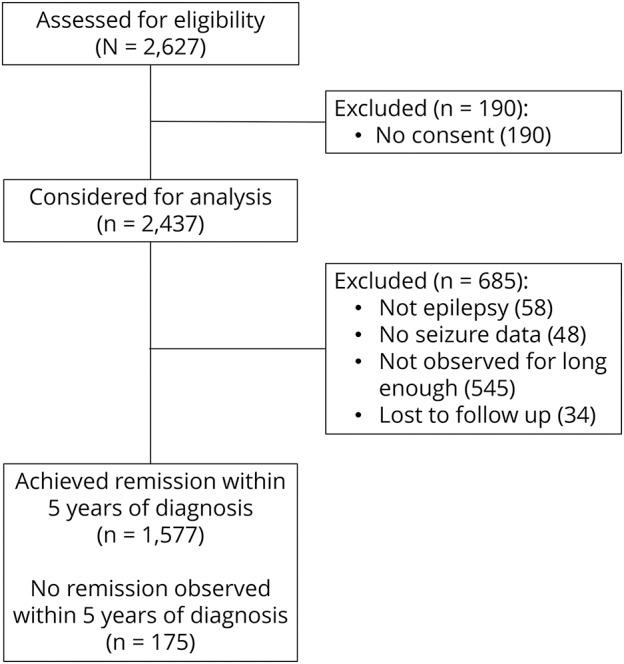
The Standard and New Antiepileptic Drug (SANAD) study is the largest prospective study in patients with epilepsy to date. We applied a recently developed multivariable approach to the SANAD dataset that takes into account not only baseline covariates describing a patient's history before diagnosis but also follow-up data as predictor variables.
RESULTS
Changes in number of seizures and treatment history were the most informative time-dependent predictors and were associated with history of neurologic insult, epilepsy type, age at start of treatment, sex, and having a first-degree relative with epilepsy. Our model classified 95% of patients. Of those classified, 95% of patients observed not to achieve remission at 5 years were correctly classified (95% confidence interval [CI] 89.5%-100%), with 51% identified by 3 years and 90% within 4 years of follow-up. Ninety-seven percent (95% CI 93.3%-98.8%) of patients observed to achieve a remission within 5 years were correctly classified. Of those predicted not to achieve remission, 76% (95% CI 58.5%-88.2%) truly did not achieve remission (positive predictive value). The predictive model achieved similar accuracy levels via external validation in 2 independent United Kingdom-based datasets.
CONCLUSION
Our approach generates up-to-date predictions of the patient's risk of not achieving seizure remission whenever new clinical information becomes available that could influence patient counseling and management decisions.
目的
确定在开始治疗后 5 年内无法实现 12 个月无癫痫发作缓解的癫痫患者。
方法
Standard and New Antiepileptic Drug(SANAD)研究是迄今为止针对癫痫患者进行的最大前瞻性研究。我们将最近开发的多变量方法应用于 SANAD 数据集,该方法不仅考虑了描述患者诊断前病史的基线协变量,还考虑了随访数据作为预测变量。
结果
发作次数的变化和治疗史是最具信息量的时间相关预测指标,与神经损伤史、癫痫类型、治疗开始时的年龄、性别以及一级亲属患有癫痫有关。我们的模型对 95%的患者进行了分类。在分类的患者中,95%未在 5 年内达到缓解的患者被正确分类(95%置信区间 [CI] 89.5%-100%),其中 51%在 3 年内和 90%在 4 年内被识别。97%(95%CI 93.3%-98.8%)观察到在 5 年内达到缓解的患者被正确分类。在预测未达到缓解的患者中,76%(95%CI 58.5%-88.2%)实际上未达到缓解(阳性预测值)。通过在两个独立的英国数据集上进行外部验证,该预测模型达到了类似的准确性水平。
结论
无论何时有新的临床信息可能影响患者咨询和管理决策,我们的方法都会生成关于患者无法达到癫痫发作缓解的风险的最新预测。


 Zotero 插件