Hughes David M, Komárek Arnošt, Bonnett Laura J, Czanner Gabriela, García-Fiñana Marta
Department of Biostatistics, University of Liverpool, Liverpool, U.K.
Department of Probability and Mathematical Statistics, Faculty of Mathematics and Physics, Charles University, Prague, Czech Republic.
Stat Med. 2017 Oct 30;36(24):3858-3874. doi: 10.1002/sim.7397. Epub 2017 Aug 1.
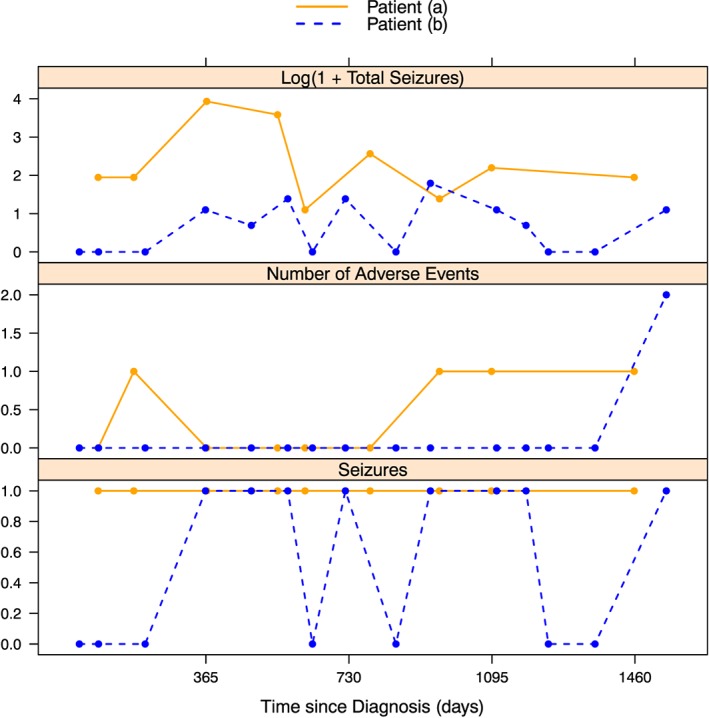
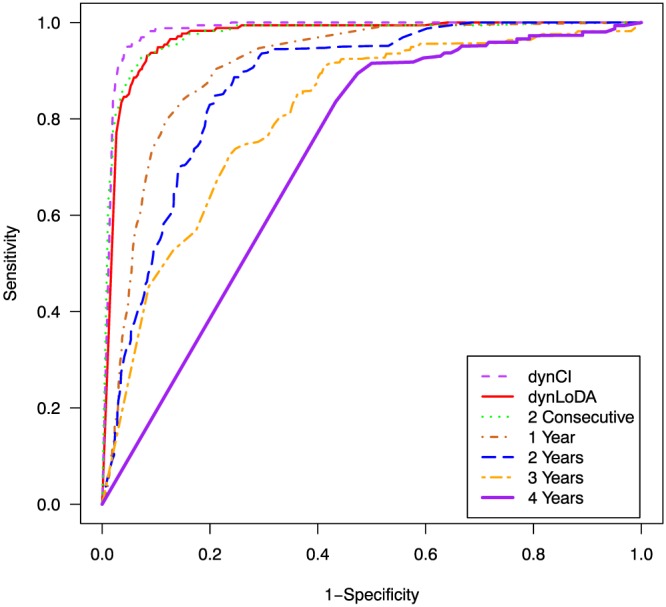
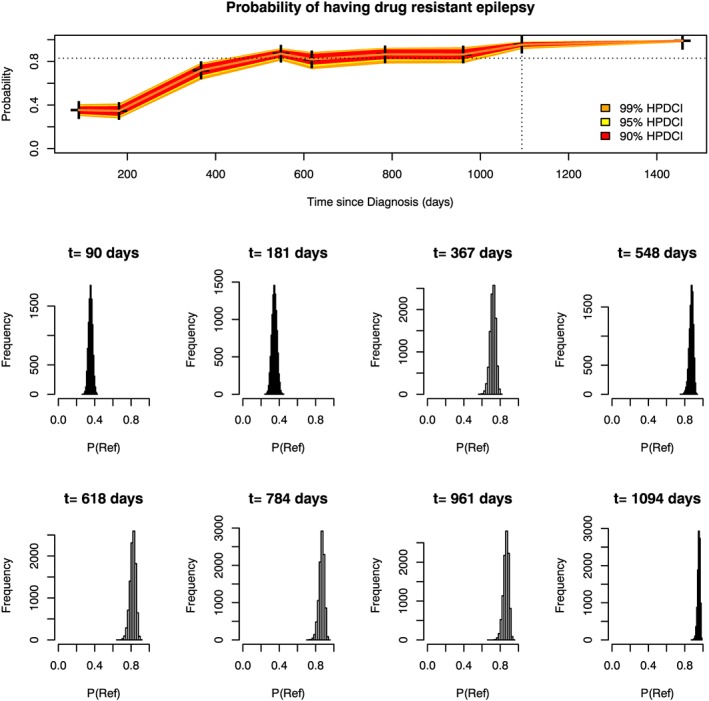
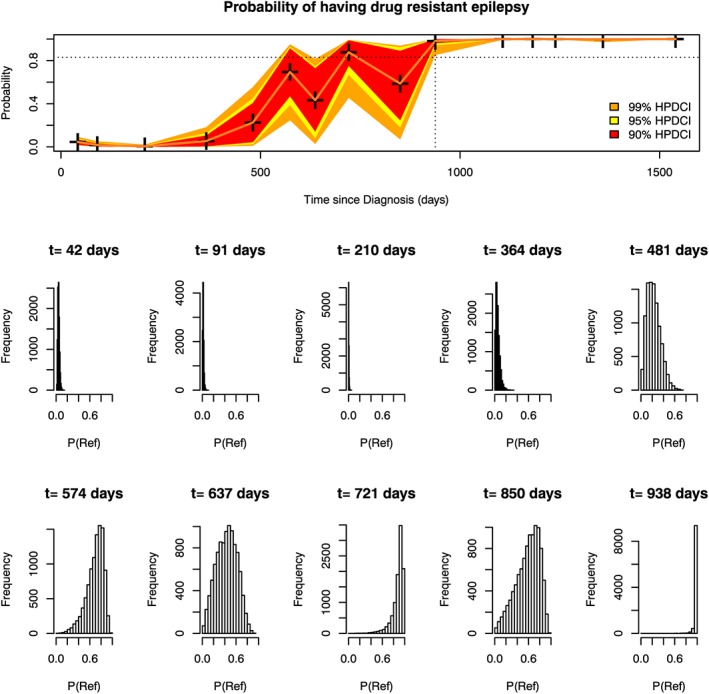
Recently developed methods of longitudinal discriminant analysis allow for classification of subjects into prespecified prognostic groups using longitudinal history of both continuous and discrete biomarkers. The classification uses Bayesian estimates of the group membership probabilities for each prognostic group. These estimates are derived from a multivariate generalised linear mixed model of the biomarker's longitudinal evolution in each of the groups and can be updated each time new data is available for a patient, providing a dynamic (over time) allocation scheme. However, the precision of the estimated group probabilities differs for each patient and also over time. This precision can be assessed by looking at credible intervals for the group membership probabilities. In this paper, we propose a new allocation rule that incorporates credible intervals for use in context of a dynamic longitudinal discriminant analysis and show that this can decrease the number of false positives in a prognostic test, improving the positive predictive value. We also establish that by leaving some patients unclassified for a certain period, the classification accuracy of those patients who are classified can be improved, giving increased confidence to clinicians in their decision making. Finally, we show that determining a stopping rule dynamically can be more accurate than specifying a set time point at which to decide on a patient's status. We illustrate our methodology using data from patients with epilepsy and show how patients who fail to achieve adequate seizure control are more accurately identified using credible intervals compared to existing methods.
最近开发的纵向判别分析方法允许使用连续和离散生物标志物的纵向历史将受试者分类到预先指定的预后组中。该分类使用每个预后组的组成员概率的贝叶斯估计。这些估计值来自生物标志物在每个组中的纵向演变的多元广义线性混合模型,并且每次有患者的新数据时都可以更新,提供了一种动态(随时间)分配方案。然而,估计的组概率的精度因患者而异,并且也随时间变化。这种精度可以通过查看组成员概率的可信区间来评估。在本文中,我们提出了一种新的分配规则,该规则结合了可信区间,用于动态纵向判别分析的背景下,并表明这可以减少预后测试中的假阳性数量,提高阳性预测值。我们还确定,通过在一段时间内不对某些患者进行分类,可以提高已分类患者的分类准确性,增强临床医生决策的信心。最后,我们表明动态确定停止规则可能比指定决定患者状态的设定时间点更准确。我们使用癫痫患者的数据说明了我们的方法,并展示了与现有方法相比,使用可信区间如何更准确地识别未实现充分癫痫发作控制的患者。