National Hospital Organization Osaka National Hospital, 2-1-14 Hoenzaka, Chuou-ku, Osaka-City, 540-0006, Japan.
Saitama Cancer Center, 780 Komuro, Inamachi Kitaadachi-gun, Saitama, 362-0806, Japan.
Int J Clin Oncol. 2019 Mar;24(3):262-273. doi: 10.1007/s10147-018-1359-3. Epub 2018 Nov 3.
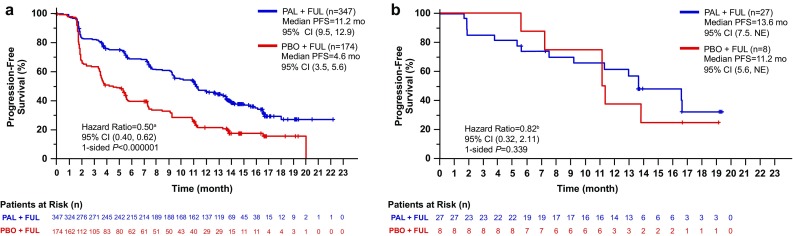
In the double-blind, phase 3 PALOMA-3 study, palbociclib-fulvestrant significantly prolonged progression-free survival versus placebo-fulvestrant in patients with hormone receptor-positive (HR+), human epidermal growth factor receptor 2-negative (HER2-) metastatic breast cancer (MBC) whose disease had progressed on prior endocrine therapy. The present study evaluated the efficacy, safety, and pharmacokinetics of palbociclib plus fulvestrant in Japanese patients enrolled in PALOMA-3.
Pre/peri/postmenopausal women with HR+/HER2- MBC were randomized 2:1 to fulvestrant (500 mg) and either palbociclib (125 mg/day; 3 weeks on/1 week off; n = 347) or placebo (n = 174). Prespecified exploratory analyses compared the efficacy (data cutoff: October 23, 2015), safety, and pharmacokinetics (data cutoff: December 5, 2014) in Japanese women versus the overall population.
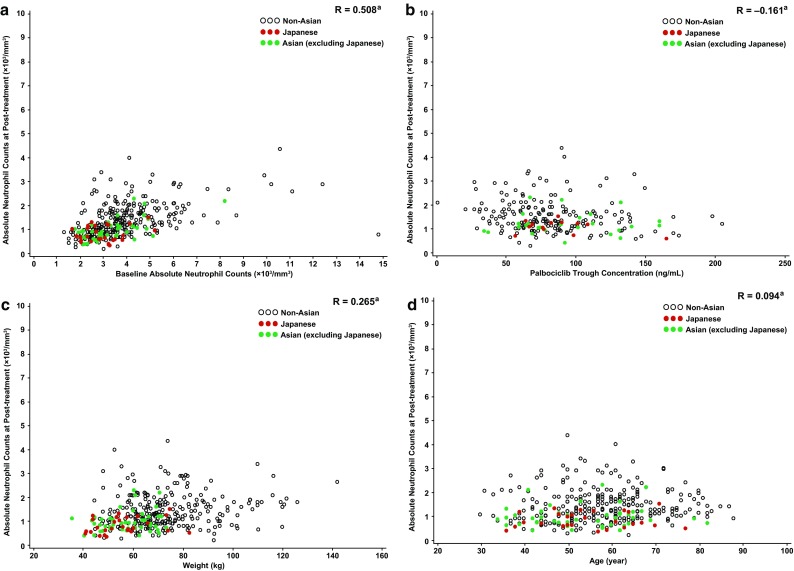
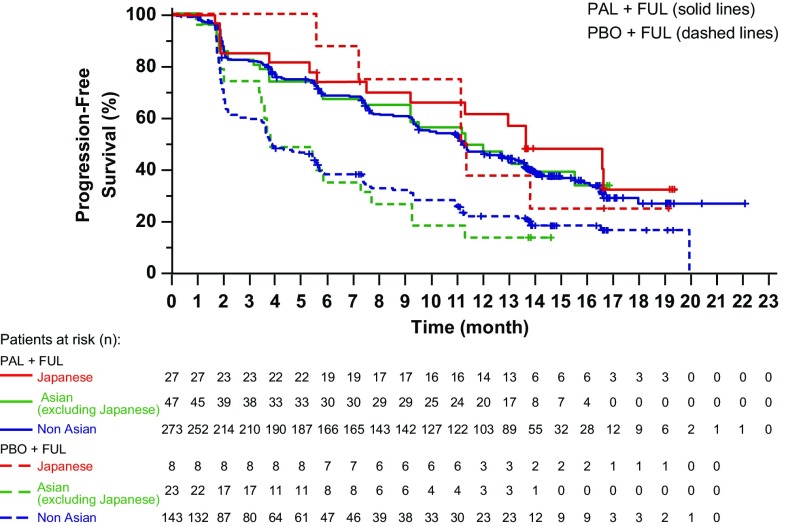
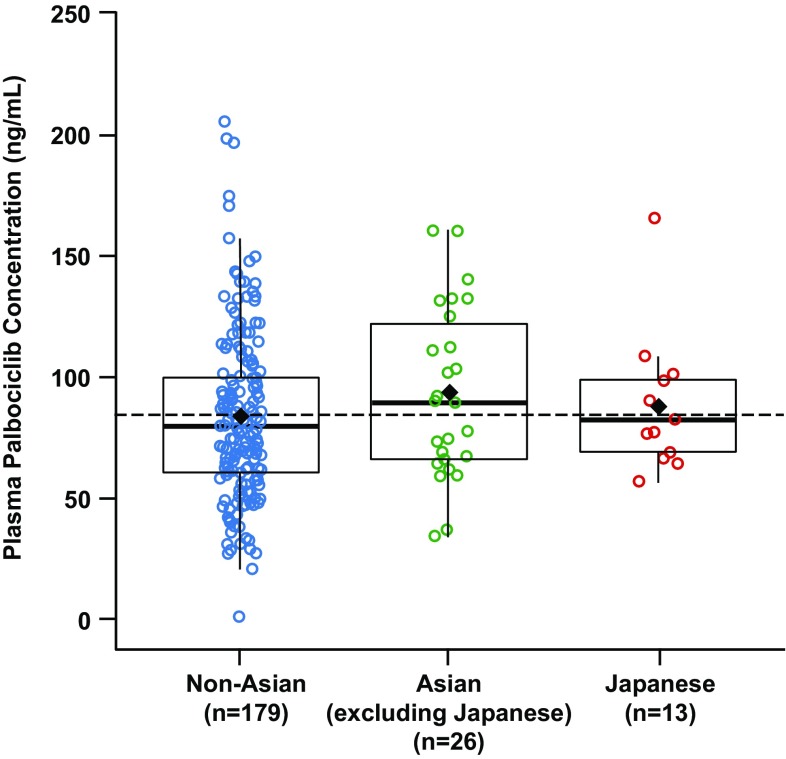
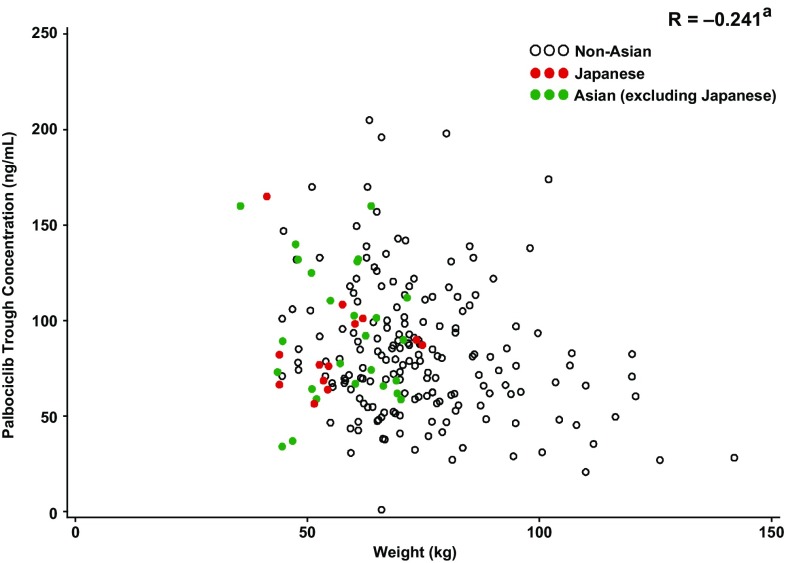
A total of 35 Japanese women were randomized to palbociclib-fulvestrant (n = 27) or placebo-fulvestrant (n = 8). Median progression-free survival was 13.6 months (95% CI, 7.5-not estimable) in the Japanese palbociclib-fulvestrant group and 11.2 months (95% CI, 5.6-not estimable) in the placebo-fulvestrant group. The most common adverse event (AE) in Japanese patients was neutropenia (all grades, 93%); no discontinuations were due to an AE. Geometric mean trough concentration values (within-subject mean steady state) for palbociclib were similar for Japanese Asian (excluding Japanese), and non-Asian patients (84.4 ng/mL, 86.3 ng/mL, and 74.8 ng/mL, respectively).
CONCLUSION(S): The results for the overall population and Japanese patients in PALOMA-3 suggest that palbociclib plus fulvestrant was effective and well tolerated in Japanese patients with HR+/HER2‒ MBC whose disease had progressed on prior endocrine therapy (Pfizer; NCT01942135).
在 PALOMA-3 这项双盲、3 期研究中,与安慰剂联合氟维司群相比,哌柏西利联合氟维司群显著延长了既往内分泌治疗后进展的激素受体阳性(HR+)、人表皮生长因子受体 2 阴性(HER2-)转移性乳腺癌(MBC)患者的无进展生存期。本研究评估了 PALOMA-3 中入组的日本患者中哌柏西利联合氟维司群的疗效、安全性和药代动力学。
绝经前/围绝经期和绝经后 HR+/HER2-MBC 患者以 2:1 的比例随机分配接受氟维司群(500mg)联合哌柏西利(125mg/天;3 周用药/1 周停药;n=347)或安慰剂(n=174)治疗。预设的探索性分析比较了日本女性与总体人群的疗效(数据截止日期:2015 年 10 月 23 日)、安全性和药代动力学(数据截止日期:2014 年 12 月 5 日)。
共有 35 名日本女性被随机分配至哌柏西利联合氟维司群组(n=27)或安慰剂联合氟维司群组(n=8)。在日本哌柏西利联合氟维司群组中,中位无进展生存期为 13.6 个月(95%CI,7.5-未估计),安慰剂联合氟维司群组中为 11.2 个月(95%CI,5.6-未估计)。日本患者中最常见的不良事件(AE)是中性粒细胞减少症(所有等级,93%);无因 AE 而停药。哌柏西利的几何均数谷浓度值(个体内平均稳态值)在日本亚洲人(不包括日本人)和非亚洲人中相似(分别为 84.4ng/mL、86.3ng/mL 和 74.8ng/mL)。
PALOMA-3 中总体人群和日本患者的结果表明,对于既往内分泌治疗后进展的 HR+/HER2- MBC 日本患者,哌柏西利联合氟维司群是有效的且耐受良好的(辉瑞;NCT01942135)。