Department of Organ Transplantation, Guangdong Second Provincial General Hospital, Guangzhou, Guangdong, China (mainland).
Department of Breast Oncology, Sun Yat-sen University Cancer Center, State Key Laboratory of Oncology in South China, Collaborative Innovation Center for Cancer Medicine, Guangzhou, Guangdong, China (mainland).
Med Sci Monit. 2018 Nov 5;24:7936-7943. doi: 10.12659/MSM.913274.
BACKGROUND The present organ shortage has led to increased use of kidneys from expanded-criteria donors, but the prognosis is disappointing due to poor graft quality. As a promising kidney protector, the Klotho gene's role in predicting short-term prognosis has not been assessed. MATERIAL AND METHODS We retrospectively analyzed data from 41 recipients and 25 donors. Multiple clinical variables were compared between different subgroups of donors or their corresponding recipients. The area under the receiver operating characteristic curve (AUROC) was used to evaluate the distinguishing ability. Dynamic changes in serum Klotho, FGF-23, and urinary NGAL were assessed. RESULTS Serum Klotho level was significantly lower in donors age ≥50 years (p=0.017), and there was a moderate negative correlation between serum Klotho expression and age (r=-0.464, p=0.019). Moreover, detection of Klotho mRNA and immunohistochemical analysis in kidneys revealed the same trend as in serum. Furthermore, for older donors (age ≥50 years), serum Klotho level had a strong negative correlation with recipient eGFR 1 month post-transplant (r=-0.686, p=0.007), which was proved to be a good predictor for estimating graft function by ROC analysis. Additionally, during the post-transplant follow-up, serum Klotho levels increased slightly after a temporary decline, while serum FGF-23 and urinary NGAL decreased significantly and then stayed low thereafter. CONCLUSIONS Klotho level, which decreases with age, may be a potential predictor of short-term renal function, especially for grafts from older donors.
目前器官短缺导致了更多的边缘供体肾脏被使用,但由于移植物质量差,预后并不理想。Klotho 基因作为一种有前途的肾脏保护因子,其预测短期预后的作用尚未得到评估。
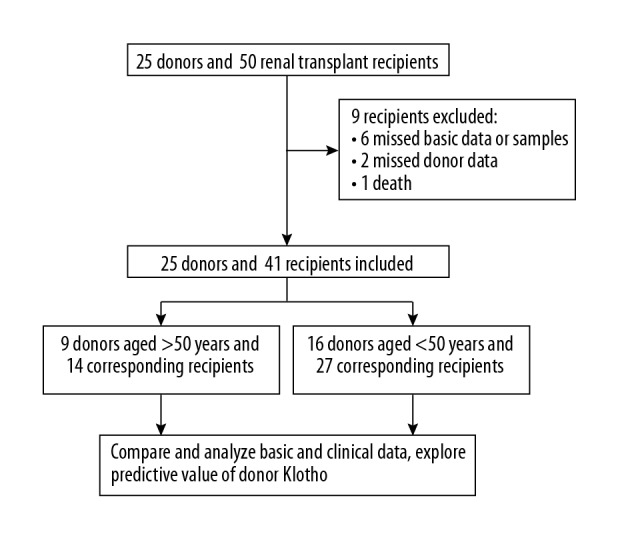
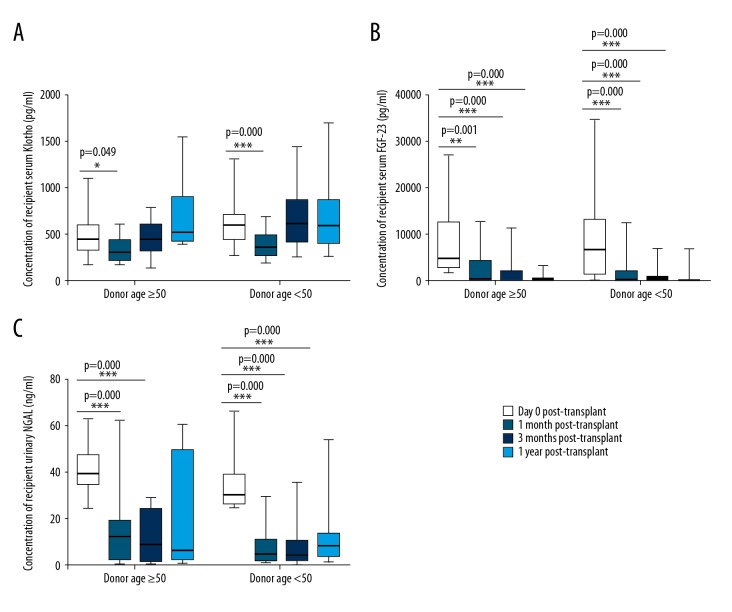
我们回顾性分析了 41 名受者和 25 名供者的数据。比较了不同供者亚组或其相应受者之间的多个临床变量。采用受试者工作特征曲线(AUROC)下面积评估鉴别能力。评估了血清 Klotho、FGF-23 和尿 NGAL 的动态变化。
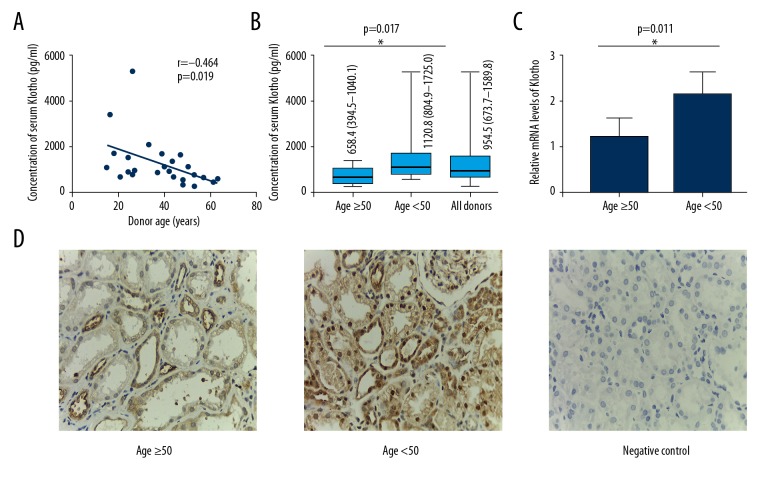
年龄≥50 岁的供者血清 Klotho 水平显著降低(p=0.017),血清 Klotho 表达与年龄之间呈中度负相关(r=-0.464,p=0.019)。此外,肾脏中 Klotho mRNA 的检测和免疫组化分析也呈现出与血清相同的趋势。此外,对于年龄较大的供者(年龄≥50 岁),移植后 1 个月受者的 eGFR 与血清 Klotho 水平呈强负相关(r=-0.686,p=0.007),ROC 分析证明这是评估移植物功能的良好预测指标。此外,在移植后随访期间,血清 Klotho 水平在短暂下降后略有升高,而血清 FGF-23 和尿 NGAL 显著下降并保持在较低水平。
随着年龄的增长而降低的 Klotho 水平可能是短期肾功能的潜在预测指标,尤其是对于来自老年供者的移植物。