Department of Biomedical Engineering and Mechanics, Virginia Tech, Blacksburg, VA, 24061, USA.
Department of Mechanical Engineering, Aix-Marseille Universite, Marseille, France.
Sci Rep. 2018 Nov 5;8(1):16314. doi: 10.1038/s41598-018-34588-0.
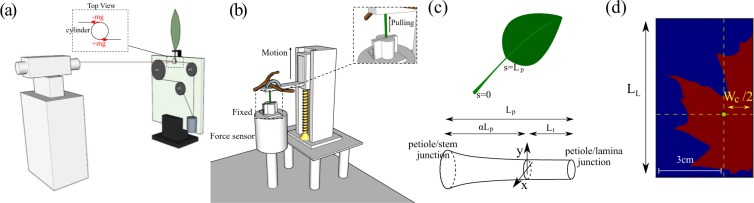
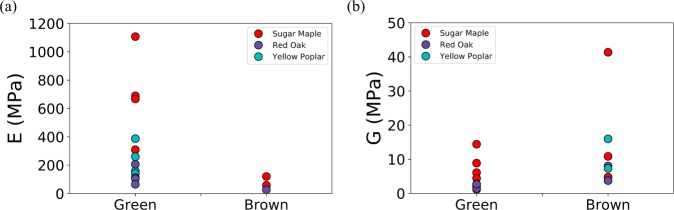
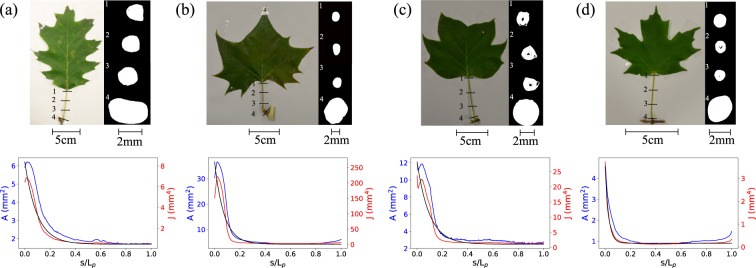
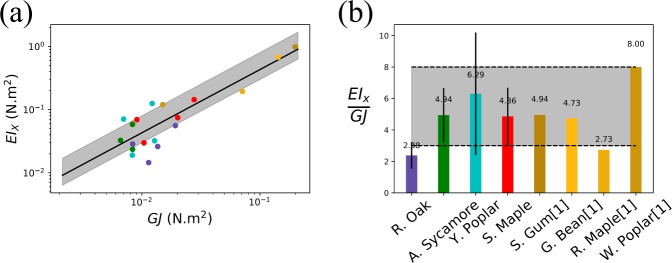
From a geometrical point of view, a non-sessile leaf is composed of two parts: a large flat plate called the lamina, and a long beam called the petiole which connects the lamina to the branch/stem. While wind is exerting force (e.g. drag) on the lamina, the petiole undergoes twisting and bending motions. To survive in harsh abiotic conditions, leaves may have evolved to form in different shapes, resulting from a coupling between the lamina geometry and the petiole mechanical properties. In this study, we measure the shape of laminae from 120 simple leaf species (no leaflets). Leaves of the same species are found to be geometrically similar regardless of their size. From tensile/torsional tests, we characterize the bending rigidity (EI) and the twisting rigidity (GJ) of 15 petioles of 4 species in the Spring/Summer: Red Oak (Quercus Rubra), American Sycamore (Platanus occidentalis), Yellow Poplar (Liriodendron tulipifera), and Sugar Maple (Acer saccharum). A twist-to-bend ratio EI/GJ is found to be around 4.3, within the range in previous studies conducted on similar species (EI/GJ = 2.7~8.0 reported in S. Vogel, 1992). In addition, we develop a simple energetic model to find a relation between geometrical shapes and mechanical properties (EI/GJ = 2L/W where L is the laminar length and W is the laminar width), verified with experimental data. Lastly, we discuss leaf's ability to reduce stress at the stem-petiole junction by choosing certain geometry, and also present exploratory results on the effect that seasons have on the Young's and twisting moduli.
从几何角度来看,一个非固着的叶子由两部分组成:一个大的平板称为叶片,和一个长梁称为叶柄,它将叶片连接到树枝/茎。当风对叶片施加力(例如阻力)时,叶柄会发生扭曲和弯曲运动。为了在恶劣的非生物条件下生存,叶子可能已经进化成不同的形状,这是叶片几何形状和叶柄机械性能之间的耦合作用。在这项研究中,我们测量了 120 种简单叶物种(无小叶)的叶片形状。同一物种的叶片在几何上是相似的,无论它们的大小如何。通过拉伸/扭转试验,我们对 4 个物种的 15 个叶柄的弯曲刚度(EI)和扭转刚度(GJ)进行了特征化:红栎(Quercus Rubra)、美国梧桐(Platanus occidentalis)、黄杨(Liriodendron tulipifera)和糖枫(Acer saccharum)。发现 EI/GJ 的扭转比约为 4.3,在以前对类似物种进行的研究范围内(S. Vogel,1992 年报道的 EI/GJ=2.7~8.0)。此外,我们开发了一个简单的能量模型,以找到几何形状和机械性能之间的关系(EI/GJ=2L/W,其中 L 是叶片的长度,W 是叶片的宽度),并用实验数据进行了验证。最后,我们讨论了叶子通过选择特定的几何形状来减少叶柄与茎交界处的应力的能力,还介绍了季节对杨氏模量和扭转模量影响的探索性结果。