Wang Lin, Fan Yao-Xin, Dou Xiao-Guang
Department of Infectious Diseases, Shengjing Hospital of China Medical University, Shenyang 110022, Liaoning Province, China.
World J Clin Cases. 2018 Oct 26;6(12):521-530. doi: 10.12998/wjcc.v6.i12.521.
To explore the effect of alanine aminotransferase (ALT) on the performance of non-invasive fibrosis tests in chronic hepatitis B (CHB) patients.
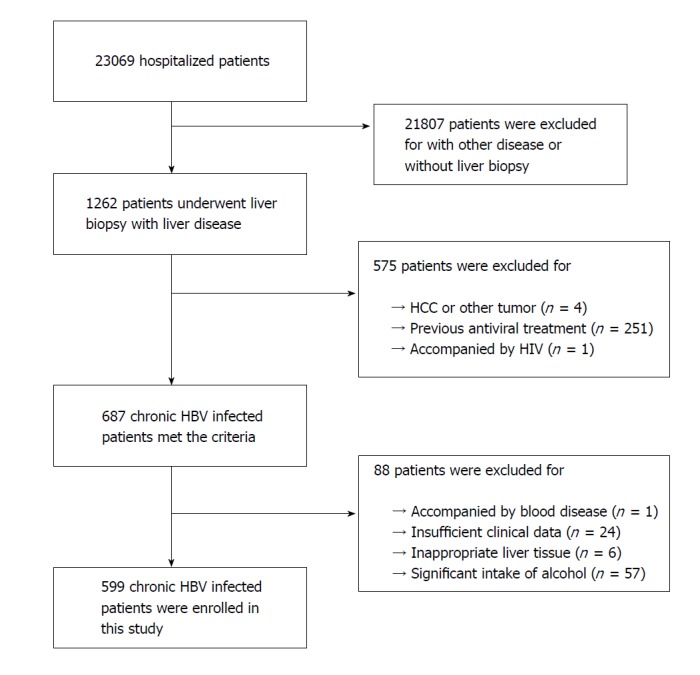
A total of 599 treatment-naive and biopsy-proven CHB patients were included in the study. The cohort was divided into the following three groups: Normal ALT (ALT ≤ 40), slightly elevated ALT (40 < ALT ≤ 80) and elevated ALT (ALT > 80). The diagnostic performance of five common non-invasive fibrosis tests for liver fibrosis (stages S2-4), including the aspartate aminotransferase (AST)-to-platelet (PLT) ratio index (APRI), fibrosis index based on 4 factors (FIB-4), King's score, Forns index and gamma-glutamyl transpeptidase (GGT)-to-PLT ratio (GPR), were evaluated for each group.
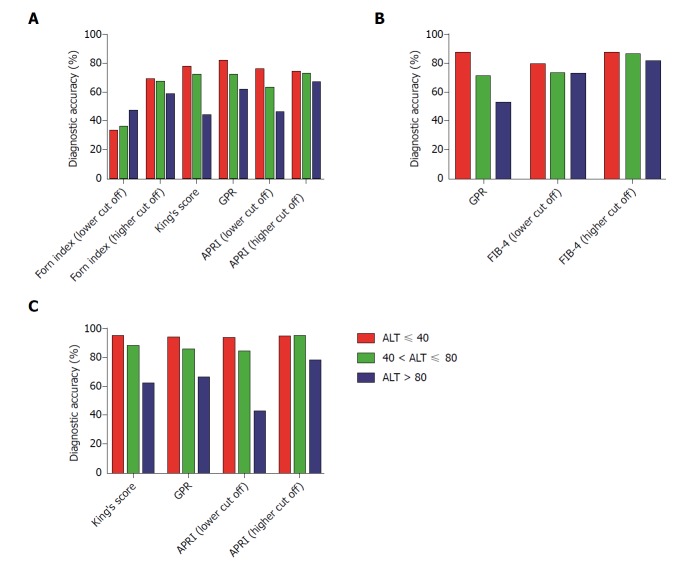
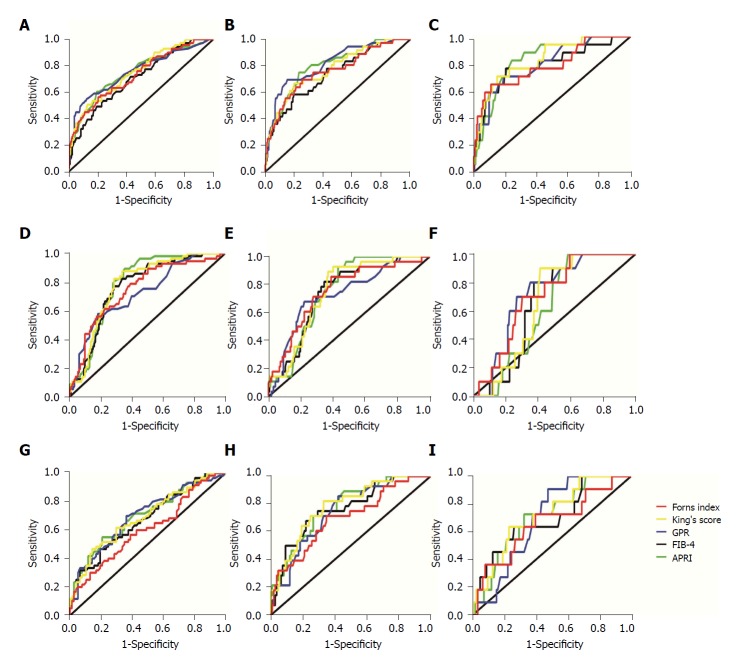
Higher ALT levels were associated with higher non-invasive fibrosis test scores. Patients with the same fibrosis stage but higher ALT levels showed higher non-invasive test scores. The areas under the receiver operating characteristics curves (AUROCs) of the non-invasive tests for prediction of ≥ S2 were higher for patients with ALT ≤ 40 U/L (range 0.705-0.755) and 40 < ALT ≤ 80 U/L (range 0.726-0.79) than for patients with ALT > 80 U/L (range 0.604-0.701). The AUROCs for predicting ≥ S3 and S4 were higher in patients with ALT ≤ 40 U/L (range 0.736-0.814 for ≥ S3, 0.79-0.833 for S4) than in patients with 40 < ALT ≤ 80 U/L (range 0.732-0.754 for ≥ S3, range 0.626-0.723 for S4) and ALT > 80 U/L (range 0.7-0.784 for ≥ S3, range 0.662-0.719 for S4). The diagnostic accuracy of the non-invasive tests decreased in a stepwise manner with the increase in ALT.
ALT has a significant effect on the diagnostic performance of non-invasive fibrosis tests. The ALT level should be considered before performing these non-invasive tests.
探讨丙氨酸氨基转移酶(ALT)对慢性乙型肝炎(CHB)患者无创纤维化检测性能的影响。
本研究共纳入599例未经治疗且经活检证实的CHB患者。该队列分为以下三组:正常ALT组(ALT≤40)、轻度升高ALT组(40<ALT≤80)和升高ALT组(ALT>80)。对包括天冬氨酸氨基转移酶(AST)与血小板(PLT)比值指数(APRI)、基于4项因素的纤维化指数(FIB-4)、金斯评分、福尔恩斯指数以及γ-谷氨酰转肽酶(GGT)与PLT比值(GPR)在内的五项常见肝脏纤维化无创检测(S2 - 4期)对每组患者的诊断性能进行评估。
较高的ALT水平与较高的无创纤维化检测评分相关。处于相同纤维化阶段但ALT水平较高的患者无创检测评分更高。ALT≤40 U/L(范围0.705 - 0.755)和40<ALT≤80 U/L(范围0.726 - 0.79)的患者预测≥S2的无创检测受试者操作特征曲线下面积(AUROC)高于ALT>80 U/L的患者(范围0.604 - 0.701)。ALT≤40 U/L的患者预测≥S3和S4的AUROC高于40<ALT≤80 U/L的患者(≥S3范围0.732 - 0.754,S4范围0.626 - 0.723)以及ALT>80 U/L的患者(≥S3范围0.7 - 0.784,S4范围0.662 - 0.719)。无创检测的诊断准确性随ALT升高呈逐步下降趋势。
ALT对无创纤维化检测的诊断性能有显著影响。在进行这些无创检测前应考虑ALT水平。