Institute of Movement and Sport Gerontology, German Sport University Cologne, Cologne, Germany.
Department of Geriatric Psychiatry and Psychotherapy, LVR-Hospital Cologne, Cologne, Germany.
Int J Geriatr Psychiatry. 2019 Feb;34(2):308-314. doi: 10.1002/gps.5021. Epub 2018 Nov 27.
To objectively quantify patients' physical activity and analyze the relationships between physical activity levels, psychopathology, and sedative medication in acute hospital dementia care.
In this cross-sectional study, we assessed the patients' physical activity based on data collection by hybrid motion sensors attached on their lower back. Daily doses of antipsychotics have been converted to olanzapine-equivalents and daily benzodiazepine medication is reported as diazepam-equivalents. We assessed patients' neuropsychiatric symptoms with the Neuropsychiatric Inventory and the Cohen-Mansfield Agitation Inventory.
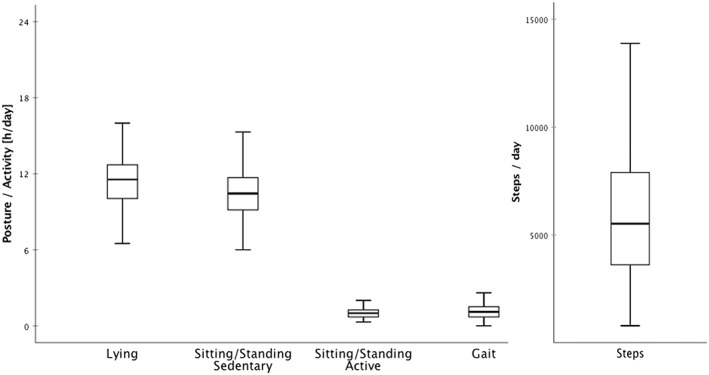
We analyzed motion sensor data from 64 patients (MMSE M = 18.6). On average, patients were lying for 11.5 hours, sitting/standing sedentary for 10.3 hours, sitting/standing active for 1.0 hours, and walking for 1.2 hours per day. The analysis revealed no correlations between patients' physical activity and antipsychotic or benzodiazepine medication. More severe neuropsychiatric symptoms were associated with a decrease in the patients' physical activity (r = .32, P = .01). In particular, patients with apathy symptoms were less physically active than patients without apathy symptoms.
The results reveal that most of the patients in acute dementia care had very low levels of physical activity. Their physical inactivity may be due to the severity of their neuropsychiatric symptoms, especially apathy. Antipsychotic and benzodiazepine medication appeared to have less impact on patients' physical activity. Dementia care should pay more attention to prevent physical inactivity in patients.
客观量化患者的身体活动,并分析身体活动水平、精神病理学和急性医院痴呆护理中的镇静药物之间的关系。
在这项横断面研究中,我们根据附着在患者下背部的混合运动传感器收集的数据评估患者的身体活动。抗精神病药物的每日剂量已转换为奥氮平等效物,每日苯二氮䓬类药物的剂量以地西泮等效物报告。我们使用神经精神病学问卷和科恩-曼斯菲尔德激越量表评估患者的神经精神症状。
我们分析了来自 64 名患者(MMSE M = 18.6)的运动传感器数据。平均而言,患者每天卧床 11.5 小时,久坐/站立不动 10.3 小时,久坐/站立活动 1.0 小时,步行 1.2 小时。分析显示,患者的身体活动与抗精神病药物或苯二氮䓬类药物之间没有相关性。更严重的神经精神症状与患者身体活动减少相关(r =.32,P =.01)。特别是,有冷漠症状的患者比没有冷漠症状的患者身体活动较少。
结果表明,急性痴呆护理中的大多数患者身体活动水平非常低。他们的身体不活动可能是由于他们的神经精神症状严重,特别是冷漠。抗精神病药物和苯二氮䓬类药物似乎对患者的身体活动影响较小。痴呆护理应更加注意预防患者身体不活动。