Belala Nacera, Maier Carolin, Heldmann Patrick, Schwenk Michael, Becker Clemens
Network Aging Research, Heidelberg University, Bergheimer Str. 20, 69115, Heidelberg, Germany.
Department of Geriatrics and Clinic for Geriatric Rehabilitation, Robert-Bosch Hospital, Stuttgart, Germany.
Z Gerontol Geriatr. 2019 Nov;52(Suppl 4):273-281. doi: 10.1007/s00391-019-01644-x. Epub 2019 Oct 29.
Mobility decline and worsening of the cognitive status are all too often the result of acute hospital treatment in older patients. This is particularly pronounced in patients with pre-existing cognitive impairment. This study strived to analyze the routines of geriatric acute care and identify reasons and triggers for sedentary behavior during acute hospitalization of cognitively impaired inpatients.
A sample of 20 moderately cognitively impaired geriatric inpatients (average age 84 years) were recruited on an acute care ward. Information on persons attending the patient, daytime, location, context, patient's activity behavior and difficulty of action were collected by behavioral mapping over a period of 35 1‑min timeslots and extrapolated to a period of 525 min. Routines were further analyzed via semi-structured interviews with five healthcare professionals (HCP).
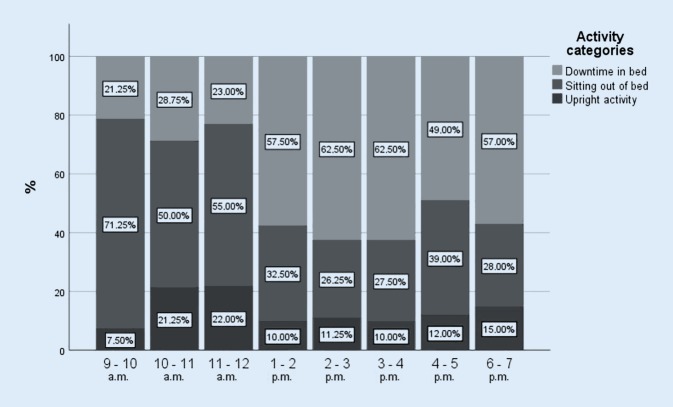
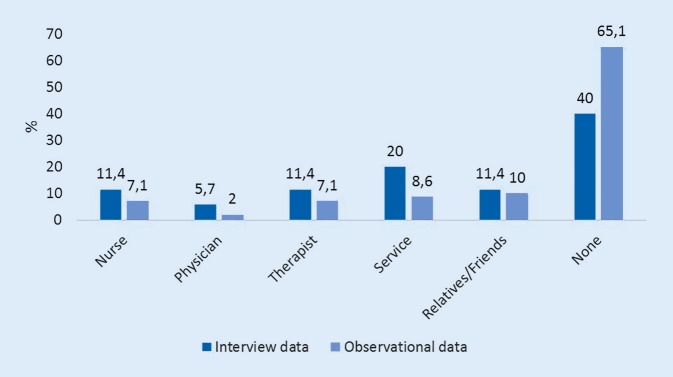
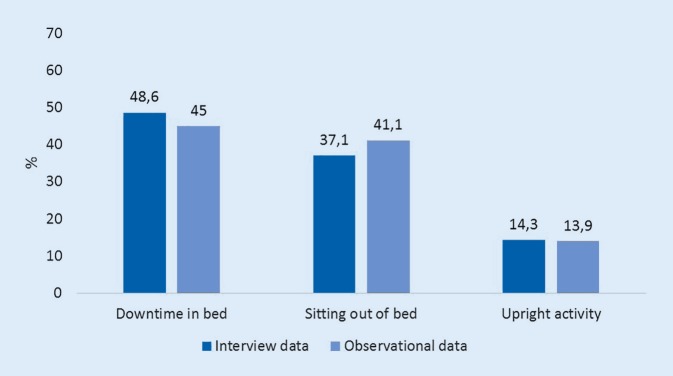
Relevant relations between various categorical and ordinal variables, such as patients' activity behavior, persons attending the patient, daytime, location, difficulty of action and contextual factors were found. Extrapolated data showed that patients spent 396.9 min (75%) in their room, 342.0 min (65%) were spent alone and 236.2 min (45%) lying in bed. The time patients spent alone was grossly underestimated by HCP.
Time spent without company, lacking meaningful activities and continuous bedridden periods due to missing demands to leave the room might have led to time spent inactive and alone. These seem to be strong predictors for sedentariness. Routines of acute care should be reorganized to increase physical activity and thereby reduce sedentary behavior of this patient group.
行动能力下降和认知状态恶化常常是老年患者急性住院治疗的结果。这在已有认知障碍的患者中尤为明显。本研究旨在分析老年急性护理的常规流程,并找出认知障碍住院患者急性住院期间久坐行为的原因和触发因素。
在一个急性护理病房招募了20名中度认知障碍的老年住院患者(平均年龄84岁)。通过行为映射,在35个1分钟时间段内收集有关探访患者的人员、白天时间、地点、情境、患者活动行为及行动困难程度的信息,并推算至525分钟的时间段。通过对五名医护人员进行半结构化访谈,进一步分析常规流程。
发现了各种分类变量和有序变量之间的相关关系,如患者的活动行为、探访患者的人员、白天时间、地点、行动困难程度和情境因素。推算数据显示,患者在病房内度过了396.9分钟(75%),342.0分钟(65%)是独自度过的,236.2分钟(45%)是卧床的。医护人员严重低估了患者独自度过的时间。
无人陪伴、缺乏有意义的活动以及因缺乏离开病房的需求而导致的持续卧床时间,可能导致了不活动和独自度过的时间。这些似乎是久坐行为的有力预测因素。应重新组织急性护理常规流程,以增加身体活动,从而减少该患者群体的久坐行为。