Department of Chemistry , Massachusetts Institute of Technology , Cambridge , Massachusetts 02139 , United States.
J Am Chem Soc. 2018 Dec 19;140(50):17606-17611. doi: 10.1021/jacs.8b09701. Epub 2018 Dec 6.
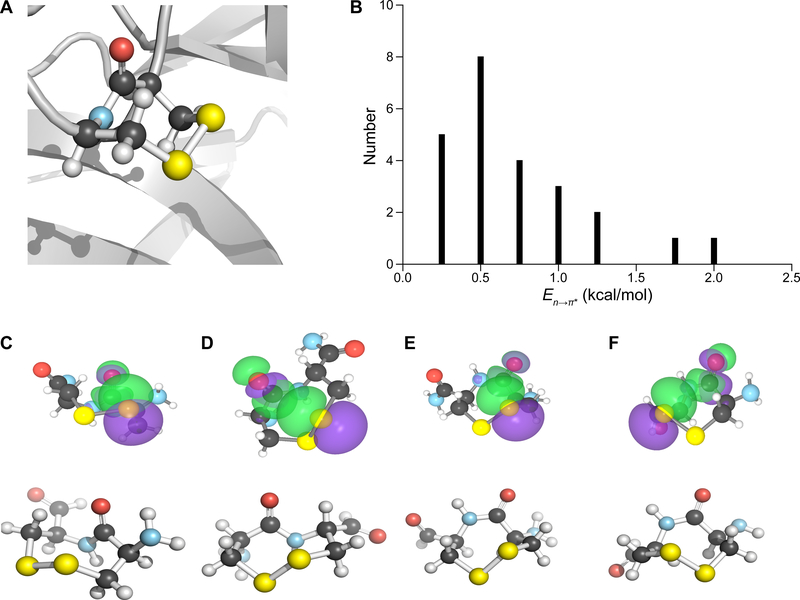
Noncovalent interactions are ubiquitous in biology, taking on roles that include stabilizing the conformation of and assembling biomolecules, and providing an optimal environment for enzymatic catalysis. Here, we describe a noncovalent interaction that engages the sulfur atoms of cysteine residues and disulfide bonds in proteins-their donation of electron density into an antibonding orbital of proximal amide carbonyl groups. This n→ π* interaction tunes the reactivity of the CXXC motif, which is the critical feature of thioredoxin and other enzymes involved in redox homeostasis. In particular, an n→ π* interaction lowers the p K value of the N-terminal cysteine residue of the motif, which is the nucleophile that initiates catalysis. In addition, the interplay between disulfide n→ π* interactions and C5 hydrogen bonds leads to hyperstable β-strands. Finally, n→ π* interactions stabilize vicinal disulfide bonds, which are naturally diverse in function. These previously unappreciated n→ π* interactions are strong and underlie the ability of cysteine residues and disulfide bonds to engage in the structure and function of proteins.
非共价相互作用在生物学中无处不在,它们发挥着稳定生物分子构象和组装的作用,并为酶催化提供了最佳环境。在这里,我们描述了一种非共价相互作用,它涉及到半胱氨酸残基和蛋白质中二硫键中的硫原子——它们将电子密度捐赠给邻近酰胺羰基的反键轨道。这种 n→π相互作用调节了CXXC 基序的反应性,CXXC 基序是硫氧还蛋白和其他参与氧化还原稳态的酶的关键特征。特别是,n→π相互作用降低了基序中 N 端半胱氨酸残基的 pK 值,该残基是引发催化的亲核试剂。此外,二硫键 n→π相互作用和 C5 氢键之间的相互作用导致超稳定的β-折叠。最后,n→π相互作用稳定了相邻的二硫键,这些二硫键在功能上具有天然的多样性。这些以前未被重视的 n→π*相互作用很强,是半胱氨酸残基和二硫键参与蛋白质结构和功能的基础。