Cancer Research Division, Cancer Council NSW, Woolloomooloo, Sydney, New South Wales, Australia.
Sydney School of Public Health, The University of Sydney, Sydney, New South Wales, Australia.
PLoS One. 2018 Nov 7;13(11):e0205034. doi: 10.1371/journal.pone.0205034. eCollection 2018.
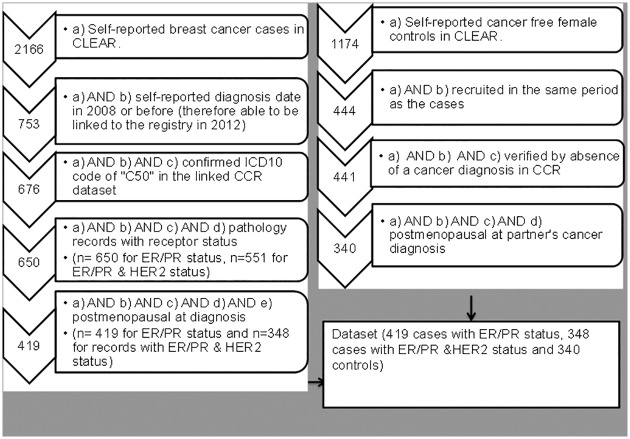
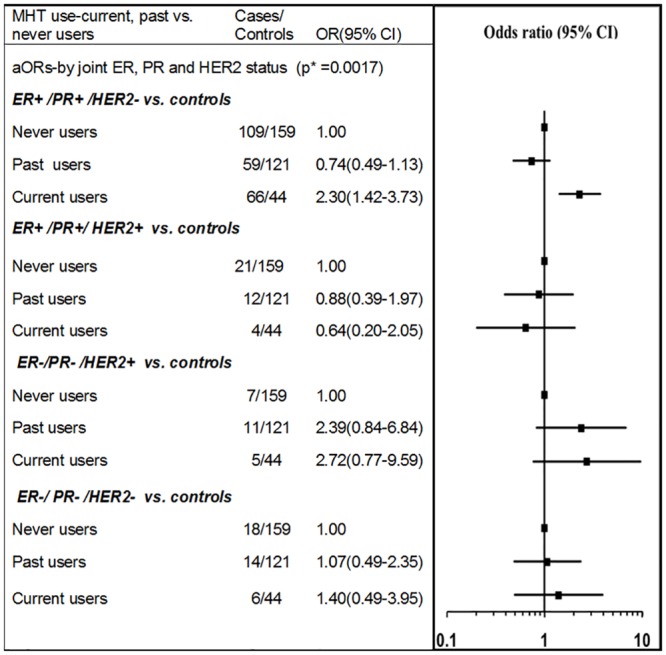
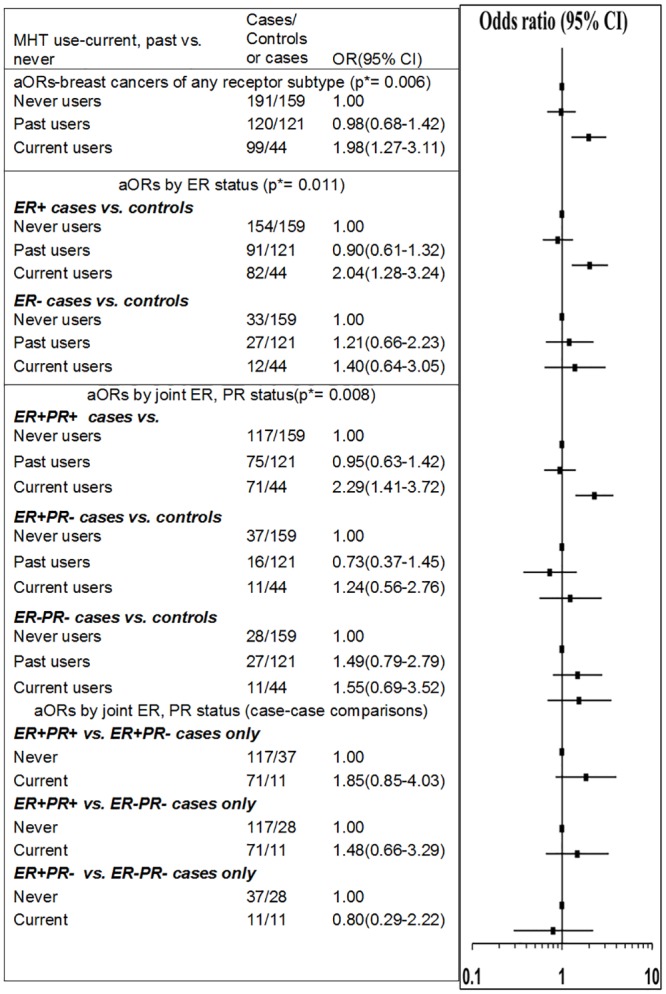
Breast cancer risk is increased with current Menopausal Hormone Therapy (MHT) use, with higher risks reported for ER+ (Estrogen Receptor positive), and ER+/PR+ (Estrogen and Progesterone Receptor positive) breast cancers than those of ER- and ER-/PR- status, respectively. There is limited evidence to suggest MHT use is associated with the specific subtype characterised as ER+/PR+/HER2- (Estrogen and Progesterone Receptor positive and Human Epidermal growth factor Receptor2 negative) status. This study aims to investigate the MHT-breast cancer relationship for breast cancer tumor receptor subtypes defined by ER expression alone, by ER and PR expression only and by joint expression of ER, PR, and HER2. Analyses compared 399 cancer registry-verified breast cancer cases with receptor status information and 324 cancer-free controls. We used multinomial logistic regression to estimate adjusted odds ratios (aORs) and 95% Confidence Intervals (CI) for current and past versus never MHT use, for subgroups defined by tumor receptor expression. Current, but not past, use of MHT was associated with an elevated risk of ER+ breast cancer (aOR = 2.04, 95%CI: 1.28-3.24) and ER+/PR+ breast cancer (aOR = 2.29, 1.41-3.72). Current MHT use was also associated with an elevated risk of the ER+/PR+/HER2- subtype (aOR = 2.30, 1.42-3.73). None of the other subtypes based on ER, ER/PR or ER/PR/HER2 expression were significantly associated with current MHT use in this analysis. Current, but not past, use of MHT increases the risk of breast cancer, with consistently higher risks reported for ER+ and ER+/PR+ subtypes and mounting evidence regarding the specific ER+/PR+/HER2- subtype. Our findings contribute to quantification of the effects of MHT, and support efforts to articulate the receptor-mediated mechanisms by which MHT increases the risk of breast cancer.
目前使用绝经激素治疗(MHT)会增加乳腺癌的风险,与 ER- 和 ER-/PR- 状态相比,报告 ER+(雌激素受体阳性)和 ER+/PR+(雌激素和孕激素受体阳性)乳腺癌的风险更高。有有限的证据表明,MHT 的使用与特定的亚型有关,这种亚型的特点是 ER+/PR+/HER2-(雌激素和孕激素受体阳性,人类表皮生长因子受体 2 阴性)状态。本研究旨在调查 MHT 与乳腺癌肿瘤受体亚型之间的关系,这些受体亚型仅通过 ER 表达、ER 和 PR 表达以及 ER、PR 和 HER2 的联合表达来定义。分析比较了 399 例经癌症登记处证实的乳腺癌病例和具有受体状态信息的 324 例无癌对照。我们使用多项逻辑回归来估计当前和过去与从不使用 MHT 相比的调整后比值比(aOR)和 95%置信区间(CI),用于根据肿瘤受体表达定义的亚组。当前而非过去使用 MHT 与 ER+乳腺癌(aOR=2.04,95%CI:1.28-3.24)和 ER+/PR+乳腺癌(aOR=2.29,1.41-3.72)的风险增加相关。当前 MHT 的使用还与 ER+/PR+/HER2-亚型的风险增加相关(aOR=2.30,1.42-3.73)。在这项分析中,基于 ER、ER/PR 或 ER/PR/HER2 表达的其他亚型均与当前 MHT 的使用无显著相关性。当前而非过去使用 MHT 会增加乳腺癌的风险,与 ER+和 ER+/PR+亚型的风险更高,并且有越来越多的证据表明特定的 ER+/PR+/HER2-亚型与此相关。我们的研究结果有助于量化 MHT 的影响,并支持努力阐明 MHT 增加乳腺癌风险的受体介导机制。