Department of Chinese as a Second Language, National Taiwan Normal University, Taipei City, Taiwan, R.O.C.
PLoS One. 2018 Nov 7;13(11):e0206788. doi: 10.1371/journal.pone.0206788. eCollection 2018.
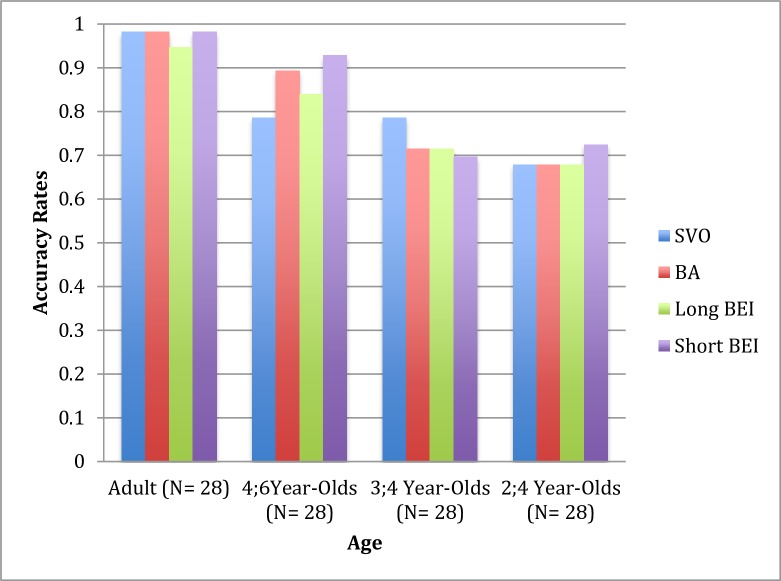
Two studies are presented that investigate the effect of linguistic cues on Mandarin speakers' comprehension of transitive constructions. Study 1 investigated Mandarin-speaking 2- to 4-year-olds' and adults' comprehension of the SVO (Subject-verb-object) construction, ba-construction (SbaOV), and subjectless ba-construction ((S)baOV) with novel verbs using the forced choice pointing paradigm (FCPP). Study 2 investigated another group of participants with similar ages' comprehension of the SVO construction, the ba-construction, the long and short passive constructions with novel verbs and FCPP. Although these constructions have differing cue strengths, participants in the same age groups comprehended these construction types equally well. The results suggest that children as young as two attended to the case markers of ba and bei, allowing them to employ abstract syntactic representations in comprehending Mandarin transitive constructions. The findings demonstrate that children are sensitive early on to the structural information encoded in the constructions.
呈现了两项研究,旨在探讨语言线索对汉语母语者理解及物结构的影响。研究 1 通过强制选择指向范式(FCPP),调查了 2 至 4 岁的汉语母语儿童和成人对 SVO(主语-动词-宾语)结构、ba 结构(SbaOV)和无主语 ba 结构((S)baOV)的理解,使用的是新动词。研究 2 则调查了另一组具有相似年龄的参与者对 SVO 结构、ba 结构、新动词的长被动结构和短被动结构的理解,也使用了 FCPP。尽管这些结构的线索强弱不同,但同一年龄组的参与者对这些结构类型的理解都同样好。结果表明,两岁的儿童就已经开始关注 ba 和 bei 的格标记,使他们能够在理解汉语及物结构时使用抽象的句法表示。这些发现表明,儿童很早就对结构信息敏感,这些信息被编码在结构中。