Institute of Global Health Innovation, Imperial College London, London, United Kingdom.
Health Division, Organization for Economic Co-operation and Development (OECD), Paris, France.
PLoS One. 2018 Nov 7;13(11):e0206703. doi: 10.1371/journal.pone.0206703. eCollection 2018.
This paper explores the contribution of body-mass index (BMI) categories in shaping past trends of use of healthcare services and associated expenditure in the US and projects results to 2025.
The study uses Medical Expenditure Panel Survey (MEPS) data for 2000-2012, reweighted on National Health and Nutrition Survey (NHANES) data for 1972-2012 and US Census Bureau data, to carry out projections for up to 2025. A combination of logistic regressions and generalized linear models was used to model use and associated expenditure for the following healthcare services: inpatient care (with/without surgery), office-based care, outpatient-care, drug prescription and home health care. Quantile regressions were used to analyse and project BMI levels.
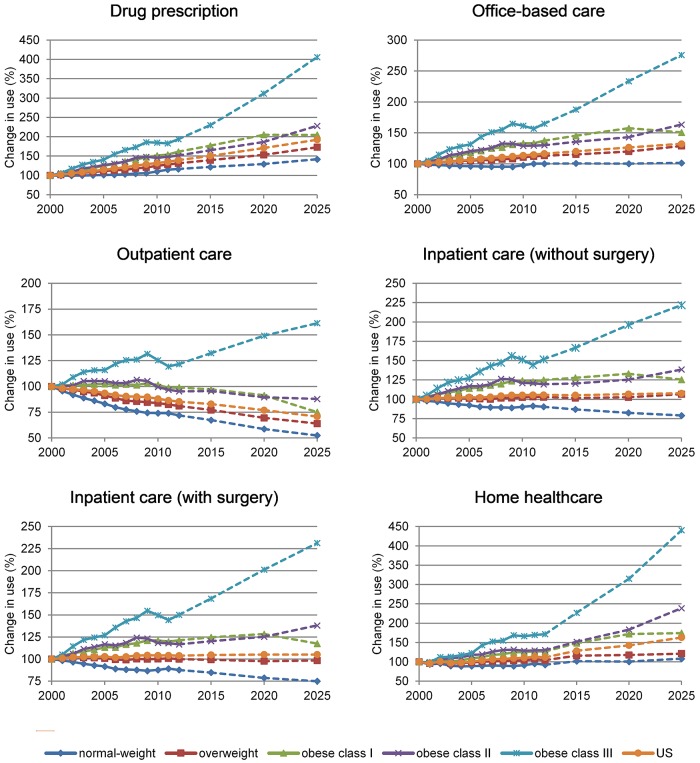
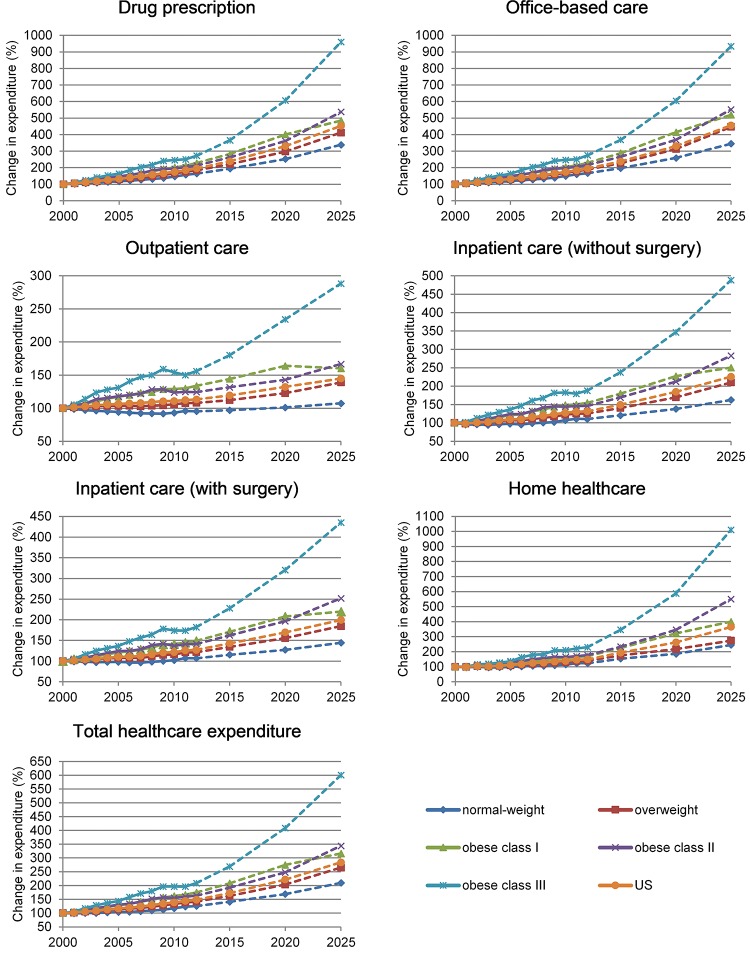
20.5 million individuals will be severely obese in 2025. Normal-weight and overweight individuals have stable trends in use for many healthcare services. Conversely, use of healthcare services in patients in class II and class III obesity will increase substantially. Total healthcare expenditure increases more quickly in the obese population than in normal-weight individuals.
Class III obesity (BMI≥40 kg/m2) significantly affects demand and expenditure for all healthcare services. Careful healthcare service planning and implementing effective policy actions to counteract such trends is crucial to meet future demand.
本文探讨了体重指数(BMI)类别在塑造美国过去医疗服务使用趋势和相关支出方面的贡献,并预测了 2025 年的结果。
本研究使用了 2000-2012 年的医疗支出调查(MEPS)数据,并根据 1972-2012 年的国家健康和营养调查(NHANES)数据以及美国人口普查局的数据进行了重新加权,以进行 2025 年之前的预测。采用逻辑回归和广义线性模型相结合的方法,对以下医疗服务的使用和相关支出进行建模:住院治疗(有/无手术)、门诊治疗、门诊治疗、药物处方和家庭保健。采用分位数回归分析和预测 BMI 水平。
到 2025 年,将有 2050 万人患有严重肥胖症。正常体重和超重人群在许多医疗服务的使用方面呈稳定趋势。相反,II 类和 III 类肥胖患者的医疗服务使用量将大幅增加。肥胖人群的医疗总支出增长速度快于正常体重人群。
III 类肥胖症(BMI≥40kg/m2)显著影响所有医疗服务的需求和支出。仔细规划医疗服务并实施有效的政策行动来应对这些趋势,对于满足未来的需求至关重要。