Graduate Institute of Neural Regenerative Medicine, College of Medical Science and Technology/Center for Neurotrauma and Neuroregeneration, Taipei Medical University, Taipei, 115, Taiwan.
Institute of Cellular and Organismic Biology, Academia Sinica, Taipei, 115, Taiwan.
J Biomed Sci. 2018 Nov 8;25(1):76. doi: 10.1186/s12929-018-0479-4.
The brain predominantly expressed RING finger protein, Znf179, is known to be important for embryonic neuronal differentiation during brain development. Downregulation of Znf179 has been observed in motor neurons of adult mouse models for amyotrophic lateral sclerosis (ALS), yet the molecular function of Znf179 in neurodegeneration has never been previously described. Znf179 contains the classical C3HC4 RING finger domain, and numerous proteins containing C3HC4 RING finger domain act as E3 ubiquitin ligases. Hence, we are interested to identify whether Znf179 possesses E3 ligase activity and its role in ALS neuropathy.
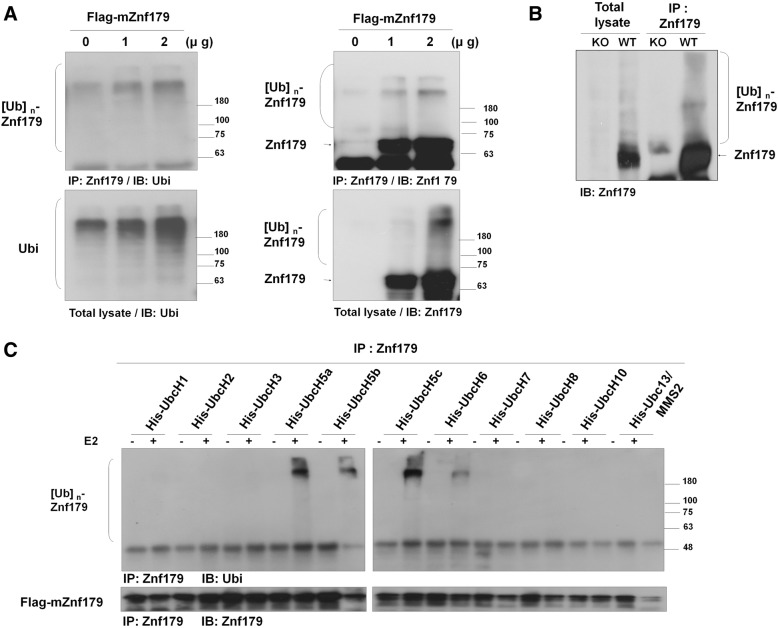
We used in vivo and in vitro ubiquitination assay to examine the E3 ligase autoubiquitination activity of Znf179 and its effect on 26S proteasome activity. To search for the candidate substrates of Znf179, we immunoprecipitated Znf179 and subjected to mass spectrometry (MS) analysis to identify its interacting proteins. We found that ALS/ FTLD-U (frontotemporal lobar degeneration (FTLD) with ubiquitin inclusions)-related neurodegenerative TDP-43 protein is the E3 ligase substrate of Znf179. To further clarify the role of E3 ubiquitin ligase Znf179 in neurodegenerative TDP-43-UBI (ubiquitinated inclusions) (+) proteinopathy, the effect of Znf179-mediated TDP-43 polyubiquitination on TDP-43 protein stability, aggregate formation and nucleus/cytoplasm mislocalization were evaluated in vitro cell culture system and in vivo animal model.
Here we report that Znf179 is a RING E3 ubiquitin ligase which possesses autoubiquitination feature and regulates 26S proteasome activity through modulating the protein expression levels of 19S/20S proteasome subunits. Our immunoprecipitation assay and MS analysis results revealed that the neuropathological TDP-43 protein is one of its E3 ligase substrate. Znf179 interactes with TDP-43 protein and mediates polyubiquitination of TDP-43 in vitro and in vivo. In neurodegenerative TDP-43 proteinopathy, we found that Znf179-mediated polyubiquitination of TDP-43 accelerates its protein turnover rate and attenuates insoluble pathologic TDP-43 aggregates, while knockout of Znf179 in mouse brain results in accumulation of insoluble TDP-43 and cytosolic TDP-43 inclusions in cortex, hippocampus and midbrain regions.
Here we unveil the important role for the novel E3 ligase Znf179 in TDP-43-mediated neuropathy, and provide a potential therapeutic strategy for combating ALS/ FTLD-U neurodegenerative pathologies.
大脑中富含 RING 指蛋白 Znf179,在大脑发育过程中对胚胎神经元分化具有重要作用。在肌萎缩侧索硬化症(ALS)的成年小鼠模型的运动神经元中观察到 Znf179 的下调,但 Znf179 在神经退行性变中的分子功能从未被描述过。Znf179 包含经典的 C3HC4 RING 指结构域,许多含有 C3HC4 RING 指结构域的蛋白质充当 E3 泛素连接酶。因此,我们有兴趣确定 Znf179 是否具有 E3 连接酶活性及其在 ALS 神经病中的作用。
我们使用体内和体外泛素化测定来检查 Znf179 的自身泛素化活性及其对 26S 蛋白酶体活性的影响。为了寻找 Znf179 的候选底物,我们免疫沉淀 Znf179 并进行质谱(MS)分析以鉴定其相互作用蛋白。我们发现 ALS/FTLD-U(额颞叶痴呆(FTLD)伴泛素包涵体)相关神经退行性 TDP-43 蛋白是 Znf179 的 E3 连接酶底物。为了进一步阐明 E3 泛素连接酶 Znf179 在神经退行性 TDP-43-UBI(泛素化包涵体)(+)蛋白病中的作用,我们在体外细胞培养系统和体内动物模型中评估了 Znf179 介导的 TDP-43 多泛素化对 TDP-43 蛋白稳定性、聚集体形成和核/质易位的影响。
在这里,我们报告 Znf179 是一种 RING E3 泛素连接酶,具有自身泛素化特征,并通过调节 19S/20S 蛋白酶体亚基的蛋白表达水平来调节 26S 蛋白酶体活性。我们的免疫沉淀测定和 MS 分析结果表明,神经病变性 TDP-43 蛋白是其 E3 连接酶底物之一。Znf179 与 TDP-43 蛋白相互作用,并介导 TDP-43 的体内和体外多泛素化。在神经退行性 TDP-43 蛋白病中,我们发现 Znf179 介导的 TDP-43 多泛素化加速了其蛋白周转率,并减弱了不溶性病理性 TDP-43 聚集体,而 Znf179 在小鼠大脑中的敲除导致皮质、海马体和中脑区域中不溶性 TDP-43 和细胞质 TDP-43 包涵体的积累。
在这里,我们揭示了新型 E3 连接酶 Znf179 在 TDP-43 介导的神经病中的重要作用,并为治疗 ALS/FTLD-U 神经退行性病变提供了潜在的治疗策略。