King C, Smith M, Currie K, Dickson A, Smith F, Davis M, Flowers P
Department of Nursing and Community Health, School of Health and Life Sciences, Glasgow Caledonian University, Cowcaddens Road, Glasgow, G4 0BA, Scotland, UK.
School of Social Sciences, Monash University, Melbourne, Australia.
BMC Vet Res. 2018 Nov 7;14(1):332. doi: 10.1186/s12917-018-1646-2.
Multi-drug resistant bacteria are an increasing concern in both human and veterinary medicine. Inappropriate prescribing and use of antibiotics within veterinary medicine may be a contributory factor to antimicrobial resistance (AMR). The 'One Health' Initiative aims to work across species and environments to reduce AMR, however; little is currently known about the factors which influence antibiotic prescribing among veterinary surgeons in companion animal practice. This paper reports on qualitative data analysis of interviews with veterinary surgeons whose practice partially or wholly focuses on companion animals (N = 16). The objective of the research was to explore the drivers of companion animal veterinary surgeons' antibiotic prescribing behaviours. The veterinary surgeons interviewed were all practising within the UK (England (n = 4), Scotland (n = 11), Northern Ireland (n = 1)). A behavioural thematic analysis of the data was undertaken, which identified barriers and facilitators to specific prescribing-related behaviours.
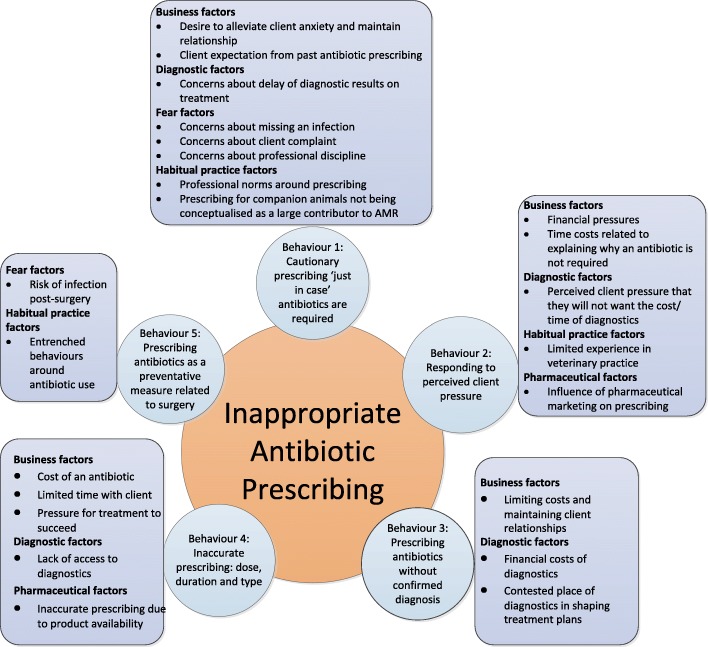
Five components of prescribing behaviours were identified: 1) confirming clinical need for antibiotics; 2) responding to clients; 3) confirming diagnosis; 4) determining dose, duration and type of antibiotic; and 5) preventing infection around surgery (with attendant appropriate and inappropriate antibiotic prescribing behaviours). Barriers to appropriate prescribing identified include: business, diagnostic, fear, habitual practice and pharmaceutical factors. Facilitators include: AMR awareness, infection prevention, professional learning and regulation and government factors.
This paper uses a behavioural lens to examine drivers which are an influence on veterinary surgeons' prescribing behaviours. The paper contributes new understandings about factors which influence antibiotic prescribing behaviours among companion animal veterinary surgeons. This analysis provides evidence to inform future interventions, which are focused on changing prescribing behaviours, in order to address the pressing public health concern of AMR.
耐多药细菌在人类医学和兽医学中都日益受到关注。兽医学中抗生素的不恰当处方和使用可能是导致抗菌药物耐药性(AMR)的一个因素。然而,“同一健康”倡议旨在跨物种和环境开展工作以减少AMR,目前对于影响伴侣动物临床兽医抗生素处方的因素知之甚少。本文报告了对部分或全部专注于伴侣动物的兽医(N = 16)进行访谈的定性数据分析。该研究的目的是探索伴侣动物临床兽医抗生素处方行为的驱动因素。接受访谈的兽医均在英国执业(英格兰(n = 4)、苏格兰(n = 11)、北爱尔兰(n = 1))。对数据进行了行为主题分析,确定了特定处方相关行为的障碍和促进因素。
确定了处方行为的五个组成部分:1)确认使用抗生素的临床必要性;2)回应客户;3)确认诊断;4)确定抗生素的剂量、疗程和类型;5)预防手术周围感染(伴有适当和不适当的抗生素处方行为)。确定的适当处方的障碍包括:业务、诊断、恐惧、习惯做法和制药因素。促进因素包括:对抗菌药物耐药性的认识、感染预防、专业学习与监管以及政府因素。
本文从行为角度审视了影响兽医处方行为的驱动因素。该论文对影响伴侣动物临床兽医抗生素处方行为的因素有了新的认识。这一分析为未来旨在改变处方行为的干预措施提供了依据,以应对抗菌药物耐药性这一紧迫的公共卫生问题。