Duan Jianzhao, Wu Yapeng, Zhou Yi, Ren Xingxu, Shao Yunhui, Feng Wei, Zhu Yunji, He Li, Guo Tiancai
State Key Laboratory of Wheat and Maize Crop Science, Collaborative Innovation Center of Henan Grain Crops, Henan Agricultural University, Zhengzhou, China.
Wheat Research Center, Henan Academy of Agricultural Sciences, Zhengzhou, China.
Front Plant Sci. 2018 Oct 23;9:1457. doi: 10.3389/fpls.2018.01457. eCollection 2018.
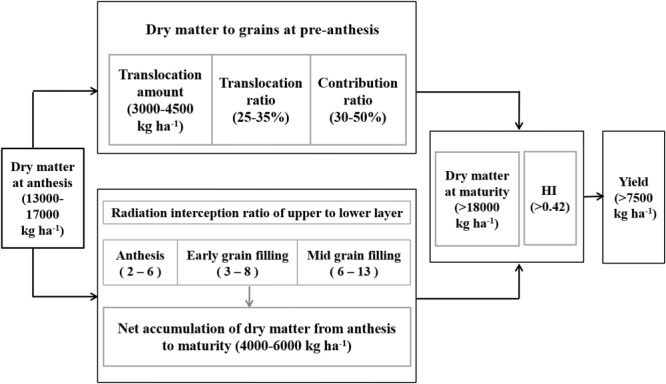
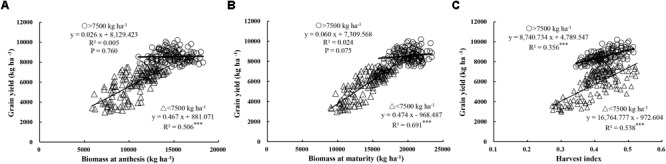
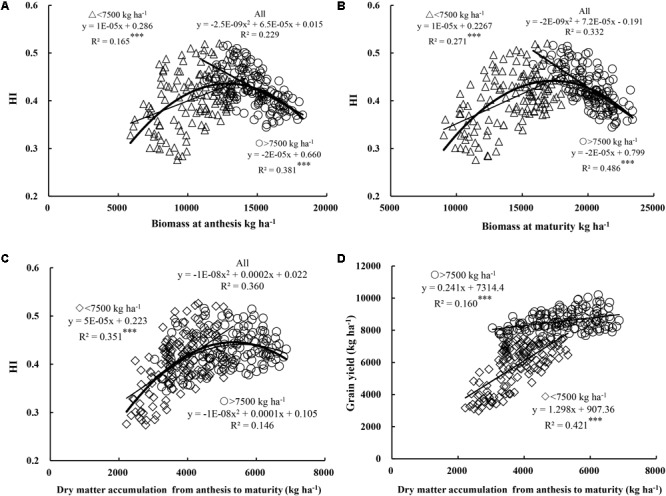
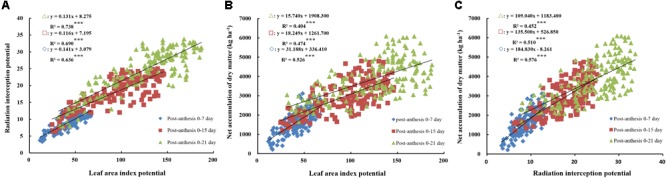
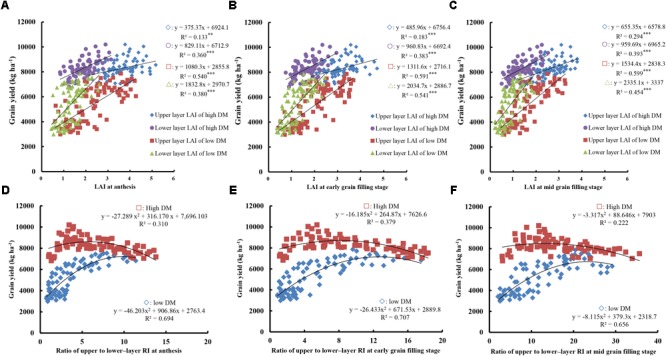
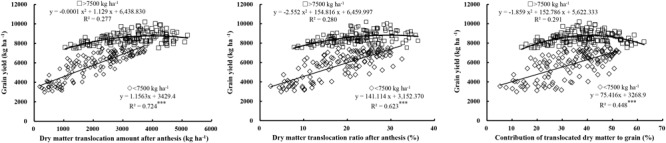
Both increased harvest index (HI) and increased dry matter (DM) are beneficial to yield; however, little is known about the priority of each under different yield levels. This paper aims to determine whether HI or DM is more important and identify the physiological attributes that act as indicators of increased yield. Two field experiments involving different cultivation patterns and water-nitrogen modes, respectively, were carried out from 2013 to 2016 in Huang-Huai Plain, China. Plant DM, leaf area index (LAI), and radiation interception (RI) were measured. Increased yield under low yield levels <7500 kg ha was attributed to an increase in both total DM and HI, while increases under higher yield levels >7500 kg ha were largely dependent on an increase in HI. Under high yield levels, HI showed a significant negative correlation with total DM and a parabolic relationship with net accumulation of DM during filling. Higher net accumulation of DM during filling helped slow down the decrease in HI, thereby maintaining a high value. Moreover, net DM accumulation during filling was positively correlated with yield, while post-anthesis accumulation showed a significant linear relationship with leaf area potential (LAP, = 0.404-0.526) and radiation interception potential (RIP, = 0.452-0.576) during grain filling. These findings suggest that the increase in LAP and RIP caused an increase in net DM accumulation after anthesis. Under DM levels >13,000 kg ha at anthesis, maintaining higher LAI and RI in lower layers during grain formation contributed to higher yield. Furthermore, the ratio of upper- to lower-layer RI showed a second-order curve with yield during filling, with an increase in the optimal range with grain development. Pre-anthesis translocation amount, translocation ratios and contribution ratios also showed second-order curves under high yield levels, with optimal values of 3000-4500 kg ha, 25-35, and 30-50%, respectively. These results confirm the importance of HI in improving the yield, thereby providing a theoretical basis for wheat production in the Huang-Huai Plain.
收获指数(HI)提高和干物质(DM)增加均有利于产量提高;然而,在不同产量水平下,对二者各自的优先性了解甚少。本文旨在确定HI和DM哪个更为重要,并识别作为产量提高指标的生理属性。2013年至2016年在中国黄淮平原分别开展了涉及不同种植模式和水氮模式的两项田间试验。测定了植株干物质、叶面积指数(LAI)和辐射截获量(RI)。低产水平(<7500 kg·ha)下产量的提高归因于总干物质和HI的增加,而高产水平(>7500 kg·ha)下产量的提高很大程度上依赖于HI的增加。在高产水平下,HI与总干物质呈显著负相关,与灌浆期干物质净积累呈抛物线关系。灌浆期较高的干物质净积累有助于减缓HI的下降,从而维持较高值。此外,灌浆期干物质净积累与产量呈正相关,花后积累与灌浆期叶面积势(LAP,r = 0.404 - 0.526)和辐射截获势(RIP,r = 0.452 - 0.576)呈显著线性关系。这些发现表明,LAP和RIP的增加导致了花后干物质净积累的增加。在花期末干物质水平>13000 kg·ha时,在籽粒形成期保持下层较高的LAI和RI有助于提高产量。此外,灌浆期上下层RI比值与产量呈二次曲线关系,随着籽粒发育,最佳范围内该比值增加。高产水平下,花前转运量、转运率和贡献率也呈二次曲线关系,最佳值分别为3000 - 4500 kg·ha、25 - 35和30 - 50%。这些结果证实了HI对提高产量的重要性,从而为黄淮平原小麦生产提供了理论依据。