Institute for Genome Sciences, University of Maryland School of Medicine, Baltimore, MD 21201, USA.
Swiss Institute of Bioinformatics, 1015 Lausanne, Switzerland.
Nucleic Acids Res. 2019 Jan 8;47(D1):D1186-D1194. doi: 10.1093/nar/gky1036.
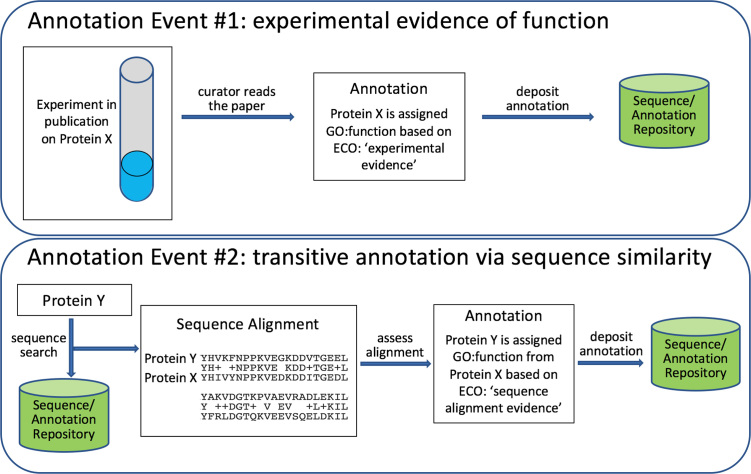
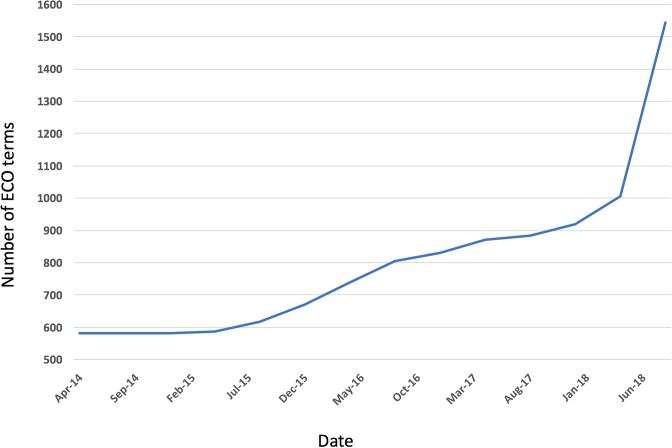
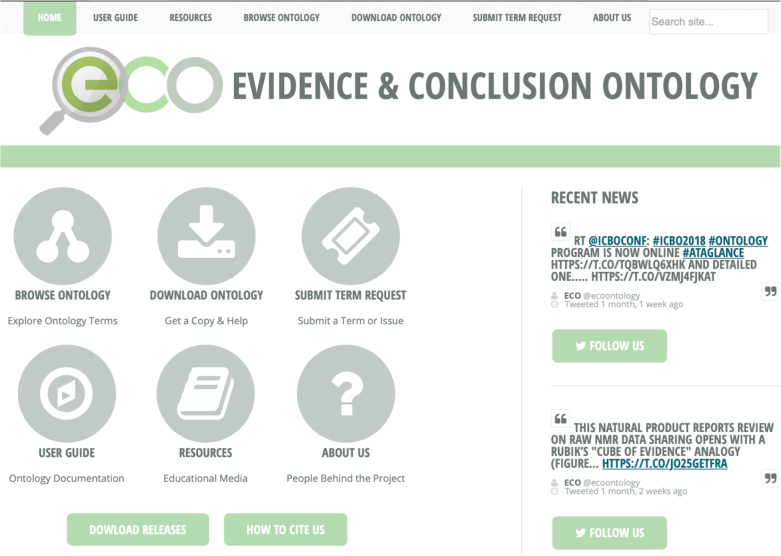
The Evidence and Conclusion Ontology (ECO) contains terms (classes) that describe types of evidence and assertion methods. ECO terms are used in the process of biocuration to capture the evidence that supports biological assertions (e.g. gene product X has function Y as supported by evidence Z). Capture of this information allows tracking of annotation provenance, establishment of quality control measures and query of evidence. ECO contains over 1500 terms and is in use by many leading biological resources including the Gene Ontology, UniProt and several model organism databases. ECO is continually being expanded and revised based on the needs of the biocuration community. The ontology is freely available for download from GitHub (https://github.com/evidenceontology/) or the project's website (http://evidenceontology.org/). Users can request new terms or changes to existing terms through the project's GitHub site. ECO is released into the public domain under CC0 1.0 Universal.
证据与结论本体 (ECO) 包含描述证据类型和断言方法的术语(类)。ECO 术语用于生物注释过程中,以捕捉支持生物学断言的证据(例如,证据 Z 表明基因产物 X 具有功能 Y)。捕获这些信息可以跟踪注释来源、建立质量控制措施并查询证据。ECO 包含超过 1500 个术语,被许多领先的生物资源所使用,包括基因本体论、UniProt 和几个模式生物数据库。ECO 根据生物注释社区的需求不断扩展和修订。该本体论可从 GitHub(https://github.com/evidenceontology/)或项目网站(http://evidenceontology.org/)免费下载。用户可以通过项目的 GitHub 站点请求添加新术语或修改现有术语。ECO 根据 CC0 1.0 通用协议发布到公有领域。