MMWR Morb Mortal Wkly Rep. 2018 Nov 9;67(44):1242-1245. doi: 10.15585/mmwr.mm6744a5.
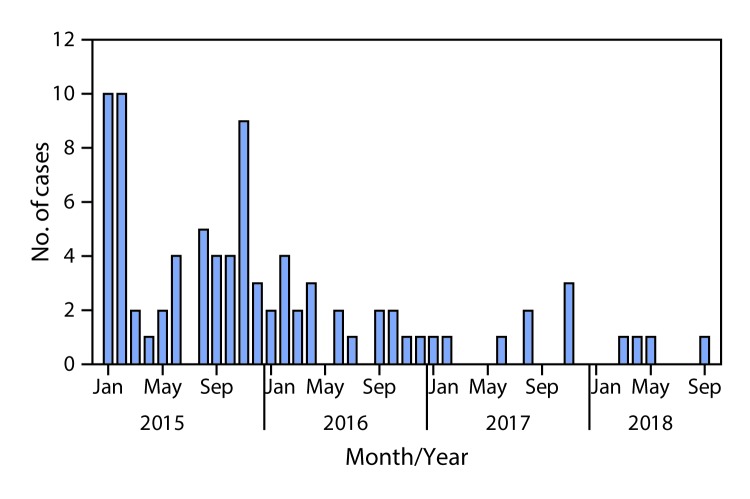
Among the three wild poliovirus (WPV) serotypes, only WPV type 1 (WPV1) has been reported in polio cases or detected from environmental surveillance globally since 2012. Pakistan remains one of only three countries worldwide (the others are Afghanistan and Nigeria) that has never had interrupted WPV1 transmission. This report documents Pakistan's activities and progress toward polio eradication during January 2017-September 2018 and updates previous reports (1,2). In 2017, Pakistan reported eight WPV1 cases, a 60% decrease from 20 cases in 2016. As of September 18, 2018, four cases had been reported, compared with five cases at that time in 2017. Nonetheless, in 2018, WPV1 continues to be isolated regularly from environmental surveillance sites, primarily in the core reservoir areas of Karachi, Quetta, and Peshawar, signifying persistent transmission. Strategies to increase childhood immunity have included an intense schedule of supplemental immunization activities (SIAs), expanding and refining deployment of community-based vaccination implemented by community health workers recruited from the local community in reservoir areas, and strategic placement of permanent transit points where vaccination is provided to mobile populations. Interruption of WPV1 transmission will require further programmatic improvements throughout the country with a focus on specific underperforming subdistricts in reservoir areas.
在三种野生脊灰病毒(WPV)血清型中,自 2012 年以来,全球仅有 WPV1 型在脊灰病例或环境监测中被报告或检测到。巴基斯坦仍然是全球仅有的三个从未有过 WPV1 传播中断的国家之一(另外两个是阿富汗和尼日利亚)。本报告记录了巴基斯坦在 2017 年 1 月至 2018 年 9 月期间消灭脊灰的活动和进展,并更新了以往的报告(1、2)。2017 年,巴基斯坦报告了 8 例 WPV1 病例,比 2016 年的 20 例减少了 60%。截至 2018 年 9 月 18 日,已报告了 4 例病例,而 2017 年同期为 5 例。尽管如此,2018 年 WPV1 仍定期从环境监测点分离出来,主要在卡拉奇、奎达和白沙瓦的核心储存区,这表明仍有持续传播。增加儿童免疫力的策略包括密集的补充免疫活动(SIAs)计划、扩大和完善由社区卫生工作者在储存区当地社区招募实施的基于社区的接种部署,以及在为流动人口提供疫苗接种的永久性过境点进行战略部署。要想中断 WPV1 的传播,需要在全国范围内进一步改进方案,重点关注储存区表现不佳的特定分区。