Department of Fish and Wildlife Conservation, Virginia Tech, Blacksburg, Virginia, United States of America.
Chobe Research Institute, Centre for Conservation of African Resources: Animals, Communities, and Land Use, Kasane, Botswana.
PLoS Med. 2018 Nov 8;15(11):e1002688. doi: 10.1371/journal.pmed.1002688. eCollection 2018 Nov.
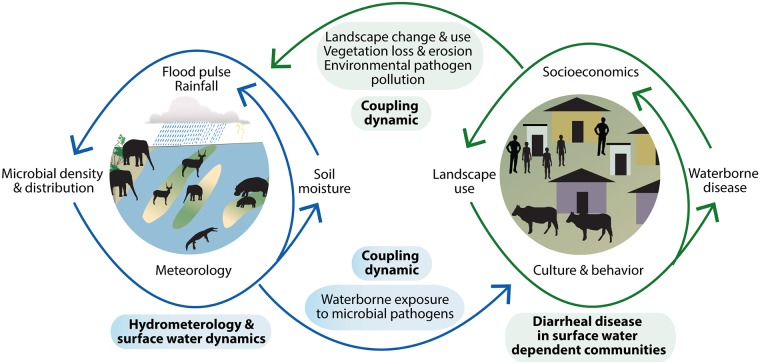
The impacts of climate change on surface water, waterborne disease, and human health remain a growing area of concern, particularly in Africa, where diarrheal disease is one of the most important health threats to children under 5 years of age. Little is known about the role of surface water and annual flood dynamics (flood pulse) on waterborne disease and human health nor about the expected impact of climate change on surface-water-dependent populations.
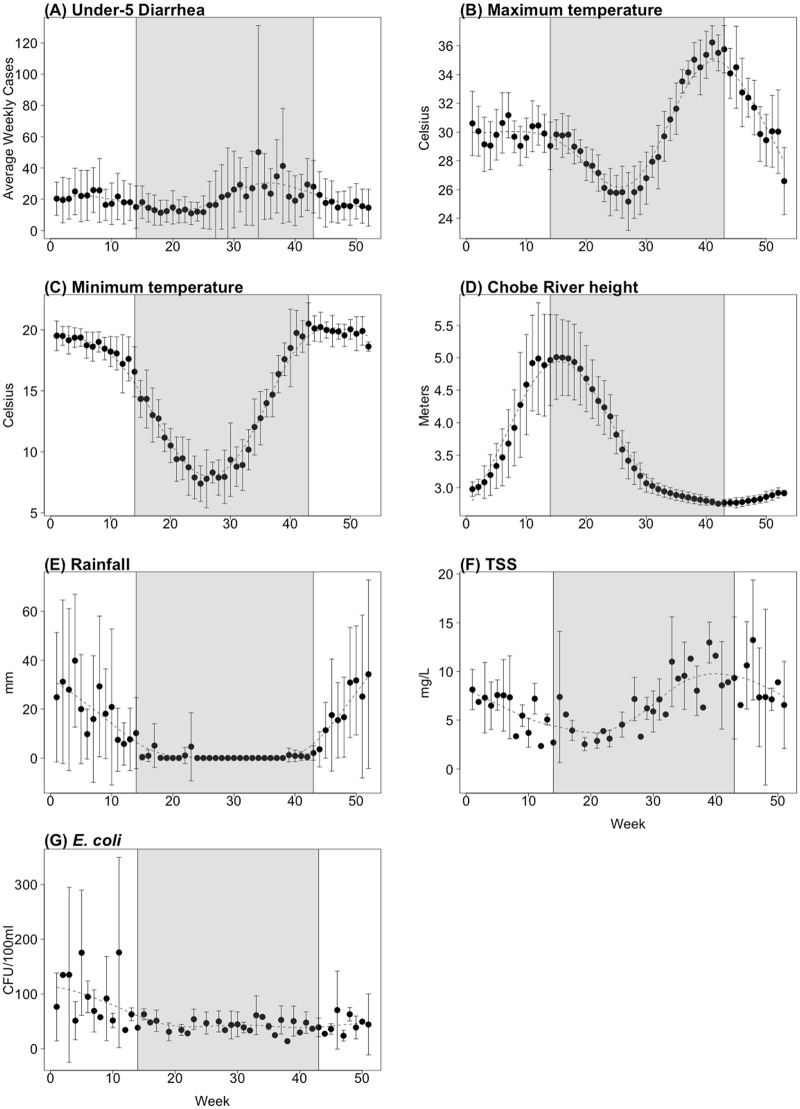
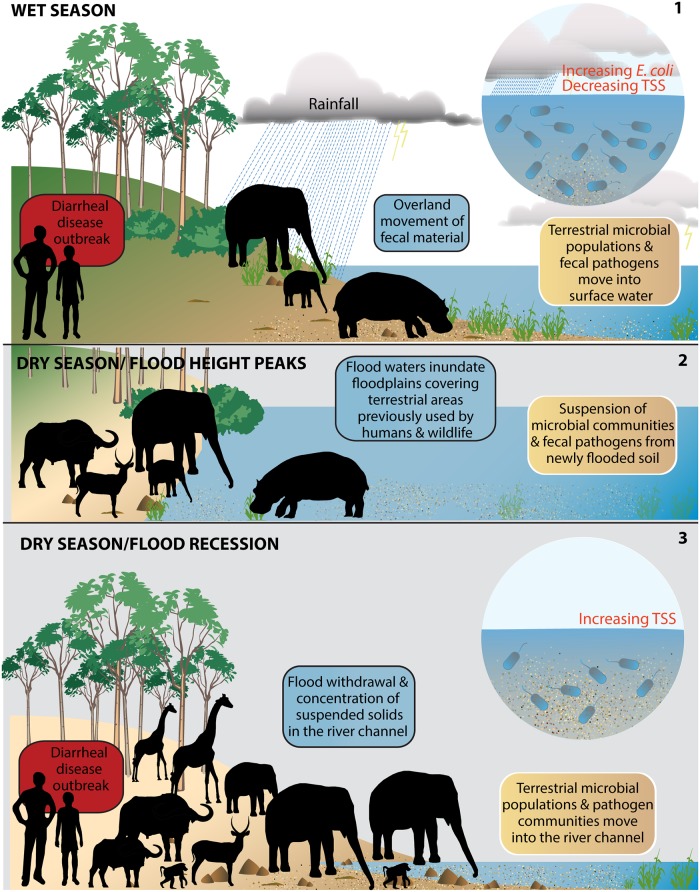
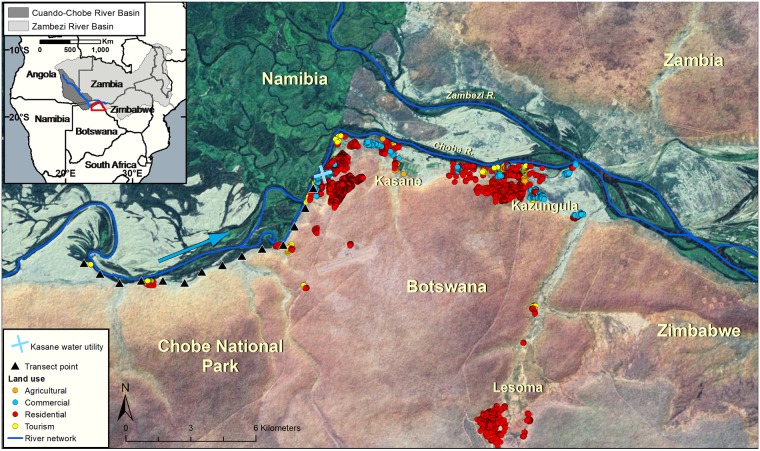
Using the Chobe River in northern Botswana, a flood pulse river-floodplain system, we applied multimodel inference approaches assessing the influence of river height, water quality (bimonthly counts of Escherichia coli and total suspended solids [TSS], 2011-2017), and meteorological variability on weekly diarrheal case reports among children under 5 presenting to health facilities (n = 10 health facilities, January 2007-June 2017). We assessed diarrheal cases by clinical characteristics and season across age groups using monthly outpatient data (January 1998-June 2017). A strong seasonal pattern was identified, with 2 outbreaks occurring regularly in the wet and dry seasons. The timing of outbreaks diverged from that at the level of the country, where surface water is largely absent. Across age groups, the number of diarrheal cases was greater, on average, during the dry season. Demographic and clinical characteristics varied by season, underscoring the importance of environmental drivers. In the wet season, rainfall (8-week lag) had a significant influence on under-5 diarrhea, with a 10-mm increase in rainfall associated with an estimated 6.5% rise in the number of cases. Rainfall, minimum temperature, and river height were predictive of E. coli concentration, and increases in E. coli in the river were positively associated with diarrheal cases. In the dry season, river height (1-week lag) and maximum temperature (1- and 4-week lag) were significantly associated with diarrheal cases. During this period, a 1-meter drop in river height corresponded to an estimated 16.7% and 16.1% increase in reported diarrhea with a 1- and 4-week lag, respectively. In this region, as floodwaters receded from the surrounding floodplains, TSS levels increased and were positively associated with diarrheal cases (0- and 3-week lag). Populations living in this region utilized improved water sources, suggesting that hydrological variability and rapid water quality shifts in surface waters may compromise water treatment processes. Limitations include the potential influence of health beliefs and health seeking behaviors on data obtained through passive surveillance.
In flood pulse river-floodplain systems, hydrology and water quality dynamics can be highly variable, potentially impacting conventional water treatment facilities and the production of safe drinking water. In Southern Africa, climate change is predicted to intensify hydrological variability and the frequency of extreme weather events, amplifying the public health threat of waterborne disease in surface-water-dependent populations. Water sector development should be prioritized with urgency, incorporating technologies that are robust to local environmental conditions and expected climate-driven impacts. In populations with high HIV burdens, expansion of diarrheal disease surveillance and intervention strategies may also be needed. As annual flood pulse processes are predominantly influenced by climate controls in distant regions, country-level data may be inadequate to refine predictions of climate-health interactions in these systems.
气候变化对地表水、水传播疾病和人类健康的影响仍然是一个日益令人关注的领域,特别是在非洲,腹泻病是 5 岁以下儿童最重要的健康威胁之一。人们对地表水以及年度洪水动态(洪水脉冲)对水传播疾病和人类健康的作用知之甚少,也不知道气候变化对依赖地表水的人口的预期影响。
我们利用博茨瓦纳北部的乔贝河(Chobe River),这是一个洪水脉冲河流-洪泛平原系统,应用多模型推理方法评估了河水位、水质(每月两次的大肠杆菌和总悬浮固体[TSS]计数,2011-2017 年)和气象变化对向医疗机构就诊的 5 岁以下儿童每周腹泻病例报告的影响(n = 10 个医疗机构,2007 年 1 月至 2017 年 6 月)。我们根据年龄组的临床特征和季节评估了腹泻病例,使用每月门诊数据(1998 年 1 月至 2017 年 6 月)。我们发现存在强烈的季节性模式,在湿季和旱季会定期发生 2 次暴发。暴发的时间与该国的情况不同,该国地表水基本不存在。在所有年龄组中,旱季的腹泻病例数量平均更多。人口统计学和临床特征因季节而异,这突出表明环境驱动因素的重要性。在湿季,降雨量(8 周滞后)对 5 岁以下儿童腹泻有显著影响,降雨量增加 10 毫米与腹泻病例数增加约 6.5%有关。降雨量、最低温度和河水位可预测大肠杆菌浓度,河水中大肠杆菌的增加与腹泻病例呈正相关。在旱季,河水位(1 周滞后)和最高温度(1 周和 4 周滞后)与腹泻病例显著相关。在此期间,河水位下降 1 米,分别估计与报告的腹泻病例增加 16.7%和 16.1%相关,滞后时间分别为 1 周和 4 周。在这个地区,随着洪水从周围的洪泛区退去,TSS 水平上升,并与腹泻病例呈正相关(0 周和 3 周滞后)。生活在该地区的人口使用了改进的水源,这表明地表水中的水文变化和快速水质变化可能会破坏水处理过程。限制因素包括健康信仰和卫生寻求行为对通过被动监测获得的数据的潜在影响。
在洪水脉冲河流-洪泛平原系统中,水文学和水质动态可能高度变化,这可能会对传统的水处理设施和安全饮用水的生产产生影响。在南部非洲,气候变化预计会加剧水文变化和极端天气事件的频率,从而加剧依赖地表水的人群中水传播疾病的公共卫生威胁。应紧急优先发展水部门,纳入对当地环境条件和预期气候驱动影响具有稳健性的技术。在艾滋病毒负担高的人群中,可能还需要扩大腹泻病监测和干预策略。由于年度洪水脉冲过程主要受到遥远地区气候控制的影响,国家一级的数据可能不足以改进对这些系统中气候-健康相互作用的预测。