Developmental Biology of Birth Defects, UCL Institute of Child Health, London, United Kingdom.
PLoS One. 2018 Nov 8;13(11):e0207251. doi: 10.1371/journal.pone.0207251. eCollection 2018.
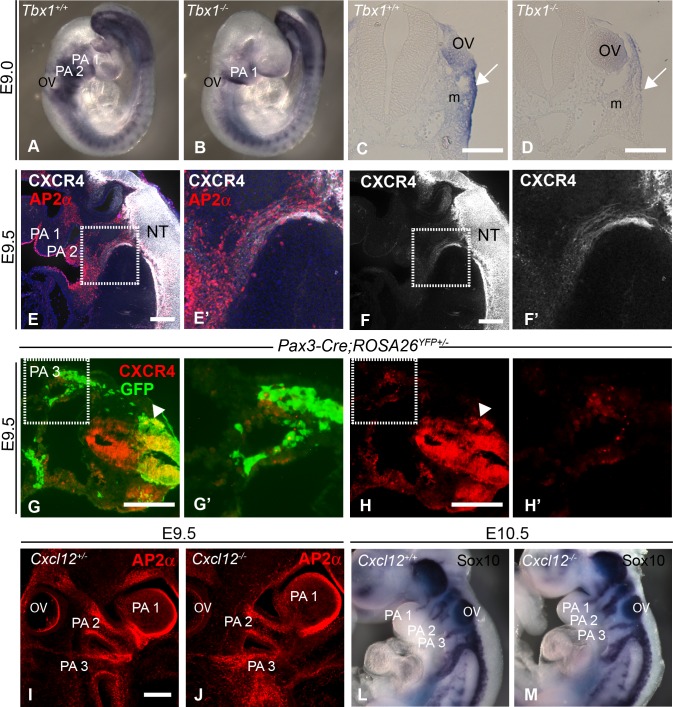
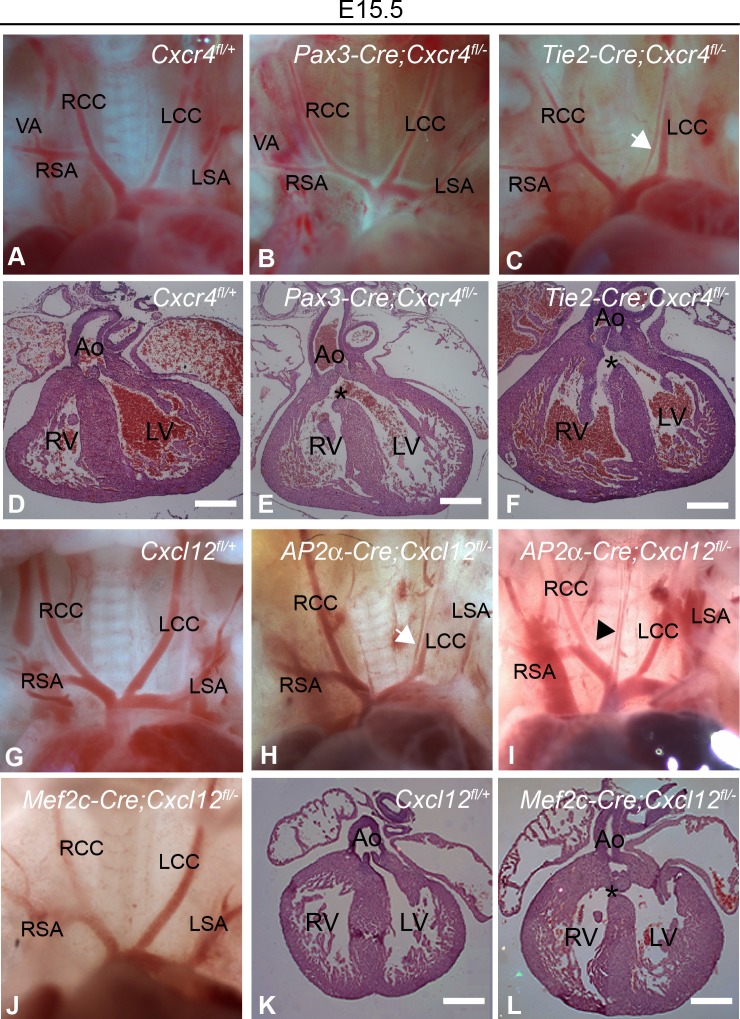
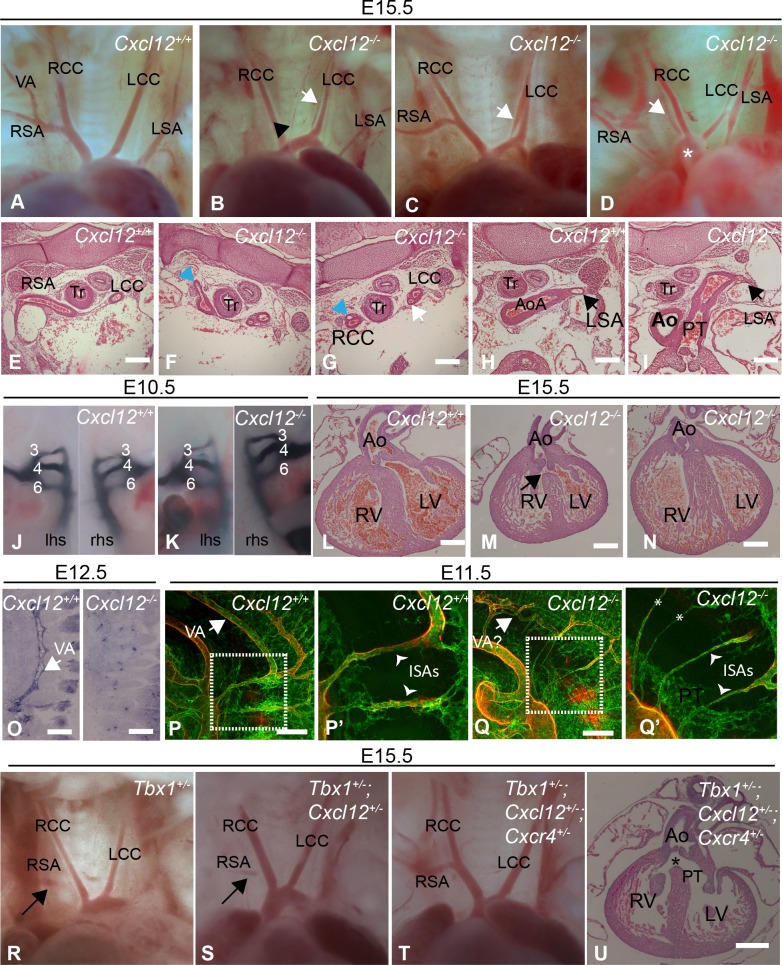
The CXCL12-CXCR4 pathway has crucial roles in stem cell homing and maintenance, neuronal guidance, cancer progression, inflammation, remote-conditioning, cell migration and development. Recently, work in chick suggested that signalling via CXCR4 in neural crest cells (NCCs) has a role in the 22q11.2 deletion syndrome (22q11.2DS), a disorder where haploinsufficiency of the transcription factor TBX1 is responsible for the major structural defects. We tested this idea in mouse models. Our analysis of genes with altered expression in Tbx1 mutant mouse models showed down-regulation of Cxcl12 in pharyngeal surface ectoderm and rostral mesoderm, both tissues with the potential to signal to migrating NCCs. Conditional mutagenesis of Tbx1 in the pharyngeal surface ectoderm is associated with hypo/aplasia of the 4th pharyngeal arch artery (PAA) and interruption of the aortic arch type B (IAA-B), the cardiovascular defect most typical of 22q11.2DS. We therefore analysed constitutive mouse mutants of the ligand (CXCL12) and receptor (CXCR4) components of the pathway, in addition to ectodermal conditionals of Cxcl12 and NCC conditionals of Cxcr4. However, none of these typical 22q11.2DS features were detected in constitutively or conditionally mutant embryos. Instead, duplicated carotid arteries were observed, a phenotype recapitulated in Tie-2Cre (endothelial) conditional knock outs of Cxcr4. Previous studies have demonstrated genetic interaction between signalling pathways and Tbx1 haploinsufficiency e.g. FGF, WNT, SMAD-dependent. We therefore tested for possible epistasis between Tbx1 and the CXCL12 signalling axis by examining Tbx1 and Cxcl12 double heterozygotes as well as Tbx1/Cxcl12/Cxcr4 triple heterozygotes, but failed to identify any exacerbation of the Tbx1 haploinsufficient arch artery phenotype. We conclude that CXCL12 signalling via NCC/CXCR4 has no major role in the genesis of the Tbx1 loss of function phenotype. Instead, the pathway has a distinct effect on remodelling of head vessels and interventricular septation mediated via CXCL12 signalling from the pharyngeal surface ectoderm and second heart field to endothelial cells.
CXCL12-CXCR4 途径在干细胞归巢和维持、神经元导向、癌症进展、炎症、远程调节、细胞迁移和发育中具有关键作用。最近,鸡的研究工作表明,神经嵴细胞 (NCC) 中 CXCR4 的信号传导在 22q11.2 缺失综合征 (22q11.2DS) 中起作用,该疾病中转录因子 TBX1 的单倍不足负责主要的结构缺陷。我们在小鼠模型中测试了这个想法。我们对 Tbx1 突变小鼠模型中表达改变的基因进行了分析,结果显示 CXCL12 在咽面外胚层和头侧中胚层中的表达下调,这两种组织都有可能向迁移的 NCC 发出信号。咽面外胚层中 Tbx1 的条件性突变与第四咽弓动脉 (PAA) 的发育不良/发育不全和主动脉弓 B 型中断 (IAA-B) 有关,这是 22q11.2DS 最典型的心血管缺陷。因此,我们除了分析通路的配体 (CXCL12) 和受体 (CXCR4) 成分的外胚层条件突变体以及 NCC 条件突变体外,还分析了组成型突变体的配体 (CXCL12) 和受体 (CXCR4) 成分。然而,在组成型或条件型突变胚胎中均未检测到典型的 22q11.2DS 特征。相反,观察到重复的颈动脉,在 Tie-2Cre (内皮细胞) 条件性敲除 Cxcr4 的情况下重现了这种表型。以前的研究表明,信号通路与 TBX1 单倍不足之间存在遗传相互作用,例如 FGF、WNT、SMAD 依赖性。因此,我们通过检查 Tbx1 和 Cxcl12 双杂合子以及 Tbx1/Cxcl12/Cxcr4 三杂合子,测试了 Tbx1 和 CXCL12 信号轴之间可能的上位性,但未能确定 Tbx1 半合子功能缺失弓动脉表型的任何加重。我们得出的结论是,NCC/CXCR4 中的 CXCL12 信号传导在 Tbx1 功能丧失表型的发生中没有主要作用。相反,该途径通过咽面外胚层和第二心区向内皮细胞发出的 CXCL12 信号传导对头部血管和室间隔重塑具有独特的影响。