van Zanden Judith E, Wagenaar Susanne, Ter Maaten Jozine M, Ter Maaten Jan C, Ligtenberg Jack J M
Department of Emergency Medicine, University of Groningen, University Medical Center Groningen, Groningen, The Netherlands.
Department of Cardiology, University of Groningen, University Medical Center Groningen, Groningen, The Netherlands.
BMC Emerg Med. 2018 Nov 8;18(1):40. doi: 10.1186/s12873-018-0189-y.
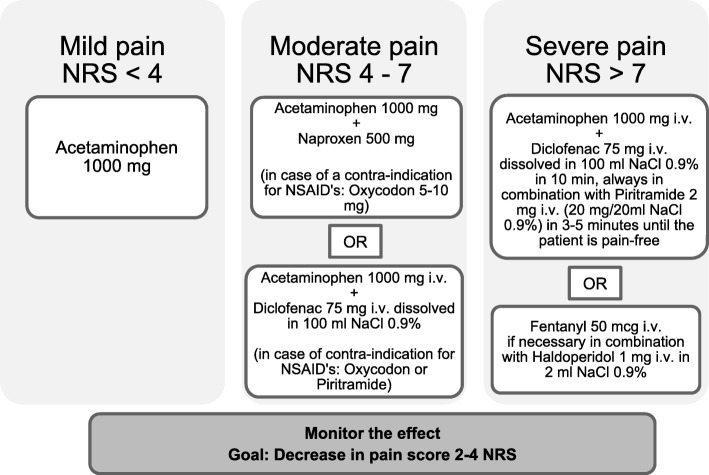
Pain management in the Emergency Department has often been described as inadequate, despite proven benefits of pain treatment protocols. The aim of this study was to investigate the effectiveness of our current pain protocol on pain score and patient satisfaction whilst taking the patients' wishes for analgesia into account.
We conducted a 10-day prospective observational study in the Emergency Department. Demographics, pain characteristics, Numeric Rating Scale pain scores and the desire for analgesics were noted upon arrival at the Emergency Department. A second Numeric Rating Scale pain score and the level of patient satisfaction were noted 75-90 min after receiving analgesics. Student T-tests, Mann-Whitney U tests and Kruskall-Wallis tests were used to compare outcomes between patients desiring vs. not desiring analgesics or patients receiving vs. not receiving analgesics. Univariate and multivariate logistic regression models were used to investigate associations between potential predictors and outcomes.
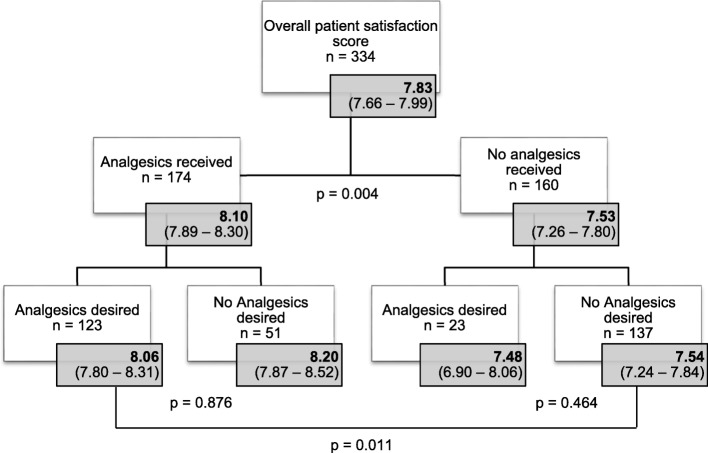
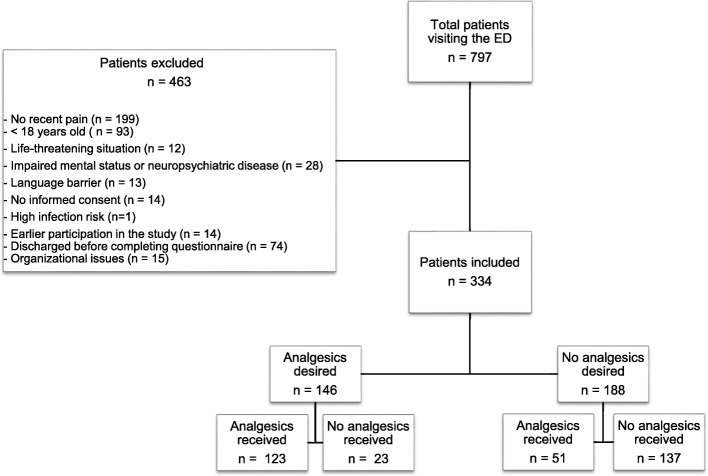
In this study 334 patients in pain were enrolled, of which 43.7% desired analgesics. Initial pain score was the only significant predictive factor for desiring analgesia, and differed between patients desiring (7.01) and not desiring analgesics (5.14). Patients receiving analgesics (52.1%) had a greater decrease in pain score than patients who did not receive analgesics (2.41 vs. 0.94). Within the group that did not receive analgesics there was no difference in satisfaction score between patients desiring and not desiring analgesics (7.48 vs. 7.54). Patients receiving analgesics expressed a higher satisfaction score than patients not receiving analgesics (8.10 vs. 7.53).
This study pointed out that more than half of the patients in pain entering the Emergency Department did not desire analgesics. In patients receiving analgesics, our pain protocol has shown to adequately treat pain, leading to a higher satisfaction for emergency health-care at discharge. This study emphasizes the importance of questioning pain score and desire for analgesics to prevent incorrect conclusions of inadequate pain management, as described in previous studies.
尽管疼痛治疗方案已被证实有益,但急诊科的疼痛管理常常被认为是不充分的。本研究的目的是在考虑患者镇痛意愿的同时,调查我们当前的疼痛方案对疼痛评分和患者满意度的有效性。
我们在急诊科进行了一项为期10天的前瞻性观察研究。记录患者到达急诊科时的人口统计学信息、疼痛特征、数字评分量表疼痛评分以及镇痛需求。在接受镇痛治疗75 - 90分钟后,记录第二次数字评分量表疼痛评分和患者满意度水平。使用学生t检验、曼 - 惠特尼U检验和克鲁斯卡尔 - 沃利斯检验来比较有镇痛需求与无镇痛需求患者之间或接受与未接受镇痛治疗患者之间的结果。使用单变量和多变量逻辑回归模型来研究潜在预测因素与结果之间的关联。
本研究纳入了334名疼痛患者,其中43.7%的患者需要镇痛治疗。初始疼痛评分是需要镇痛治疗的唯一显著预测因素,需要镇痛治疗的患者(7.01)与不需要镇痛治疗的患者(5.14)之间存在差异。接受镇痛治疗的患者(52.1%)的疼痛评分下降幅度大于未接受镇痛治疗的患者(2.41对0.94)。在未接受镇痛治疗的患者组中,有镇痛需求与无镇痛需求的患者满意度评分没有差异(7.48对7.54)。接受镇痛治疗的患者的满意度评分高于未接受镇痛治疗的患者(8.10对7.53)。
本研究指出,进入急诊科的疼痛患者中,超过一半的患者不需要镇痛治疗。在接受镇痛治疗的患者中,我们的疼痛方案已显示出能充分治疗疼痛,从而使出院时对急诊医疗保健的满意度更高。本研究强调了询问疼痛评分和镇痛需求的重要性,以防止得出如先前研究中所述的疼痛管理不充分的错误结论。