Institute of Radiological Protection and Nuclear Safety, B.P. n°17, F-92262, Fontenay-aux-Roses, France.
Unité de Thérapie Tissulaire et Traumatologie de Guerre, Institut de Recherche Biomédicale des Armées, Clamart, France.
Stem Cell Res Ther. 2018 Nov 8;9(1):299. doi: 10.1186/s13287-018-1051-6.
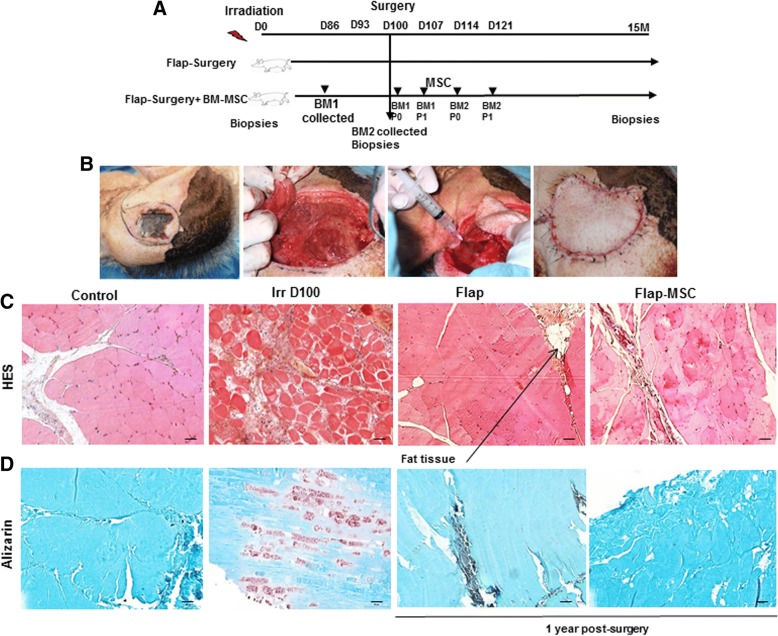
Medical management of the severe musculocutaneous radiation syndrome involves surgical intervention with debridement of necrotic tissue. Even when skin excision is replaced by specific plastic surgery, treatment of the muscle radiation injury nonetheless remains difficult, for it involves a massive muscle defect in an unpredictable environment, subject to inflammatory waves weeks to months after irradiation, which delay healing and predispose the patient to the development of fibrous scar tissue. In this study, we investigated the long-term effect of local injections of bone marrow-derived mesenchymal stromal cells (BM-MSCs), combined with plastic surgery, to treat muscle necrosis in a large animal model.
Three months after irradiation to the rump, minipigs were treated by excision of necrotic muscle tissue, vascularized flap surgery, and four injections with or without local autologous BM-MSCs, performed weekly. The quality of the muscle wound healing was examined 1 year post-surgery.
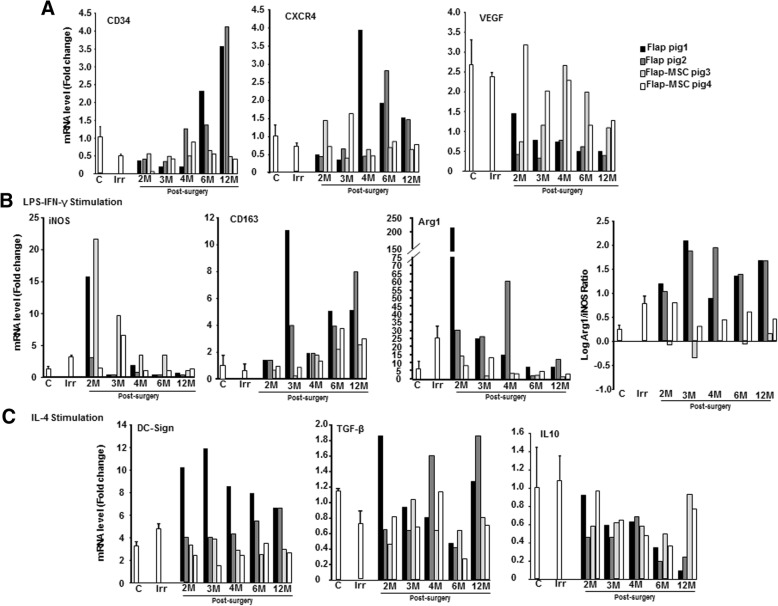
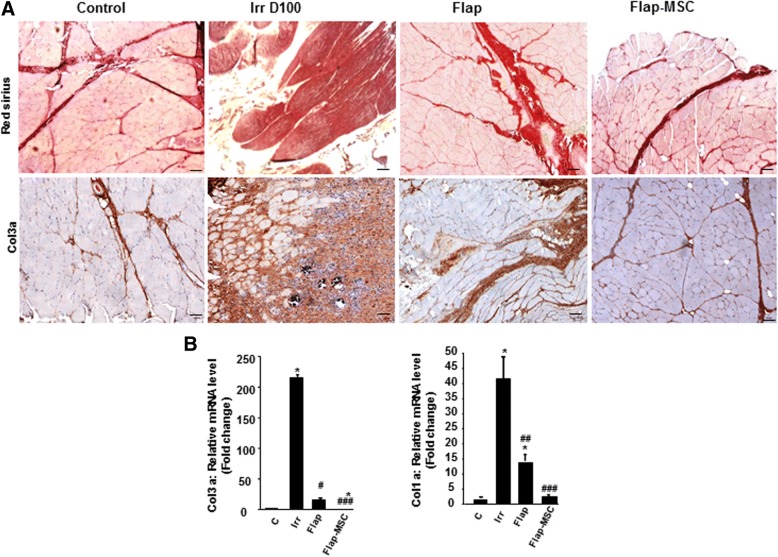
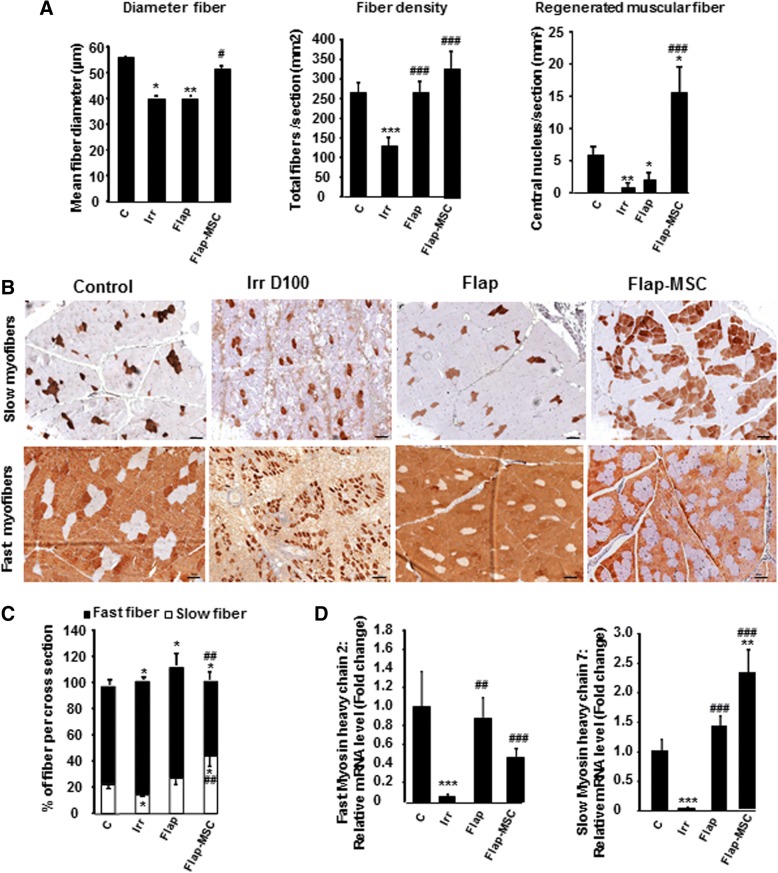
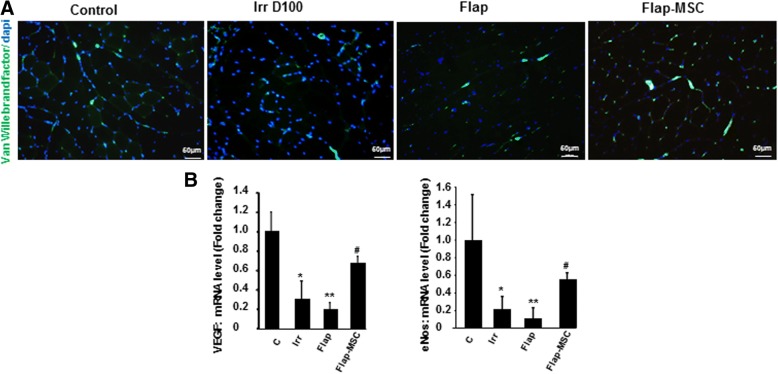
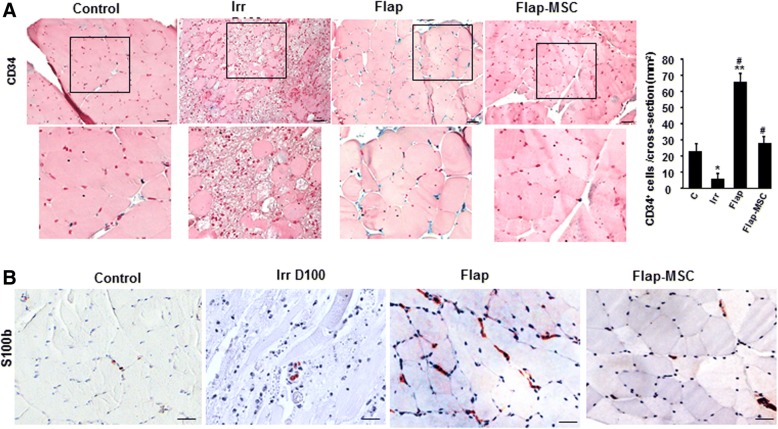
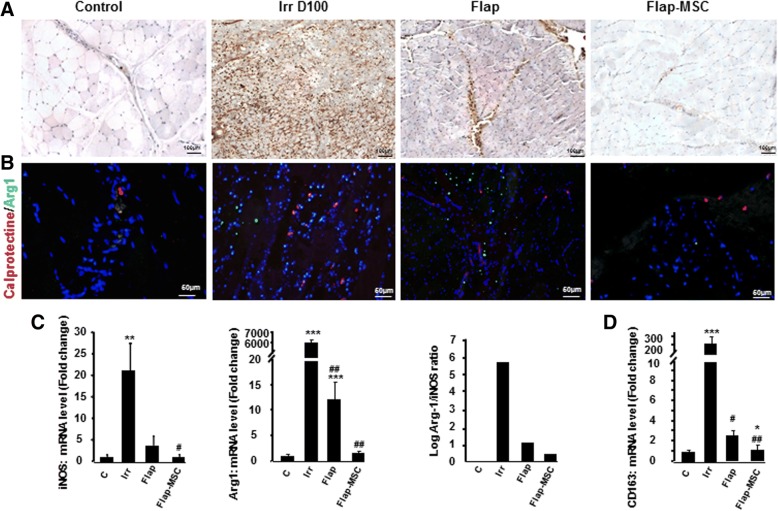
The skeletal muscle surgery without MSC treatment led to permanent deposition of collagen 1 and 3, decreased myofiber diameter, failed muscle fiber regeneration, a reduced number of capillaries, and the accumulation of high calcium and fat. In animals treated by surgery and MSC injections, these indicators were substantially better and demonstrated established regeneration. MSC therapy acts at several levels by stimulating growth factors such as VEGF, which is involved in angiogenesis and satellite cell pool maintenance, and creating a macrophage M1/M2 balance.
Thus, cell therapy using BM-MSCs is an effective and safe way to improve recovery of irradiation-induced skeletal muscle damage without signs of long-term degeneration.
严重的肌肉放射性综合征的医学治疗包括坏死组织清创的手术干预。即使皮肤切除被特定的整形手术取代,肌肉放射性损伤的治疗仍然很困难,因为它涉及到不可预测环境中的大量肌肉缺损,在照射后数周到数月会受到炎症波的影响,这会延迟愈合并使患者易发生纤维性瘢痕组织的形成。在这项研究中,我们研究了局部注射骨髓间充质基质细胞(BM-MSCs)结合整形手术治疗大型动物模型中肌肉坏死的长期效果。
在臀部照射后 3 个月,通过切除坏死的肌肉组织、血管化皮瓣手术和每周进行 4 次局部自体 BM-MSCs 注射来治疗小型猪。术后 1 年检查肌肉伤口愈合的质量。
没有 MSC 治疗的骨骼肌手术导致胶原蛋白 1 和 3 的永久性沉积、肌纤维直径减小、肌肉纤维再生失败、毛细血管数量减少以及高钙和脂肪的积累。在接受手术和 MSC 注射治疗的动物中,这些指标明显更好,并显示出已建立的再生。MSC 治疗通过刺激血管内皮生长因子(VEGF)等生长因子在多个水平发挥作用,VEGF 参与血管生成和卫星细胞池维持,并创造巨噬细胞 M1/M2 平衡。
因此,使用 BM-MSCs 的细胞治疗是改善辐射诱导的骨骼肌损伤恢复的有效且安全的方法,没有长期退化的迹象。