Department of Genetics and Evolutionary Biology, Biosciences Institute, University of São Paulo (USP), São Paulo, SP, Brazil.
Human Genome and Stem-Cell Center, Institute of Biosciences, University of São Paulo (USP), São Paulo, Brazil.
Sci Rep. 2018 Nov 8;8(1):16552. doi: 10.1038/s41598-018-35022-1.
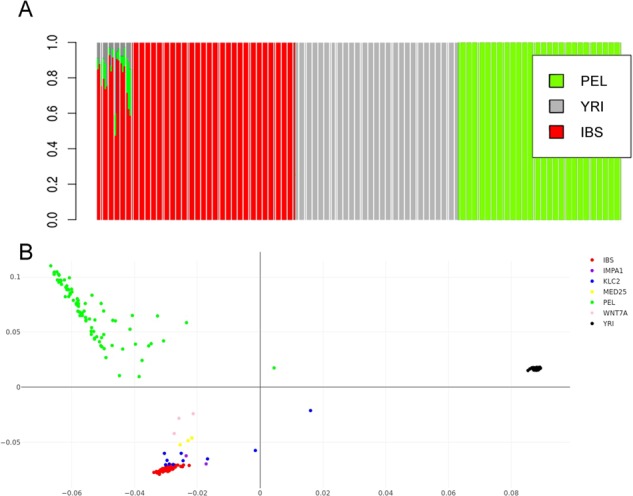
The mutation age and local ancestry of chromosomal segments harbouring mutations associated with autosomal recessive (AR) disorders in Brazilian admixed populations remain unknown; additionally, inbreeding levels for these affected individuals continue to be estimated based on genealogical information. Here, we calculated inbreeding levels using a runs of homozygosity approach, mutation age and local ancestry to infer the origin of each chromosomal segments containing disorder-causing mutations in KLC2, IMPA1, MED25 and WNT7A. Genotyped data were generated from 18 patients affected by AR diseases and combined to the 1000 genome project (1KGP) and Simons genome diversity project (SGDP) databases to infer local ancestry. We found a major European contribution for mutated haplotypes with recent mutation age and inbreeding values found only in Native American and Middle East individuals. These results contribute to identifying the origin of and to understanding how these diseases are maintained and spread in Brazilian and world populations.
在巴西混合人群中,与常染色体隐性(AR)疾病相关的突变染色体片段的突变年龄和局部祖源仍然未知;此外,这些受影响个体的近交水平仍然基于系谱信息进行估计。在这里,我们使用纯合子运行分析、突变年龄和局部祖源来计算近交水平,以推断携带 KLC2、IMPA1、MED25 和 WNT7A 疾病相关突变的每个染色体片段的起源。从 18 名受 AR 疾病影响的患者中生成了基因型数据,并与 1000 基因组计划(1KGP)和西蒙斯基因组多样性计划(SGDP)数据库相结合,以推断局部祖源。我们发现,具有近期突变年龄和仅在美洲原住民和中东个体中发现的近交值的突变单倍型主要来自欧洲。这些结果有助于确定这些疾病在巴西和世界人群中的起源以及了解它们是如何维持和传播的。