Schaan Ana Paula, Costa Lorenna, Santos Diego, Modesto Antonio, Amador Marcos, Lopes Camile, Rabenhorst Sílvia Helena, Montenegro Raquel, Souza Bruno D A, Lopes Thayson, Yoshioka France Keiko, Pinto Giovanny, Silbiger Vivian, Ribeiro-Dos-Santos Ândrea
Human and Medical Genetics Laboratory, Federal University of Pará, Av. Augusto Corrêa, 01 - Cidade Universitária Prof. José Silveira Netto - Guamá, Belém, PA, 66075-110, Brazil.
Clinical and Toxicological Analyses Department, Federal University of Rio Grande do Norte, Natal, RN, 59300-000, Brazil.
BMC Evol Biol. 2017 Aug 9;17(1):185. doi: 10.1186/s12862-017-1027-7.
The distribution of mitochondrial DNA (mtDNA) lineages in Brazil is heterogeneous due to different regional colonization dynamics. Northeastern Brazil, although being an important region in terms of human imigration and ethnic admixture, has little information regarding its population mtDNA composition. Here, we determine which mitochondrial lineages contributed to the formation of the Northeastern Brazilian population. Our sample consisted of 767 individuals distributed as follows i) 550 individuals from eight Northeastern states (Piauí, Ceará, Rio Grande do Norte, Paraíba, Pernambuco, Alagoas, Sergipe, and Bahia) which were sequenced for mtDNA hypervariable segments I, II, and III; ii) 217 individuals from Alagoas and Pernambuco (previously published data). Data analysis was performed through sequence alignment and Haplogrep 2.0 haplogroup assignment tools. Furthermore, maternal ancestry distribution was contextualized and, when possible, related to historical events to better understand the biological interactions and population dynamics that occurred in this region since the beginning of colonization.
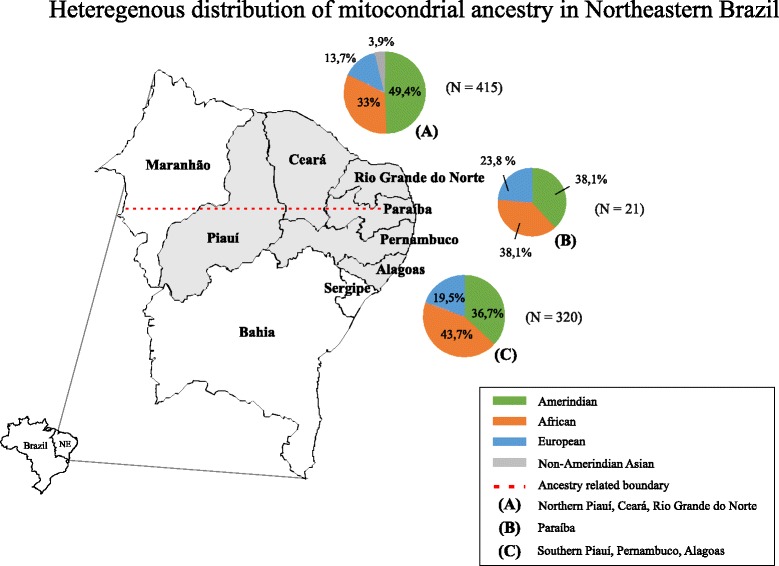
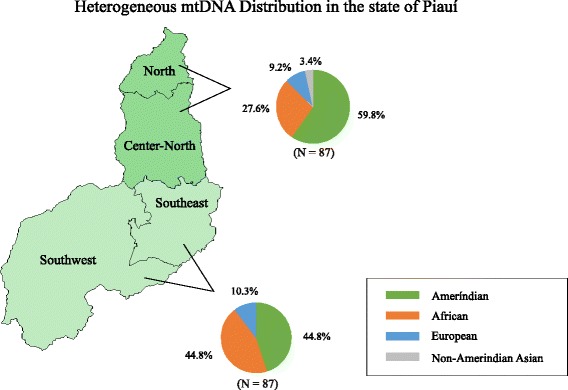
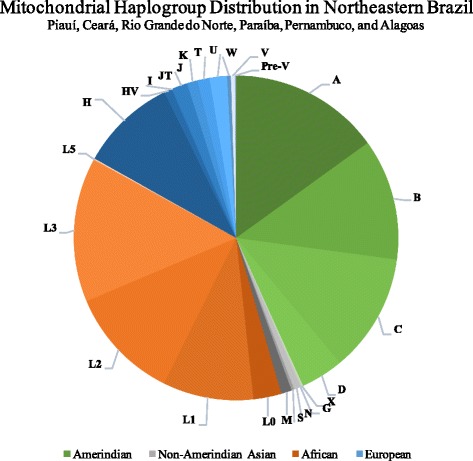
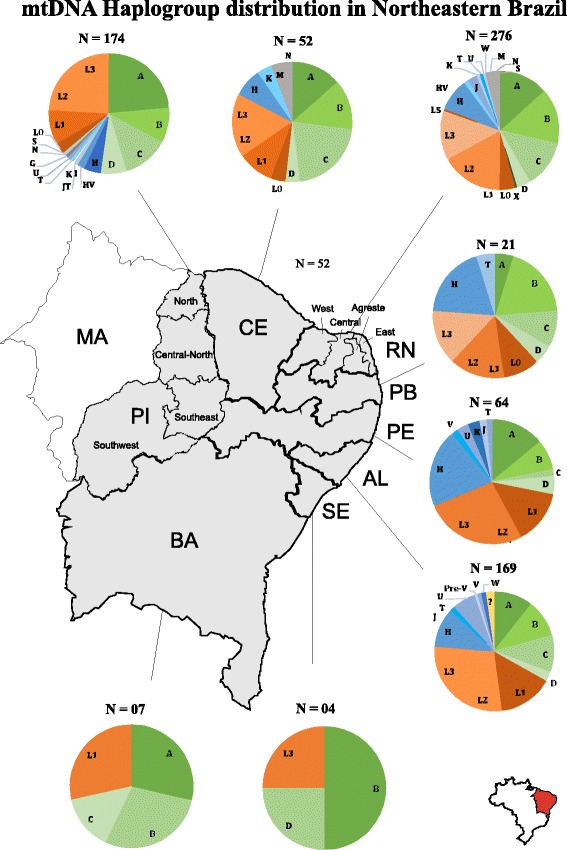
Unexpectedly, Amerindian mitochondrial ancestry was the highest in the Northeastern region overall, followed by African, European and non-Amerindian Asian, unlike previous results for this region. Alagoas and Pernambuco states, however, showed a larger African mtDNA frequency. The Northeastern region showed an intraregional heterogeneous distribution regarding ancestral groups, in which states/mesoregions located to the north had a prevalent Amerindian ancestral frequency and those to the south had predominance of African ancestry. Moreover, results showed great diversity of European haplogroups and the presence of non-Amerindian Asian haplogroups.
Our findings are in disagreement with previous investigations that suggest African mitochondrial ancestry is the most prevalent in the Brazilian Northeast. The predominance of Amerindian lineages exemplifies the importance of indigenous women in the formation of the population, despite intense African slave entry and conflicts with European settlers. The variable distribution of ancestral groups observed in the Northeast is in accordance with historical records showing the similarities with colonization dynamics occurred in the Amazon region and the Brazilian Southeast. Moreover, the variety of European haplogroups suggests multiple origins of founding groups, specially those found in Western European populations.
由于不同的区域殖民动态,巴西线粒体DNA(mtDNA)谱系的分布存在异质性。巴西东北部虽然在人类移民和种族混合方面是一个重要地区,但关于其人群mtDNA组成的信息却很少。在这里,我们确定哪些线粒体谱系对巴西东北部人群的形成有贡献。我们的样本由767名个体组成,分布如下:i)来自八个东北部州(皮奥伊州、塞阿拉州、北里奥格兰德州、帕拉伊巴州、伯南布哥州、阿拉戈斯州、塞尔希培州和巴伊亚州)的550名个体,对其mtDNA高变区I、II和III进行了测序;ii)来自阿拉戈斯州和伯南布哥州的217名个体(先前发表的数据)。通过序列比对和Haplogrep 2.0单倍群分配工具进行数据分析。此外,对母系祖先分布进行了背景分析,并在可能的情况下与历史事件相关联,以更好地理解自殖民开始以来该地区发生的生物相互作用和人口动态。
出乎意料的是,与该地区先前的结果不同,美洲印第安人的线粒体祖先在整个东北地区最高,其次是非洲、欧洲和非美洲印第安亚洲人。然而,阿拉戈斯州和伯南布哥州显示出较高的非洲mtDNA频率。东北地区在祖先群体方面呈现出区域内的异质性分布,其中北部的州/中地区美洲印第安祖先频率普遍较高,而南部的州/中地区非洲血统占主导地位。此外,结果显示欧洲单倍群具有很大的多样性,并且存在非美洲印第安亚洲单倍群。
我们的研究结果与先前的调查结果不一致,先前的调查表明非洲线粒体祖先在巴西东北部最为普遍。美洲印第安谱系的优势体现了土著女性在人口形成中的重要性,尽管有大量非洲奴隶进入以及与欧洲定居者发生冲突。在东北部观察到的祖先群体的可变分布与历史记录相符,这些记录显示了与亚马逊地区和巴西东南部殖民动态的相似之处。此外,欧洲单倍群的多样性表明创始群体有多个起源,特别是那些在西欧人群中发现的起源。