Patel Kruten M, Handal Brian A, Payne William K
Doctors Medical Center, Orthopedic Surgery Department, Graduate Medical Education, 1400 Florida Avenue Suite 200, Modesto, CA, 95350, United States.
Grandview Medical Center, Orthopedic Surgery Department, Graduate Medical Education, 405 W. Grand Ave, Dayton, OH, 45405, United States.
Int J Surg Case Rep. 2018;53:189-192. doi: 10.1016/j.ijscr.2018.10.050. Epub 2018 Oct 31.
Early intervention in femoral neck stress fractures (FNSFs) can be self- limiting, but they have an insidious presentation. High index of suspicion for an occult fracture is necessary to avoid bilateral progression and/or operative interventions.
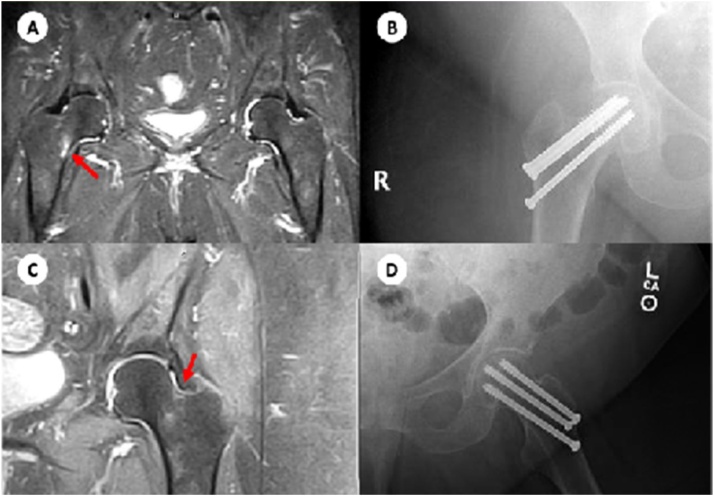
A 83-year-old female, non-athlete, presents with multiple comorbidities and progressive bilateral FNSFs. Initially the patient presented with groin pain and radiographs demonstrated a non-displaced compression type fracture of the right femoral neck without any inciting events. Subsequently, during a post-operative visit of her right hip, a work-up for new onset contralateral groin pain revealed a non-displaced tension type fracture on the left femoral neck. Both FNSFs were treated with percutaneous cannulated screw fixation.
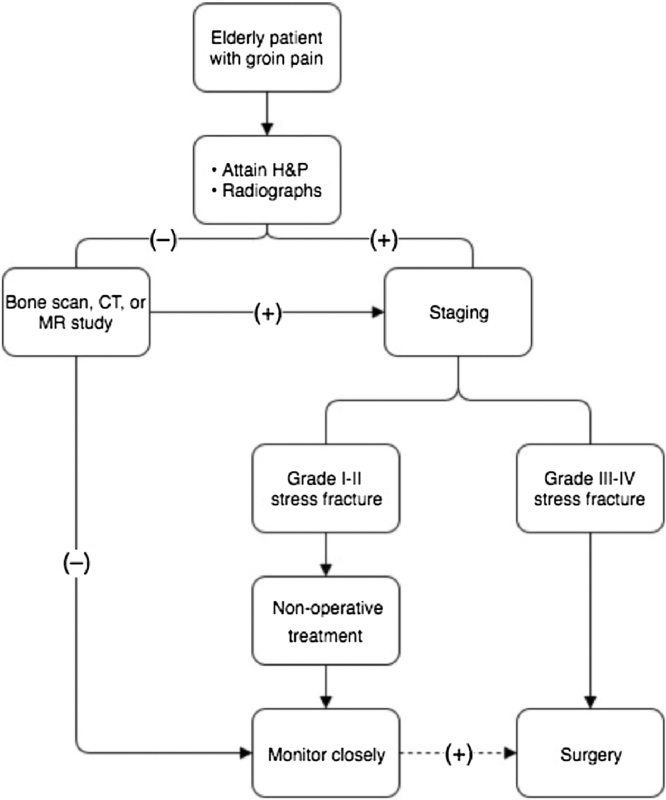
Vitamin D deficiency, poor nutrition, and osteoporosis have been associated with developing stress fractures. This presents an interesting question of whether these frequently referenced risk factors play an interrelated role. Treatment algorithms are controversial, but have been successful in preventing the progression of occult stress fractures. Yet, identification of FNSFs represents a major challenge in diagnosis for clinicians.
This case report documents an uncommon fracture pattern in the elderly population. With an aging population, it is pertinent to avoid missed opportunities for prompt diagnosis and implementation of noninvasive methods of treatment. Therefore, paying attention to the risk factors with a high index of suspicion would be ideal.
股骨颈应力性骨折(FNSFs)的早期干预可能是自限性的,但其表现隐匿。对隐匿性骨折保持高度怀疑指数对于避免双侧进展和/或手术干预至关重要。
一名83岁非运动员女性,患有多种合并症,出现双侧进行性FNSFs。最初,患者表现为腹股沟疼痛,X线片显示右股骨颈无移位的压缩型骨折,无任何诱发事件。随后,在她右髋关节术后随访期间,对新发的对侧腹股沟疼痛进行检查发现左股骨颈有一处无移位的张力型骨折。两处FNSFs均采用经皮空心螺钉固定治疗。
维生素D缺乏、营养不良和骨质疏松与应力性骨折的发生有关。这就引出了一个有趣的问题,即这些经常被提及的风险因素是否起相互关联的作用。治疗方案存在争议,但已成功预防隐匿性应力性骨折的进展。然而,FNSFs的识别对临床医生来说是诊断中的一大挑战。
本病例报告记录了老年人群中一种不常见的骨折类型。随着人口老龄化,避免错过及时诊断和实施非侵入性治疗方法的机会至关重要。因此,以高度怀疑指数关注风险因素将是理想的做法。