Pharmacy College, Jinzhou Medical University, Jinzhou 121001, China.
Institute of Medicinal Plant Development, Chinese Academy of Medical Sciences & Peking Union Medical College, Beijing 100193, China.
Toxins (Basel). 2018 Nov 8;10(11):462. doi: 10.3390/toxins10110462.
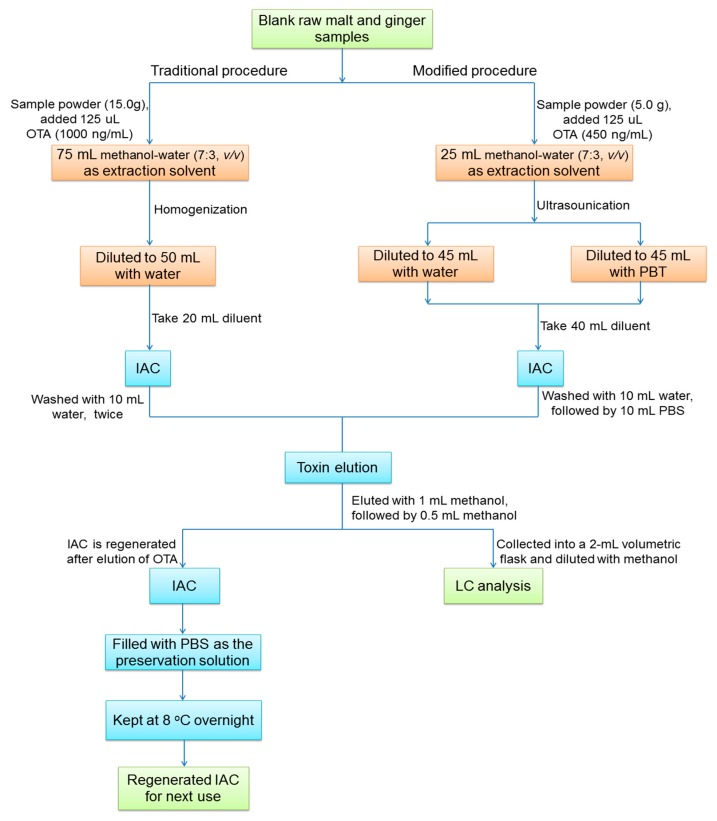
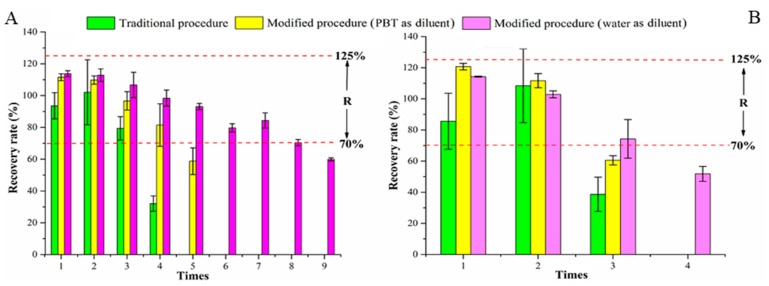
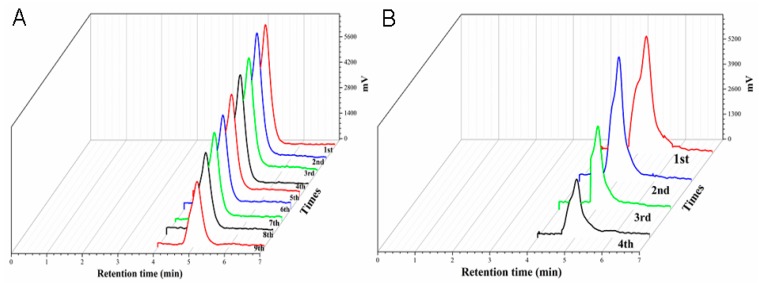
Immunoaffinity columns (IACs) are most popularly used for mycotoxin clean-up in complex matrices prior to chromatographic analysis. But, their high cost has limited their wide application and the regeneration of IACs for multiple instances of reuse is important. This study aimed to investigate the feasibility of regeneration and reuse of IACs for purification of ochratoxin A (OTA) in spiked raw malt and dried ginger samples followed by high performance liquid chromatography-fluorescence detection. After each use, the IACs were filled with phosphate buffer saline (PBS) as the preservation solution and stored at 8 °C overnight for regeneration and reuse until the recovery rate was <70%. The results showed that matrix type, preparation procedure, and pH value of sample extraction exhibited major effects on the reuse of IACs for OTA clean-up. While, after modifying the sample preparation procedure using water as the diluent and the solution at a pH of 7 to 8, the IACs could be used eight and three times for the spiked raw malt and dried ginger samples with OTA after regeneration. Regarding the traditional procedure recommended in Chinese Pharmacopoeia (2015 edition), the IACs could be used for three and two times for the spiked raw malt and dried ginger samples with OTA, respectively. Therefore, the corresponding experimental cost could be reduced to one-eighth and one-third of the original cost. This is the first study on the regeneration and reuse of IACs for OTA clean-up in complex Chinese herbal medicines, providing a green and economical tool for a large number of samples analysis with low cost.
免疫亲和柱(IACs)在色谱分析之前,常用于复杂基质中真菌毒素的净化。但是,其高成本限制了它们的广泛应用,而 IACs 的多次重复使用的再生是很重要的。本研究旨在探讨 IACs 用于净化受污染的麦芽和干姜中真菌毒素(OTA)的可行性,然后进行高效液相色谱-荧光检测。每次使用后,IACs 用磷酸盐缓冲盐水(PBS)作为保存溶液填充,并在 8°C 下储存过夜进行再生和重复使用,直到回收率<70%。结果表明,基质类型、制备程序和样品提取的 pH 值对 IACs 用于 OTA 净化的重复使用有主要影响。而在修改了样品制备程序,使用水作为稀释剂和 pH 值为 7 到 8 的溶液后,IACs 可以在再生后用于受污染的麦芽和干姜样品中 OTA 的八次和三次净化。对于中国药典(2015 年版)推荐的传统程序,IACs 可以用于受污染的麦芽和干姜样品中 OTA 的三次和两次净化。因此,相应的实验成本可以降低到原来成本的八分之一和三分之一。这是首次研究 IACs 在复杂中草药中用于 OTA 净化的再生和重复使用,为大量样品的低成本分析提供了绿色、经济的工具。