Ladlow Peter, Bennett N, Phillip R, Dharm-Datta S, McMenemy L, Bennett A N
Academic Department of Military Rehabilitation, Defence Medical Rehabilitation Centre (DMRC) Headley Court, Surrey, UK
Academic Department of Military Rehabilitation, Defence Medical Rehabilitation Centre (DMRC) Headley Court, Surrey, UK.
J R Army Med Corps. 2019 Oct;165(5):330-337. doi: 10.1136/jramc-2018-001082. Epub 2018 Nov 9.
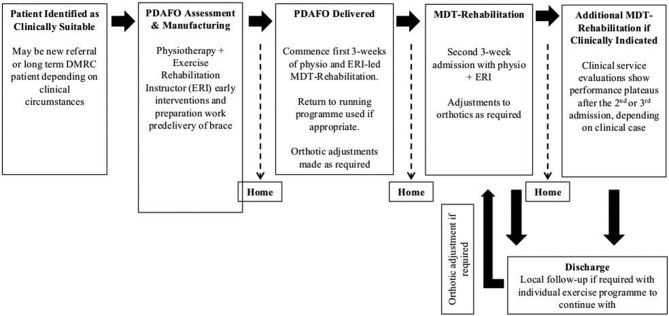
Individuals with delayed below-knee amputation have previously reported superior clinical outcomes compared with lower limb reconstruction. The UK military have since introduced a passive-dynamic ankle-foot orthosis (PDAFO) into its rehabilitation care pathway to improve limb salvage outcomes. The aims were to determine if wearing a PDAFO improves medium-term clinical outcomes and what influence does multidisciplinary team (MDT) rehabilitation have after PDAFO fitting? Also, what longitudinal changes in clinical outcomes occur with MDT rehabilitation and how do these results compare with patients with previous lower extremity trauma discharged prior to PDAFO availability?
We retrospectively evaluated levels of mobility, activities of daily living, anxiety, depression and pain in a heterogeneous group of 23 injured UK servicemen 34±11 months after PDAFO provision. We also retrospectively analysed 16 patients across four time points (pre-PDAFO provision, first, second and final inpatient admissions post-PDAFO provision) using identical outcome measures, plus the 6 min walk test.
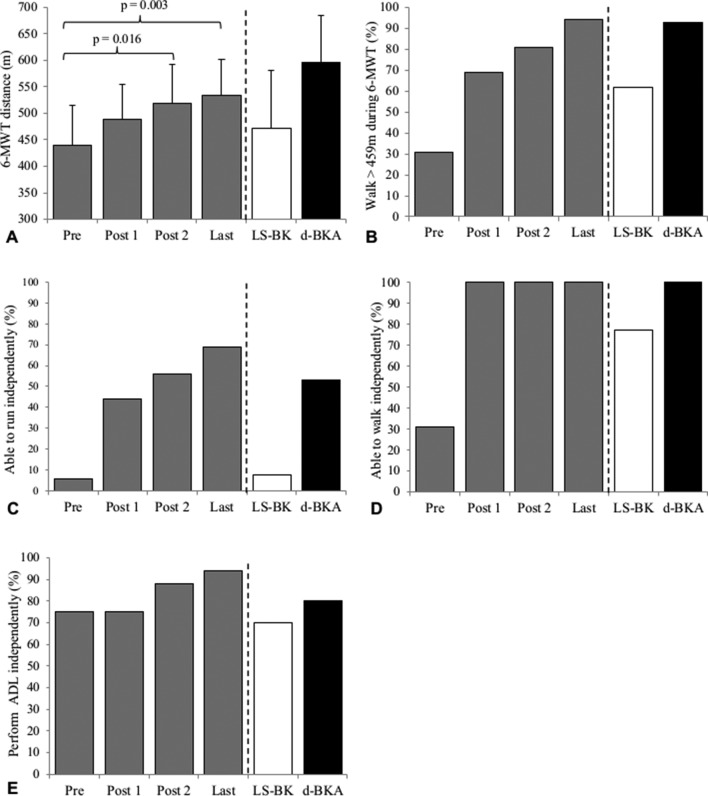
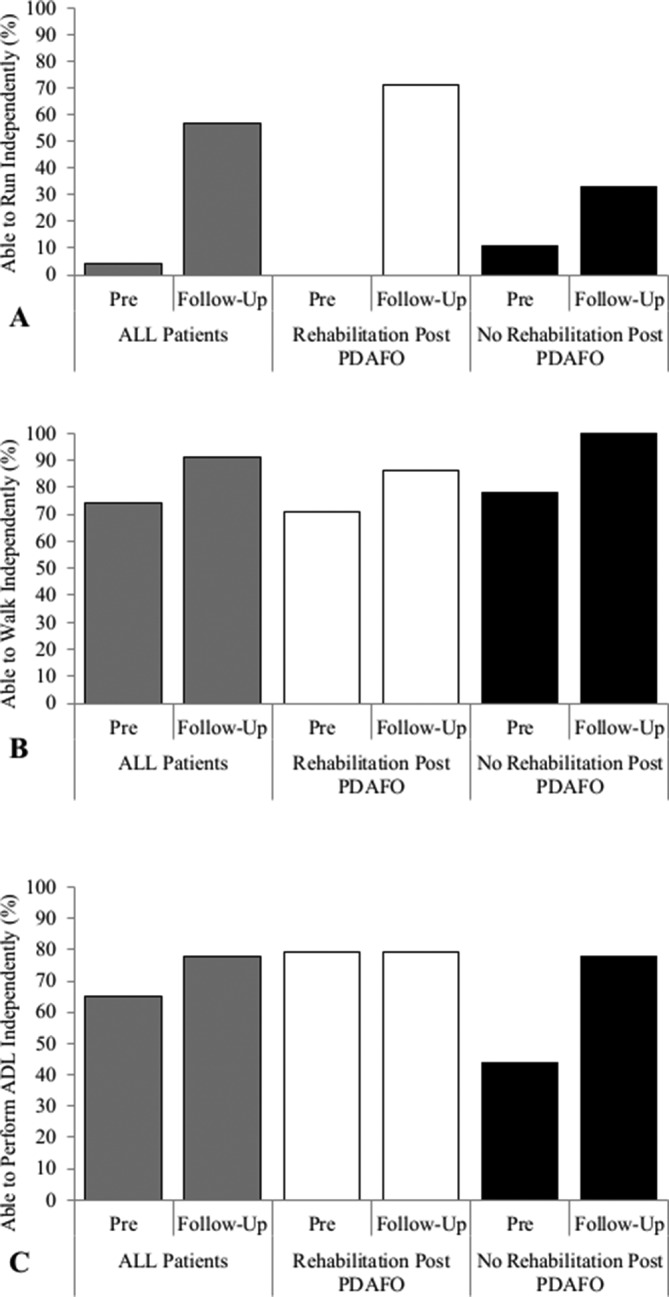
Outcomes were compared with previous below-knee limb salvage and amputees. Before PDAFO, 74% were able to walk and 4% were able to run independently. At follow-up, this increased to 91% and 57%, respectively. Mean depression and anxiety scores remained stable over time (p>0.05). After 3 weeks, all patients could walk independently (pre-PDAFO=31%). Mean 6 min walk distance significantly increased from 440±75 m (pre-PDAFO) to 533±68 m at last admission (p=0.003). The ability to run increased from 6% to 44% after one admission.
All functional and most psychosocial outcomes in PDAFO users were superior to previous limb salvage and comparable to previous below-knee amputees. The PDAFO facilitated favourable short-term and medium-term changes in all clinical outcome measurements.
与下肢重建相比,延迟膝下截肢的患者此前报告了更好的临床结果。此后,英国军方已将被动动态踝足矫形器(PDAFO)引入其康复护理路径,以改善肢体挽救结果。目的是确定佩戴PDAFO是否能改善中期临床结果,以及PDAFO适配后多学科团队(MDT)康复有何影响?此外,MDT康复后临床结果会发生哪些纵向变化,这些结果与在PDAFO可用之前出院的既往下肢创伤患者相比如何?
我们回顾性评估了23名受伤的英国军人在佩戴PDAFO后34±11个月时的活动能力、日常生活活动、焦虑、抑郁和疼痛水平。我们还回顾性分析了16名患者在四个时间点(佩戴PDAFO前、佩戴PDAFO后的首次、第二次和最后一次住院)的情况,使用相同的结局指标,外加6分钟步行试验。
将结果与之前的膝下肢体挽救患者和截肢患者进行比较。在佩戴PDAFO之前,74%的患者能够行走,4%的患者能够独立跑步。在随访时,这一比例分别增至91%和57%。平均抑郁和焦虑评分随时间保持稳定(p>0.05)。3周后,所有患者都能独立行走(佩戴PDAFO前为31%)。平均6分钟步行距离从440±75米(佩戴PDAFO前)显著增加到最后一次住院时的533±68米(p=0.003)。一次住院后跑步能力从6%提高到44%。
PDAFO使用者的所有功能和大多数心理社会结果均优于之前的肢体挽救结果,且与之前的膝下截肢患者相当。PDAFO促进了所有临床结局测量指标在短期和中期的有利变化。