Department of Research and Development, Saveetha Institute of Medical and Technical Sciences, Chennai 602 105, India.
Biomaterials and Advanced Drug Delivery Laboratory, Stanford University School of Medicine, Stanford, CA 94305, USA.
Oxid Med Cell Longev. 2018 Oct 21;2018:2764831. doi: 10.1155/2018/2764831. eCollection 2018.
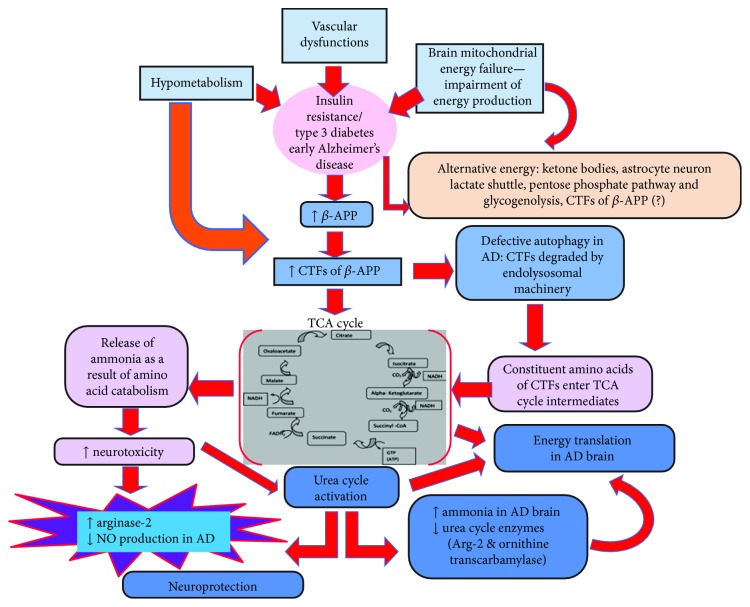
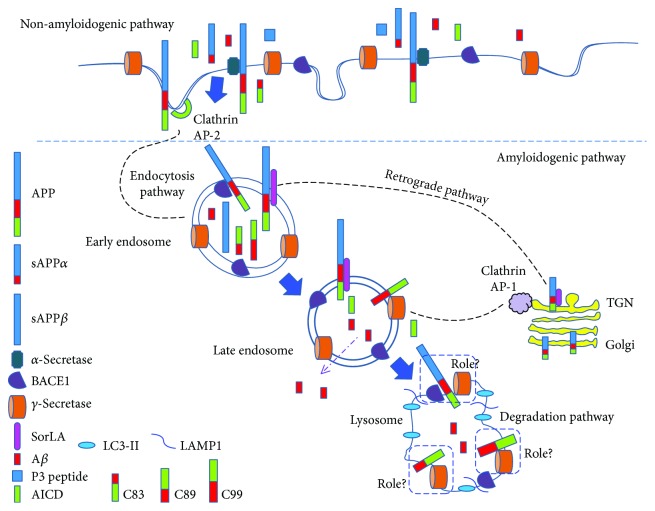
Vascular dysfunctions, hypometabolism, and insulin resistance are high and early risk factors for Alzheimer's disease (AD), a leading neurological disease associated with memory decline and cognitive dysfunctions. Early defects in glucose transporters and glycolysis occur during the course of AD progression. Hypometabolism begins well before the onset of early AD symptoms; this timing implicates the vulnerability of hypometabolic brain regions to beta-secretase 1 (BACE-1) upregulation, oxidative stress, inflammation, synaptic failure, and cell death. Despite the fact that ketone bodies, astrocyte-neuron lactate shuttle, pentose phosphate pathway (PPP), and glycogenolysis compensate to provide energy to the starving AD brain, a considerable energy crisis still persists and increases during disease progression. Studies that track brain energy metabolism in humans, animal models of AD, and studies reveal striking upregulation of beta-amyloid precursor protein (-APP) and carboxy-terminal fragments (CTFs). Currently, the precise role of CTFs is unclear, but evidence supports increased endosomal-lysosomal trafficking of -APP and CTFs through autophagy through a vague mechanism. While intracellular accumulation of A is attributed as both the cause and consequence of a defective endolysosomal-autophagic system, much remains to be explored about the other -APP cleavage products. Many recent works report altered amino acid catabolism and expression of several urea cycle enzymes in AD brains, but the precise cause for this dysregulation is not fully explained. In this paper, we try to connect the role of CTFs in the energy translation process in AD brain based on recent findings.
血管功能障碍、代谢低下和胰岛素抵抗是阿尔茨海默病(AD)的高风险和早期因素,AD 是一种与记忆衰退和认知功能障碍相关的主要神经退行性疾病。在 AD 进展过程中,葡萄糖转运体和糖酵解早期就出现缺陷。代谢低下在早期 AD 症状出现之前就已经开始;这一时间点表明,代谢低下的脑区易受β-分泌酶 1(BACE-1)上调、氧化应激、炎症、突触衰竭和细胞死亡的影响。尽管酮体、星形胶质细胞-神经元乳酸穿梭、戊糖磷酸途径(PPP)和糖原分解可以代偿以向饥饿的 AD 大脑提供能量,但仍然存在相当大的能量危机,并且在疾病进展过程中会增加。跟踪人类大脑能量代谢、AD 动物模型和研究的研究揭示了β-淀粉样前体蛋白(-APP)和羧基末端片段(CTFs)的显著上调。目前,CTFs 的确切作用尚不清楚,但有证据支持通过自噬通过模糊机制增加 -APP 和 CTFs 的内体溶酶体运输。虽然细胞内 A 的积累被归因于内溶酶体自噬系统缺陷的原因和结果,但关于其他 -APP 切割产物仍有许多需要探索。许多最近的研究报告称,AD 大脑中的氨基酸分解代谢和几种尿素循环酶的表达发生改变,但这种失调的确切原因尚未完全解释。在本文中,我们试图根据最近的发现,将 CTFs 在 AD 大脑能量翻译过程中的作用联系起来。